

A life of hidden treasures, excavations, and great discoveries: the film about Antonio Zara premieres in Carbonia.
Antonio Sanna's film, dedicated to the famous self-taught Sardinian archaeologist, debuts at the Cineteatro in Piazza Roma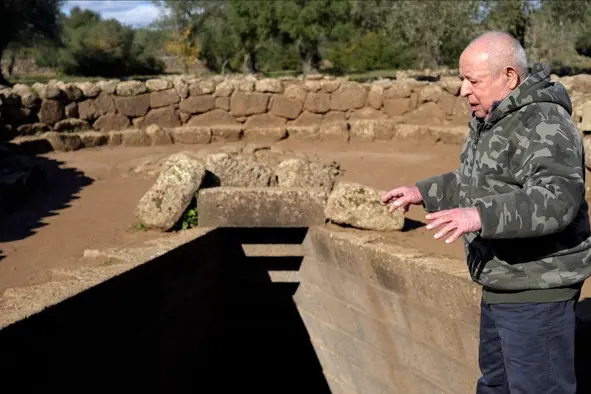
Per restare aggiornato entra nel nostro canale Whatsapp
The story of a life dedicated to the hidden treasures of Sardinia: "Antonio Zara – The Man Who Loved Digging," a documentary by Antonio Sanna, produced by ArKaosfilm in collaboration with Società Umanitaria Carbonia and the Amici della Miniera Association, premieres with a preview screening on Thursday, February 12th at the Cineteatro centrale in Piazza Roma, Carbonia. Admission is free starting at 6:00 PM.
Following official greetings from Regional Councilor for Culture Ilaria Portas and Mayor Pietro Morittu, speakers will include the film's director Antonio Sanna, the regional director of the CSC of the Società Umanitaria in Sardinia, Paolo Serra, Piero Agus, president of the Amici della Miniera association, and the family of the late Antonio Zara. The 49-minute film alternates between black-and-white and color images, archival materials, and contemporary footage to recount the life and discoveries of Antonio Zara, a key figure—and one who has long remained marginalized—in Sardinian archaeology.
Born in Gairo and raised in Carbonia, Zara discovered a passion for archaeology at a young age thanks to the stories of his elders and his exploration of the local nuraghes and caves. At 14, he made his first discovery on Monte Crobu, later delivering the finds to the Superintendency. His meeting with Inspector Vittorio Pispisa marked the beginning of a field apprenticeship that would lead him, in 1962, at just 16, to the discovery of the Tophet of Monte Sirai, a key site for the study of the Phoenician-Punic civilization in Sardinia.
From that moment on, Zara participated in dozens of excavation campaigns as a technical assistant to the Superintendency, developing an extraordinary ability to "read" the landscape and identify archaeological sites of great importance. Among the most important campaigns in which Zara participated were the excavation and restoration of the Sacred Well of Santa Cristina and the one that led to the discovery of the famous bronze statuette of the so-called "Sardus Pater" in Fluminimaggiore (now preserved at the National Archaeological Museum of Cagliari).
The documentary, written and directed by Antonio Sanna, who also handles photography, editing, and drone filming with Renzo Gualà , was born from an idea by Sergio Zara and features original music by Mauro Usai for piano by Omar Bandinu; and the narration of Maria Giovanna Ganga and Gianni Cossu, with an introductory text by Enea Bagiella and excerpts from Antonio Zara's books Io c'ero – I racconti dell'assistente and I racconti del pozzo.
The film interweaves testimonies from scholars, friends, and family—including Piero Bartoloni, Giorgio Secci, Angelo Saba, and Giovanna Pietra—with original photographs by Antonio Zara, Ugo Virdis, Piero Bartoloni, and Peter Paul Mackey, creating an intimate and collaborative portrait of a man driven by curiosity, perseverance, and a love for the land. The screening will be an opportunity to rediscover not only Antonio Zara, but also a key piece of the archaeological and cultural history of Sulcis Iglesiente. The initiative is supported by the Autonomous Region of Sardinia, the Fondazione di Sardegna, and the Municipalities of Carbonia and Paulilatino, in collaboration with the Superintendency of Archaeology, Fine Arts, and Landscape, the Carbonia Museum System, Archeotour Paulilatino, and the Genna Maria Park and Museum of Villanovaforru.
(Unioneonline)