Final exams, the second test today: a version of Quintilian in the classical studies, and calculations on Lake Bracciano and the Friuli earthquake in the scientific studies.
After the essay, today comes the most feared written exam. In Sardinia, 12,000 students are facing the exam.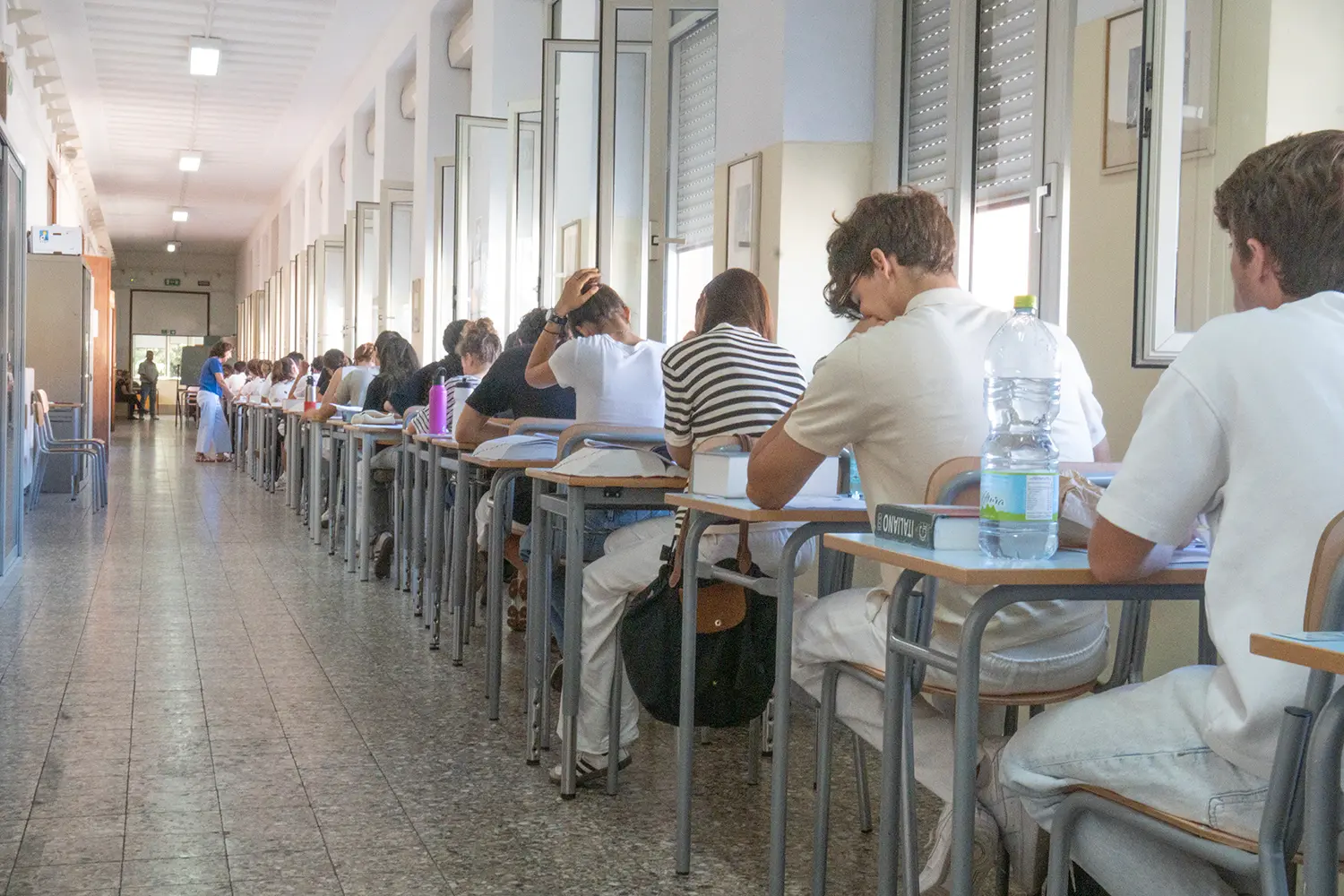
Per restare aggiornato entra nel nostro canale Whatsapp
Latin in classical high schools and mathematics in scientific high schools. This is followed by humanities in the humanities major, business economics for technical institutes specializing in economics (Administration, Finance, and Marketing), tourism and business disciplines for tourism, and design, construction, and systems for the "Construction, Environment, and Territory" major. These are just some of the subjects currently awaiting Italian high school graduates who are called upon to take the written exam that defines their course of study.
The bell rang at 8:30 a.m. throughout Italy , and as the ministerial envelopes were opened, the first clues began to emerge. At the classical high school , a passage from the first book of Quintilian's Institutio Oratoria , one of the most important pedagogical works of antiquity, was presented. In the chosen passage, the author reflects on the role of music in the formation of the perfect orator . Students are required to understand and interpret the text, perform linguistic and stylistic analysis, and delve deeper into the subject, accompanied by personal reflections.
In the science program , the math test is divided into two problems . The first concerns the water level of Lake Bracciano, north of Rome, used as a water reserve. Students must analyze tabulated data from 2016 and 2017 sampling and construct a mathematical model describing the lake's level changes over time. The second problem is a classic functional analysis, with the various analysis steps and the corresponding graph. This is followed by eight questions. Students must choose four of them. The questions include other real-life situations involving playful and sporting aspects: a volleyball tournament and a game of scopone. According to rumors, the game "Cover the Spot" is also mentioned.
At the beginning of the math test, the students found a quote by Albert Einstein about the uncertainty of mathematics applied to reality, taken from "Geometrie und Erfahrung," a 1921 lecture. "To the extent that the theorems of mathematics refer to reality, they are not certain, and to the extent that they are certain, they do not refer to reality." The closing quote of the exams is: "Mathematics is the most beautiful game in the world. It absorbs more than chess, gambles more than poker, and lasts longer than Monopoly. It is free, and can be played anywhere. Archimedes did it in a bathtub" by Professor Richard J. Trudeau, Dots and Lines, Kent State University Press, 1976.
Unlike the first exam, which is the same for everyone and lasts six hours, the second varies depending on the major. For example, it ranges from four hours for classical high school students to six for scientific high school students, up to eighteen hours spread over three days for art high school students .
This year, 527,607 students are taking the exams—513,479 internal candidates and 14,128 external—while the examination boards number 13,989, representing a total of 27,884 classes. 273,854 students come from high schools; 167,136 from technical institutes; and 86,617 from vocational schools. After the written exams, the oral exams begin, but they cannot begin until two days after the written exams, so they will begin next week. Schools will decide the schedule independently, and the letter with which the examination boards will begin their examinations has already been drawn.
to question.
The 2026 final exam is the first following the changes introduced by Legislative Decree 127 of 2025. The main changes concern the oral exam, which has been redefined around four subjects. Among the new rules is one that provides for disqualification in the event of a silent exam . As for the written exams, however, the structure remains unchanged, as does the weighting of school credits earned over the three years, which continue to play a major role in the final grade, expressed out of 100. After months of revision, simulations, and the inevitable recourse to random questions, for thousands of boys and girls, one of the most important moments of their school career has finally arrived.