

The 3D reproduction of the Satyr, symbol of Porto Torres, is underway.
The model of the mask will be created by master Salvatore Ganga, designer for the archaeological missions of the University of Sassari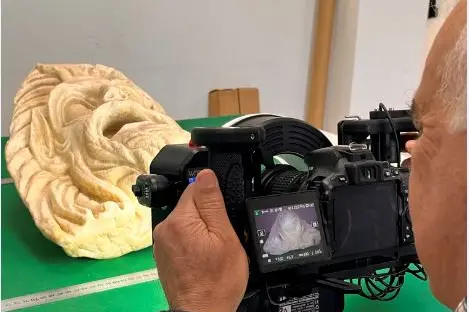
Per restare aggiornato entra nel nostro canale Whatsapp
Work has begun on the three-dimensional reproduction of the Satyr Mask, the important white marble artefact from the 1st century AD from the Maetzke Baths and preserved in the Museo Nazionale Antiquarium Turritano in Porto Torres.
Salvatore Ganga, the surveyor and designer for the University of Sassari's archaeological missions, has offered his expertise and experience to reproduce one of the most iconic and representative finds in Turris's archaeological heritage. The mask testifies to the decorative richness of the city's Roman buildings, the diffusion of classical cults and symbols, and the central role of Turris Libisonis, ancient Porto Torres, as a Roman colony in the Mediterranean. The 3D model, commissioned by the Municipality and the Pro Loco Turris, had multiple objectives, both from a promotional and territorial perspective and from a scientific perspective and for studies on the find.
Thanks to the relationship established between the municipal administration, the Pro Loco, and the Viareggio Carnival Foundation, the model will be used by Viareggio master papier-mâché artist Giacomo Marsili to design a masquerade for the upcoming Turritano Summer Carnival, dedicated to the festival's logo, which recalls the satyr. At the same time, for study and research, the three-dimensional model will be made available to the Regional Directorate of Museums of Sardinia for future initiatives to enhance the artifact's value and scientific study.
The initiative once again demonstrates the close collaboration between the municipal administration, the Antiquarium, and DRM Sardegna, fostering dialogue and shared goals, primarily the promotion of the city's enormous archaeological, historical, and cultural heritage. The three-dimensional reproduction of archaeological finds is now recognized as a highly important tool for research and dissemination of cultural heritage. Digital scanning and modeling allow scholars to analyze the objects' shapes, proportions, engravings, and traces of manufacturing processes with great precision without risking damage.
Thanks to the ability to zoom in or observe the artifact from any angle, it is possible to identify details that are difficult to see with the naked eye and make comparisons with other similar artifacts held in different museums or archaeological sites. Furthermore, a 3D model can be easily shared between universities, museums, and research centers worldwide, facilitating comparative study and interdisciplinary work, without the need to physically move the artifact. The goal, therefore, is to ensure that this crucial artifact is increasingly used to promote and enhance the historical and archaeological beauty of Porto Torres.
The Mask of the Satyr was discovered between 2002 and 2003 during excavations of the Maetzke Baths in the ancient Roman colony of Turris Libisonis. The artifact is generally dated to the 1st century AD, a period of great urban development in Turris Libisonis. The sculpture depicts the face of a mythological figure with a full beard, pronounced features, and an open mouth, likely used as a decorative element for a fountain or water feature within the baths complex.