

Two suspects identified in the Leipzig attack: "One had an Italian visa."
They are a Russian with a Latvian passport and a Belarusian with ties to Moscow's secret services. Berlin is demanding a crackdown on Russian tourist visas.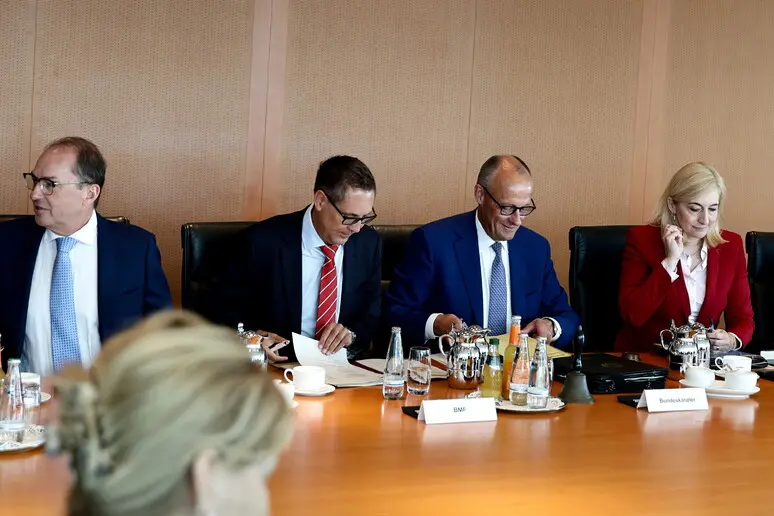
(Handle)
Per restare aggiornato entra nel nostro canale Whatsapp
The first, of Russian origin with a Latvian passport. The second, Belarusian with a Russian passport. And, above all, with ties to Moscow's secret services. The circle around the perpetrators of the hybrid attack in Leipzig is tightening .
After officially accusing Russia of the events in the Saxon city in early August, Berlin has begun to release the first clues about the perpetrators of the attack. With a development that will have serious consequences: according to Bild, one of them, the man of Belarusian origin, had an Italian tourist visa .
News leaked to the German media at the same time that Ursula von der Leyen and Mark Rutte were meeting to plan a response strategy to the Kremlin seem to confirm the Russian origins of the attack at Leipzig airport, where between 4 and 14 August three drones loaded with explosives were found, one of which had impacted - without dramatic consequences - with a DHL cargo plane .
German authorities have so far identified two suspects, although the investigation is focusing on four individuals involved , identified through DNA evidence or the identification of cell towers. What made headlines, however, was the fact that one of the suspected attackers had an Italian tourist visa. This may have been the key to his entry into the Schengen Area and Germany.
On the sidelines of the Gymnich meeting in Ireland, Foreign Minister Antonio Tajani immediately assured the authorities that "investigations" would be carried out. "There is a process for granting visas, because certain requirements must be met. If individuals meet them, and there is no 'alert' regarding individuals, the visa is granted," the Foreign Minister explained. Qualified security sources later that evening clarified that the Belarusian with an Italian tourist visa had never transited through Italy.
The news from Berlin, however, has reopened a Pandora's box in the EU: the debate over limiting Russian tourism entry into Europe. This issue was also central to the latest sanctions package, when—at the instigation of the Baltics—the Commission proposed barring entry to all Russians who fought in Ukraine since 2022. A group of countries, including Italy, had put a damper on the implementation of the measure, citing several technical difficulties in identifying Russian veterans and arguing that it was preferable to address the visa regime.
Now, however, Brussels could return to the fray with a crackdown that would not only affect veterans, but all tourist visas granted to Russians. "We really need to limit the issuance of tourist visas," emphasized EU High Representative Kaja Kallas. "There are too many tourist visas for Russians in the EU," warned Berlin . European Parliament Vice President Pina Picierno shared the same opinion, stating that in 2025, EU countries issued over 477,000 tourist visas to Russian citizens, a trend that is increasing compared to 2024. Italy, France, and Spain were the countries most affected.
Meanwhile, in Germany, the situation is now at its highest and the confrontation with the Kremlin is at an all-time high. After Berlin decided to close the Russian consulate in Bonn and terminate the contract with Russia House, Moscow summoned the German chargé d'affaires, promising "a tough reaction."
(Unioneonline)