

Board of Peace, what reflection on the next international order
The organizational structure desired by Donald Trump and its possible influences and consequences on the global geopolitical level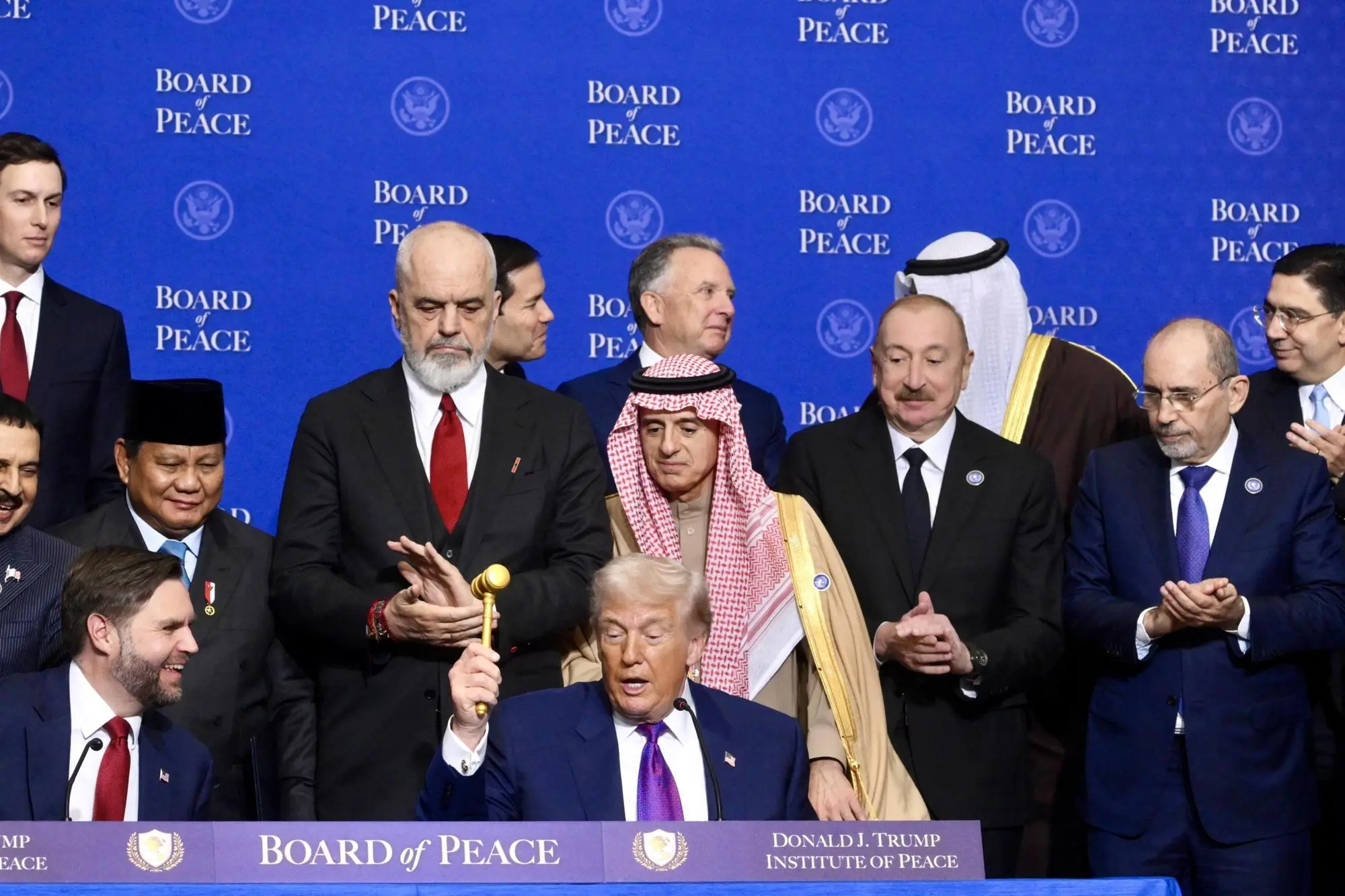
Per restare aggiornato entra nel nostro canale Whatsapp
To remain on the definitional level, the Board of Peace, which has been much talked about recently, should be, and in fact is, an international organization whose Statute aims to promote stability, the restoration of a legitimate government, and ensure conditions of lasting peace in areas threatened by conflict.
No question, except that the Board of Peace was expressly established by US President Donald Trump in September 2025, and was officially established on January 22, 2026, with the signing of its Statute in Davos, Switzerland. This means that Donald Trump himself holds the office of President for Life within that Organization, and he alone has sole authority over potential third-party access, subject to the President's invitation alone.
To be clear, although such an organization, specifically, should currently be aimed at establishing a network of diplomatic initiatives and economic resources to manage the so-called "transition" and reconstruction in the Gaza Strip, it would appear to express much more in terms of the distribution of geopolitical power. Regardless of its intentions and best intentions, it would seem necessary to be critically aware that, while each participating state has a single vote, and should, decisions are adopted by majority vote, they would only enter into force with the final approval of President Trump, who, in the event of a tie, would cast the deciding vote. In essence, and if we wanted to say it differently, but not too much, it would seem (the use of the conditional is necessary) that Donald Trump represents, in the institutional context of the Organization, the apical summit of a structure that would like, and would appear to, present itself as the expression of a typically self-referential and super partes power.
Donald Trump, "primus," but not "inter pares." So, what is the political and relational value of such an organization? Does it represent a functional alternative to the United Nations? Does its organizational structure conflict with Article 11 of our Constitution? The questions overlap and overlap, especially when considered within a geopolitical framework in which not only Italy, but also the European Union as a whole, appear almost like non-decisive spectators of third-party dynamics that directly affect their interests in the Mediterranean.
It should not be considered a mere coincidence that the inaugural meeting was marked primarily by the presence of Middle Eastern countries considered close to Donald Trump, including Israel and Saudi Arabia on the one hand, and Argentina on the other. Nor should it be considered a mere coincidence that both France and the United Kingdom decided not to participate, unlike the European Union (whose unity in the circumstance appears to have been further weakened, as if it were a third entity compared to its members) and Italy, which instead chose to participate in the proceedings solely as "observers," that is, favoring a formula that could be described as "hybrid" and non-qualifying due to its lack of formal provision.
Vladimir Putin's Russia and Xi Jinping's China, for their part, have not even joined.
Well, if this is the picture emerging as a result of Donald Trump's initiative, then we could consider the skeleton of the new international order to be in place, within which the leading role of the United States could be directly challenged and contested by Russia and China, international players reluctant to abide by the rules of the game.
Giuseppina Di Salvatore – Lawyer, Nuoro