

Treasure found at the bottom of the sea in Arzachena, the ministry (and the Regional Administrative Court) said: "No reward, no chance discovery."
Diver Davide Azara had discovered 50,000 ancient coins at a depth of three meters and immediately notified the authorities. The Superintendency declared them "extraordinary value." But a metal detector had been used.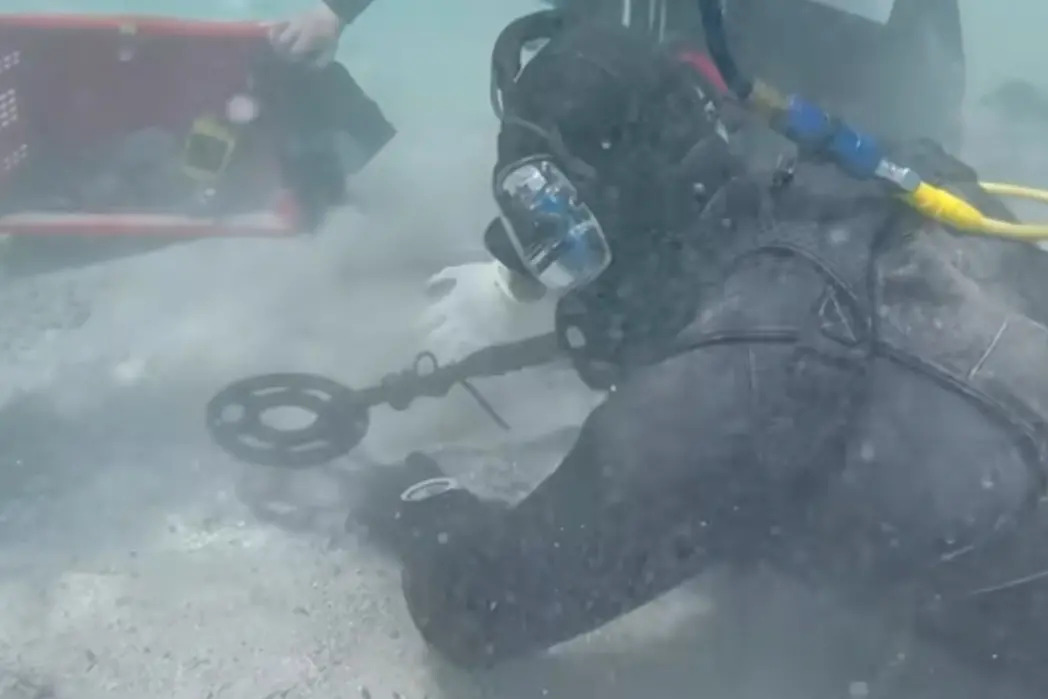
Per restare aggiornato entra nel nostro canale Whatsapp
He found treasure at the bottom of the sea, and as a law-abiding citizen, he didn't hesitate to alert the relevant authorities. But according to the Ministry of Culture, and also according to the Regional Administrative Court, he's not entitled to a reward. The discovery wasn't accidental, that's the verdict.
The discovery of 50,000 bronze coins dating back to the 4th century AD and some amphora fragments has so far yielded no results for diver Davide Azara: he made the discovery on May 25, 2023, during a dive along the coast of Arzachena, about 100 meters from Capriccioli beach, at a depth of just three meters.
They had noticed something under the sand. So he went back on board to get a metal detector (and here lies his "sentence"), which reported the presence of a large quantity of metals. Azara realized what he might be dealing with. " The discovery was immediately reported to the mayor and the superintendent (as well as to the Carabinieri and the Coast Guard)," the ruling states, "and the appellant arranged for the temporary preservation of the finds, following the instructions received from the Superintendency's archaeologist responsible for the area. At the latter's direction, among other things, Azara delivered the recovered material to the Porto Cervo Carabinieri Station in the late morning ." The next day, Azara and his father Michele "collaborated with the personnel of the Superintendency's Underwater Archaeology Service and the Carabinieri in the initial on-site intervention, also aimed at identifying the macro-areas of dispersion."
The survey yielded significant results. The Ministry of Culture, in an official press release, described it as a "huge cache of coins." It was one of the "most significant discoveries in recent years," surpassing even that of Seaton, UK, in 2013, when 22,888 follis coins were unearthed. The Superintendency commented on the discovery as follows: "The treasure discovered in the waters of Arzachena represents one of the most significant numismatic discoveries in recent years and once again highlights the richness and importance of the archaeological heritage that the seabed of our seas, traversed by people and goods since ancient times, still preserves and preserves."
The following November, Azara had requested "recognition of the monetary reward" provided for by the Cultural Heritage Code for those who make archaeological discoveries: a down payment equal to one-fifth of the value of the items found is required, in addition to the final sum that must be estimated. The amount? It's difficult to estimate. But thinking in the region of five zeros might not be too far off.
But there's a specific rule in the law: the discovery must be "accidental." And for the ministry, this isn't the case in Arzachena: the use of the metal detector, according to the authorities, implies that Azara was looking for something. Thus, the reward was denied. And the Regional Administrative Court (TAR) ruled in favor of the ministry: "A fortuitous discovery, as also clarified by case law, is characterized as a discovery that occurs by chance, and as such was not expected or foreseeable," the ruling reads. The presence of the metal detector on board, even if used as a second chance, according to the court (and the MIC), implies that Azara wasn't ruling out finding something during the dives. Or, perhaps, that he was counting on it: no luck, then. And no reward. Unless an appeal to the Council of State is filed, possibly successful.