

Space, a €20 million research center at SOS Enattos: the first step toward the Einstein Telescope.
The tender for the construction of a multidisciplinary center at the Lula mine has been published: the Region, INAF, INFN, and INGV are participating.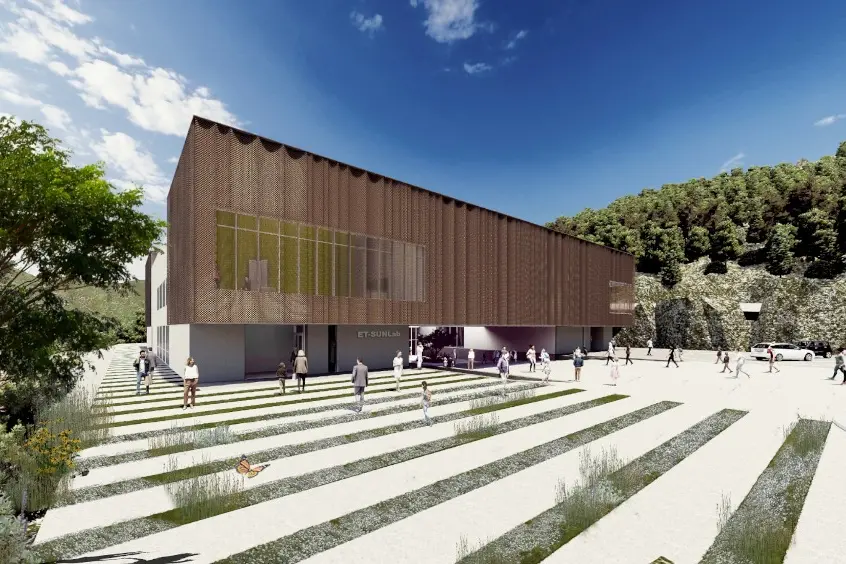
Per restare aggiornato entra nel nostro canale Whatsapp
The call for tenders for the construction of the “ET-SUnLab” (Einstein Telescope Sardinia Underground Laboratory) research centre has been published in the Official Journal of the European Union. The centre will be built in the area of the Sos Enattos mine (in Lula, in the Nuoro province), a candidate for hosting the Einstein Telescope (ET) gravitational wave observatory.
The project is funded with approximately 10 million euros by the Region and an equal amount divided between the National Institute for Nuclear Physics (INFN), the National Institute for Astrophysics (INAS) and the National Institute of Geophysics and Volcanology (INGV).
Last December 15th, the concession for free use by INFN, INAF and INGV of the 13,000 square meter area designated for the construction of SUnLab, owned by Igea, was signed in Cagliari.
The INFN
"The SUnLab project represents the first concrete step toward the future Einstein Telescope gravitational wave observatory, which will bring a multidisciplinary center open to research institutions and universities to the candidate site of Sos Enattos, Sardinia," emphasized INFN President Antonio Zoccoli. "It will be a unique location for developing and testing the cutting-edge technologies needed for ET and capable of attracting young researchers, creating a new high-level scientific community. SUnLab will also be a space for participation and discussion between the scientific community, the business world, and civil society, with the aim of fostering dialogue with the local community, which is essential on the path to the Einstein Telescope."
The Inaf
"INAF is also participating in the construction of the laboratory for the development of technologies aimed at the construction and operation of the Einstein Telescope," says President Roberto Ragazzoni. "To our deep-rooted presence in the region with our important section that manages the Sardinia Radio Telescope—the 64-meter radio telescope (San Basilio, Cagliari)—we bring to SUnLab two of the best technologies developed by INAF and recognized worldwide: the control of "smart" mirrors and the development of a prototype of the MezzoCielo very wide-field telescope. With the first, after eliminating atmospheric turbulence in traditional telescopes, we will improve the sensitivity of the interferometers used in the Einstein Telescope. With the second, we intend to build a generation of instruments capable of observing the optical counterparts of gravitational waves in real time, a new chapter in the era of multimessenger astronomy."
The Region
"Let's move from words to action," commented Regional President Alessandra Todde. "The creation of the research center, like the recent announcement of the opening of an INGV office in Nuoro, demonstrates how even the mere fact of being a candidate to host the Einstein Telescope has a direct impact on our communities. The center, which will be established and operate regardless of the outcome of the award, will attract dozens of scholars to settle in the area, with positive impacts on the local economy and development."
The INGV
"ET-SUnLab will be a reference point for Earth Sciences and geophysical monitoring," stated Fabio Florindo, President of the INGV. "The facility will allow us to deepen our understanding of the planet's deep structure, geodynamic processes, and local seismic noise, taking advantage of a site with unique geophysical characteristics. For the INGV, SUnLab represents an opportunity to integrate observations and advanced technologies, contributing to national and European scientific research and supporting the Italian candidacy of the Einstein Telescope."
(Unioneonline)