

Oliena, major drill in the Su Bentu cave: 165 technicians working for 44 hours
A complex rescue of an injured person was simulated. Rescuers arrived from all over Italy.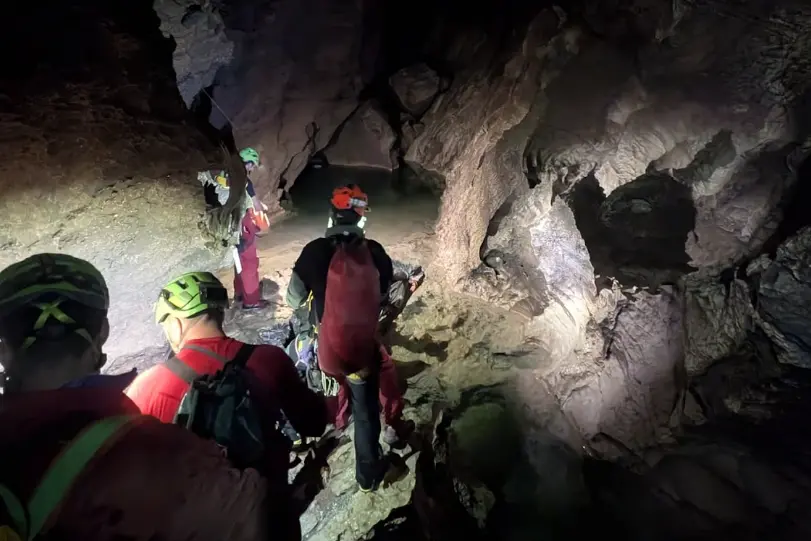
(Photo Alpine Rescue)
Per restare aggiornato entra nel nostro canale Whatsapp
The complex Alpine and Speleological Rescue exercise in the Su Bentu cave, within the Lanaitho Valley in the Municipality of Oliena, has concluded.
Three intense days with 165 technicians from 11 Italian regions who took turns in eight teams to rescue a participant who pretended to have been injured more than 3,000 metres away inside the cave .
Among the technicians in action and who alternated within the teams were three doctors and three nurses from the CNSAS, specially trained not only in cave progression but also in medical assistance in particularly critical conditions such as those found in a natural cavity or other impervious environment.
The operations began on Friday, December 5th and included a simulated complex rescue operation for a participant who was injured inside the cave after falling from a height, sustaining injuries to his lower limb and back.
The CNSAS first response team reached the injured man in the section of the cave known as Sala Giovanni Nonnis, where technicians immediately assessed the environment, the possible circumstances of the accident, and the injured man's condition, providing him with the necessary medical assistance.
While the Mobile Coordination Center arrived outside and the base camp was being set up, a second team ran a telephone line along the entire length of the cave up to the helper to allow the first team to quickly communicate the situation to the outside.
Other teams of technicians deployed within the cave to set up rope handling devices that allowed the stretcher with the injured man to be safely transported outside.
During the rescue operations, it was necessary to overcome numerous natural obstacles, including narrow passages, flooded tunnels and vertical shafts.
On Saturday, numerous authorities arrived at the Mobile Coordination Centre to participate in the presentation of the real-time multimedia broadcast , made possible thanks to Ermes , the system created, developed and patented by the Speleological Technical Commission of the CNSAS to bring the Internet into caves .
During the event, the authorities were introduced to new technologies that allow responding technicians to remain in constant contact with the Operations Coordination Center. Specifically, thanks to the ERMES device, they were able to listen to the assessment of the injured man's condition , analyze his vital signs , and perform a live ultrasound via video conference . They also followed the discussions between the medical team monitoring the patient in the cave and the Sassari 118 Emergency Operations Center , which was remotely monitoring the injured man's medical progress and ready to provide highly specialized support.
The recovery operations lasted a total of 44 hours and concluded with the stretcher carrying the injured man being released around 3 a.m. on December 7.
The event, organized by the 8th Speleological Rescue Zone of the Sardinian Alpine and Speleological Rescue Service, also involved the Speleological Technical Commission and the Medical Commission, successfully demonstrating the close collaboration between technicians from across Italy, as well as the organizational coordination capabilities of the CNSAS. Furthermore, the exercise highlighted the sophisticated specialized skills that each CNSAS technician is ready to deploy during a medical rescue operation in a challenging or hostile environment.