

Fires in Sardinia: Over 5,000 hectares of forest to go up in smoke by 2026
From January to October, an area equivalent to seven thousand soccer fields was devastated. Legambiente: "Delays in prevention and planning were among the causes."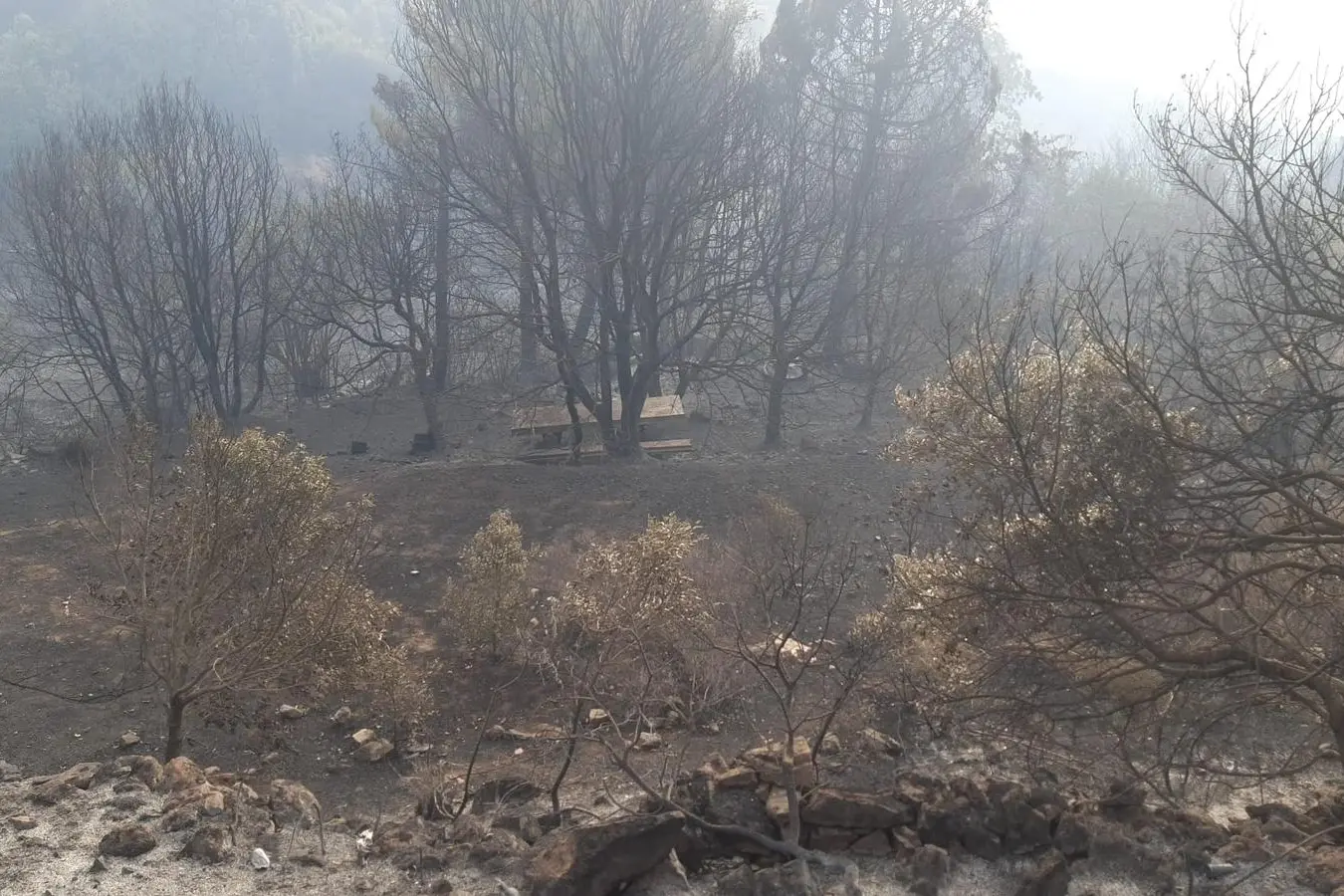
A forest devastated by a fire last summer in Arzana (photo by R. Secci)
Per restare aggiornato entra nel nostro canale Whatsapp
From January 1st to October 15th, 2026, 5,043 hectares of forest went up in smoke in Sardinia due to fires . This area covers over 50 square kilometers, equivalent—to give an idea of its size—to approximately seven thousand football fields or the area occupied by the entire city of Bergamo, or—to stay within the island—similar to that occupied by the municipalities of Stintino and Castelsardo.
The data comes from the latest report “The Bieconomy of Forests 2026” presented in Rome during the IX Forest Forum on sustainable forest management and edited by Legambiente using Effis/Copernicus data.
The dossier highlights how Sardinia is one of the regions most affected by forest fires, in fourth place after Calabria (14,359 hectares up in smoke), Puglia (13,649) and Piedmont (5,159).
Last July, the Region reported that in the first seven months of the year, the area of forests destroyed by fires in Sardinia had decreased compared to the previous year: 212 hectares burned compared to the 709 hectares recorded in the same period in 2025. Nationally, however, this year saw a significant increase in fires: 20.5% more than in 2025, with 130,858 hectares burned overall (+36% compared to 2025), equivalent to 183,275 soccer fields.
According to the analyses, four red alerts will impact the forest heritage in 2026: in addition to the surge in fires, the acceleration of the climate crisis and alien species, delays in prevention and the slow growth of planning , certification and sustainable forest management, and dependence on foreign timber .
Yet, it is emphasized, "in Italy, forests are growing and advancing, due to the abandonment of rural and mountainous areas." To adequately protect forested areas from fires, the report continues, "an urgent paradigm shift is needed , working on active and structural prevention, based on sustainable forest management , land maintenance, urban planning in urban-rural interface zones, the application of prescribed burning, the comprehensive updating of municipal fire registers, and advanced satellite monitoring systems (such as EFFIS)—and on a national industrial plan that places the forest-wood-energy supply chain at its core to accelerate the ecological transition of the forestry sector."
(Unioneonline/lf)