Cagliari seen from Sinnai, the power of super-telephotos between reality and illusion.
Two extreme perspectives, eleven kilometers apart and a single image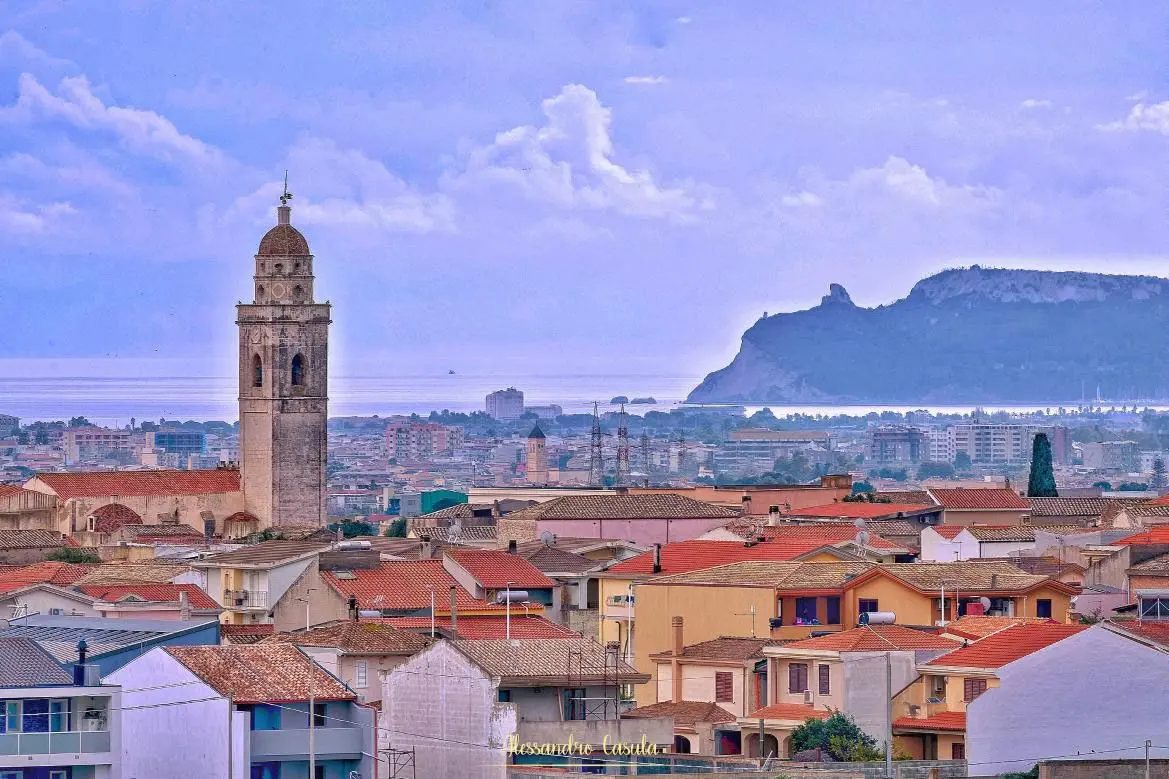
Per restare aggiornato entra nel nostro canale Whatsapp
Sometimes, just a few kilometers away is enough to discover a completely different city. Cagliari, observed from Sinnai through the attentive and patient eye of Alessandro Casula and his telephoto lens, changes face: it becomes compact, overlapping, almost unreal.
It is the result of two unusual shooting points, carefully chosen and told through photographs and videos taken with extreme focal lengths of 400 and 600 mm, capable of compressing space and offering surprising perspectives.

The first view begins at the foot of the Sinnai pine forest , along the white woodshed road that leads to Settimo San Pietro. From here, the gaze sweeps across the countryside and encounters a near-perfect alignment: the bell tower of Settimo San Pietro stands out in front of the Sella del Diavolo, while the Poetto sea opens up behind it. An interplay of planes that only a telephoto lens can construct, transforming kilometers of distance into a single, compact scene, where symbolic elements of the territory seem to interact with one another.
The second perspective opens up from Via Einstein, also in Sinnai . Here the view becomes even bolder: the bell tower of Settimo San Pietro takes center stage once again, but this time framing Cagliari in all its verticality.
The Castello neighborhood emerges clearly, almost suspended, while the mountains of Capoterra rise in the background, with Mount Arcosu marking the horizon. In the upper left, discreet but recognizable, Cagliari Cathedral appears. All this at a distance of approximately 11 kilometers from the shooting point: a surprising distance, considering the clarity and narrative power of the image.

From a technical point of view, the work was carried out by Casula with a Canon EOS 5D Mark III , using two professional lenses: the Canon EF 70-200 IS L USM II and the Canon EF 300 L f/2.8, the latter combined with a 2x focal length multiplier.
The choice of 5-shot bracketing allowed for better management of light and contrast, which are essential when working at such long distances and with subjects immersed in atmospheres often veiled by haze.