Amp Tavolara-Punta Coda Cavallo, researchers say, "Without new restrictions, the underwater heritage is at risk."
A day of in-depth study dedicated to the health of marine ecosystems and the future challenges of conservation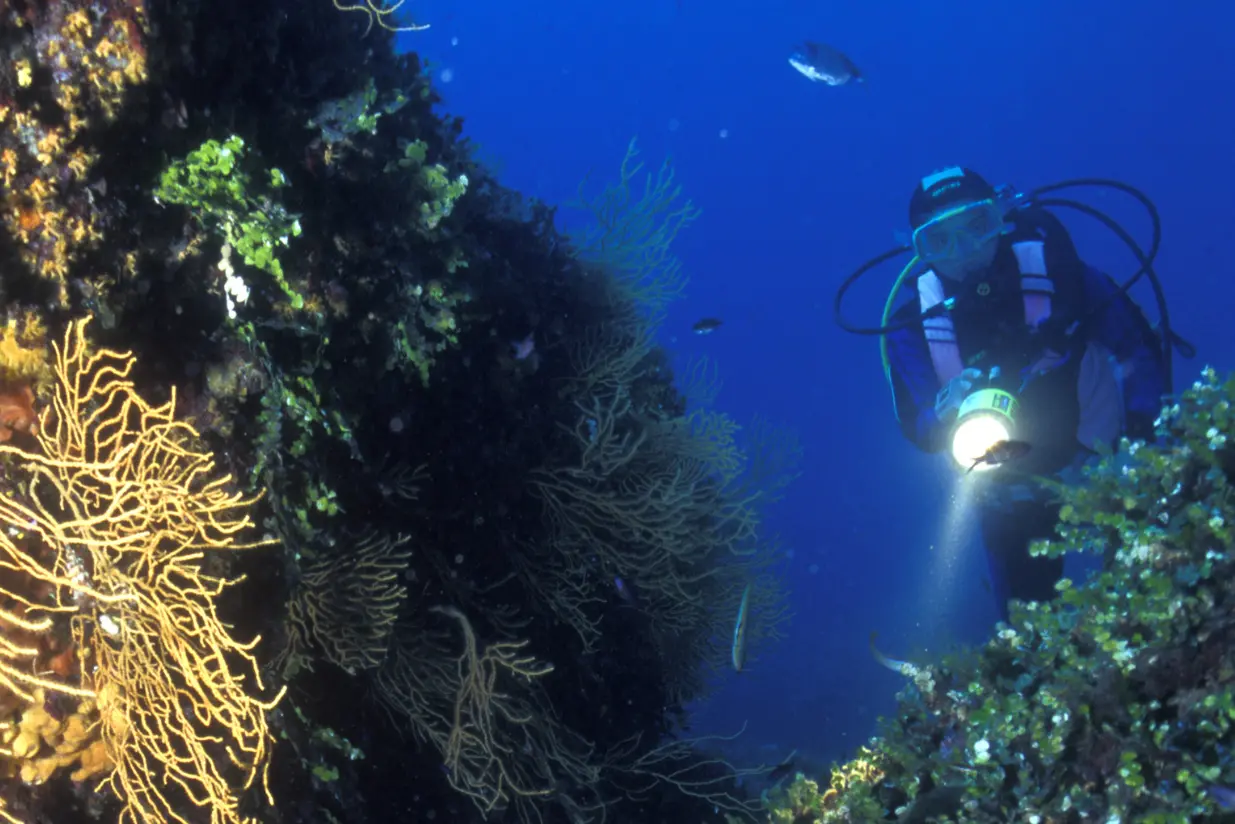
Per restare aggiornato entra nel nostro canale Whatsapp
A day of in-depth discussion on the health of marine ecosystems and future conservation challenges took place in the Aula Magna of the University of Olbia, focusing on the results of research conducted in the Tavolara–Punta Coda Cavallo Marine Protected Area. Researchers, institutional bodies, and industry professionals analyzed a robust body of scientific studies, which converged on a clear message: to ensure the survival of the Park's exceptional underwater heritage, improved management and more stringent constraints are necessary. From coralligenous monitoring to the study of fish fauna, to the effects of climate change, the emerging picture highlights an ecosystem increasingly threatened by warming waters, overfishing, abandoned gear, and the growing pressure of megayachts. Among the speakers was Professor Paolo Guidetti, director of research at the Stazione Zoologica Anton Dohrn and director of the Genoa Marine Centre, who has collaborated with the MPA for over twenty years, collecting data on fish fauna through non-destructive visual census techniques. “The results I present concern only the last five years of a project that, in terms of duration and quantity of data, has become unique in the Mediterranean,” Guidetti explained, “and they show unequivocally that in Zone A the fish fauna is richer, more abundant, and composed of large species.”
The situation is different for zones B and C, where no significant differences are observed compared to areas outside the Park. "This indicates a fishing pressure that must be regulated," he emphasized, "and which is not attributable to professional fishermen, but rather to the thousands of licensed recreational fishermen, whose numbers must be limited."
During the censuses, researchers also record the presence of lost fishing gear: "Weighs, lines, artificial bait, and even speargun shafts in areas where they shouldn't be. The control system must be strengthened."
Abandoned gear represents a major threat to fragile species such as gorgonians and rare corals like Savalia savaglia. To protect the ancient forest of "golden coral" on the Park's seabed, last August, in collaboration with the Northern Sardinia Maritime Directorate, "Operation Patriarchi" was launched, which resulted in an ordinance banning fishing and anchoring in a 540-hectare area between Tavolara and Molara.
The measure, which expired on October 31, allowed scientific exploration to continue, leading to the discovery of forests of Paramuricea macrospina at depths of over 70 meters. As explained by Egidio Trainito, a collaborator with the MPA and researcher at the Anton Dohrn Zoological Station, significant populations of the pink Eunecella rugosa and the rare Leptogorgia sarmentosa have also emerged over the past ten years. These species are both rare and vulnerable.
"Warming waters are causing decisive changes," Trainito explained. "Healthy gorgonians are now found below 40 meters; this year, we recorded 21 degrees Celsius at 50 meters. Deep-sea habitats are being colonized by previously absent algae, and we're seeing the disappearance of iconic species like red scorpionfish and lobsters, which are now only found below 50-60 meters." Professor Federico Niccolini of the University of Pisa also spoke on the topic of climate change, describing the situation as "very alarming" for the sea's ability to provide ecosystem services.
"Today, a hectare of sea produces around 5,000 euros a year in ecosystem benefits," he explained, "but in 2050, even within a Marine Protected Area, it will drop to 3,000 euros, while outside MPAs it will be just 2,000."
The conclusion is clear: "By destroying nature, we will all become poorer. The only solution is decarbonization, but we continue to increase CO₂ in the atmosphere."
Niccolini, who has collaborated with the Tavolara MPA for twenty years on socioeconomic studies related to tourism and fishing, reiterated the urgent need to regulate recreational fishing: "We need new rules, inspections at the right times, and modern tools like drones. It's also essential to continue the environmental education process, in which this MPA represents a virtuous example." Aiming for a management evolution, Leonardo Lutzoni, director of the Tavolara–Punta Coda Cavallo MPA, emphasized the importance of "disseminating scientific knowledge about what is happening in the Park." President Francesco Lai clarified the meeting's objective: "To show the scientific community and citizens the evidence that has emerged to initiate two administrative procedures: immediately, an additional fishing restriction and, in the future, a review of the zoning." Also attending the meeting were Professor Giorgio Bavestrello (UniGe), Gianluca D'Agostino, Maritime Director of Northern Sardinia, and Dr. Martina Canessa. (UniGe), Professor Alessandro Cau (University of Cagliari) and Dr. Michela Angiolillo of ISPRA.