The Google alert that saved thousands of lives in Venezuela: how it works and when it's useful
Experts: "It works for those far from the epicenter." It Alert is in effect in Italy.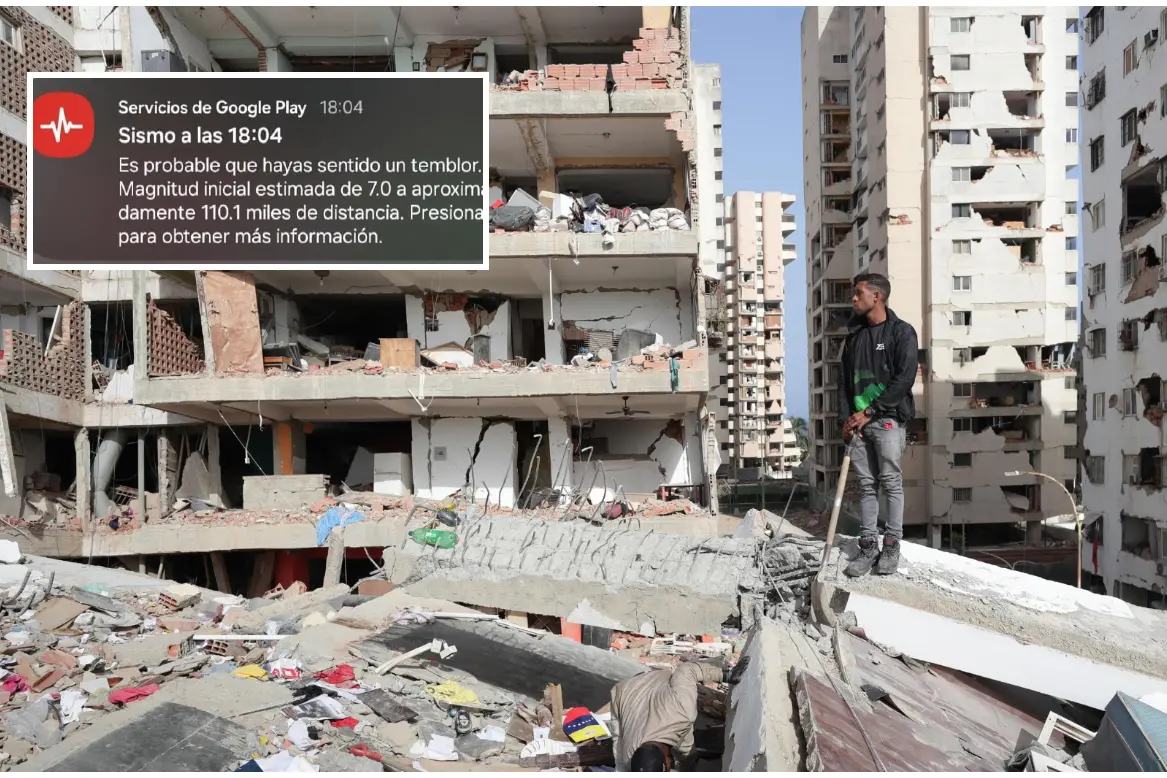
Per restare aggiornato entra nel nostro canale Whatsapp
Google's alert system , which in Venezuela , in some cases, sent a warning message to smartphones a few seconds before the earthquake, may have been of some use only to those who were very far from the epicenter.
Salvatore Stramondo, director of the Earthquake Department at the National Institute of Geophysics and Volcanology, clarified this. "It's important to emphasize that the Android system doesn't predict earthquakes ," Stramondo told ANSA. "It uses the accelerometers in cell phones, which can detect the first, lighter shaking produced by the primary waves, called P waves, which are the fastest."
The bulk of the earthquake's destructive energy is carried by slower secondary waves, or S-waves. At the epicenter, the time difference between the arrival of the two types of waves is minimal, so the warning could only have given those kilometers away time to reach safety , having received the message a few dozen seconds before the shock.
"Its usefulness depends greatly on where you are," says the INGV expert. Furthermore, the system only works if the signal is detected simultaneously by many phones in the same area: in that case, it attempts to estimate the epicenter, magnitude, and potentially affected area, and sends an alert to users.
In Italy , Google's alert system is not available, but there is a national system managed by the Civil Protection Department for real-time public alert, IT-Alert, which sends a message with a distinctive sound to cell phones in the affected area.
"Around the world," Stramondo comments, " systems like Android are only active in specific areas, such as the West Coast of the United States and Japan, which has one of the most advanced warning systems. In these areas, they are useful because earthquakes usually occur at sea, and therefore a long time passes between the arrival of the P waves and that of the S waves. In Italy, however ," Stramondo continues, " earthquakes usually occur beneath our feet, so a similar warning system would not be very useful ."
In Italy, too, seismic early warning networks are being developed, and trials are already underway. In Irpinia, for example, there's Presto (Probabilistic and Evolutionary Early Warning System), an early warning algorithm that analyzes seismic network data in real time and sends notifications a few seconds in advance. "This system primarily serves to secure infrastructure," Stramondo emphasizes, "for example, it allows trains to slow down before an earthquake arrives."
(Unioneonline)