

Donald Trump's journey from peacemaker to conqueror. And the role of the European Union.
Considerations on the war in Iran and its economic and geopolitical implications. And an ineffective EU.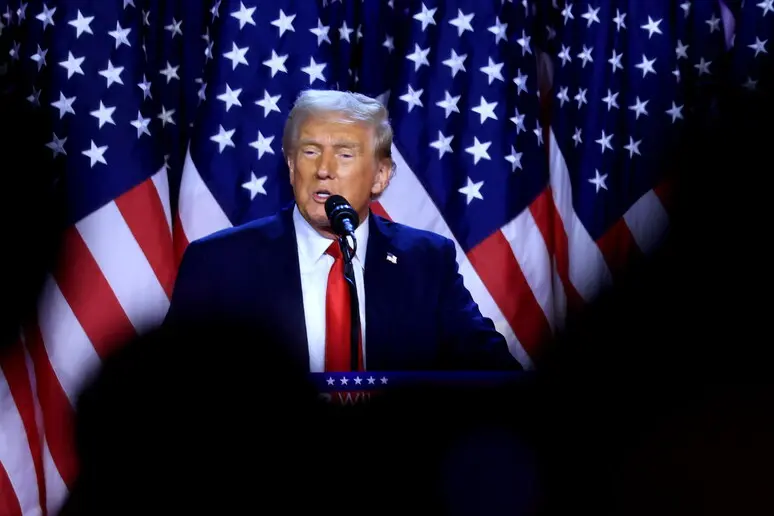
(Handle)
Per restare aggiornato entra nel nostro canale Whatsapp
Anyone who understands this is smart. It was May 2024, and Donald Trump, at a rally in the Bronx, had declared, according to press agencies, not only that "with him as president there would never be a war in Ukraine, there would never be a war with Israel, and there would never be an October 7th," but also that "the color of one's skin didn't matter" because "we were all Americans."
Throughout his election campaign, he also repeatedly reiterated that he would put an end to ongoing conflicts, referring in particular to those in Ukraine and Gaza. He described himself as a Peacemaker, noting that no war had been waged during his previous four years in office. Since then, on closer inspection, a lot of water must have passed under the bridge, seemingly washing away all good intentions. And something has likely changed, or perhaps it has simply been revealed and made clear, in terms of ideological planning: on Saturday, February 28, the United States and Israel attacked Iran, which, for its part, appears to have responded with equal force.
Reflecting on the matter, the world has become accustomed to Donald Trump's behavioral fluctuations, but what seems to be raising ever greater concerns today is the European Union's attitude toward the current situation. The European Union has appeared somewhat institutionally disjointed (if I may use the expression), its complex structure divided, and its ability to influence the course of events, limiting itself, inevitably, to passively submitting to them. Adding to this the further circumstance that the European Union, to date, does not appear to be a unified and unified entity among its member states, including countries willing to undertake unspecified defensive actions if necessary, and others unwilling to justify America's actions, then drawing conclusions seems far from simple.
The mere notion of the attack launched by the United States and Israel as an opportunity to promote and achieve regime change in Iran (assuming, and perhaps not conceding, under international law, that it is possible to interfere in the internal and external affairs of another state, good or bad), would seem illusory, and might even smack of an attempt to justify, after the fact, an uncalibrated action that seriously risks having serious global repercussions, with consequences that are perhaps unmanageable.
Tehran, contrary to Donald Trump's expectations, has not appeared to be sitting idly by. The European Union's very credibility, already undermined by the geopolitical events of recent years, appears to be compromised, as it is currently unfit to establish a principle of trust that reflects the image of a political and economic community founded on genuinely shared values and on compliance with an international order that once existed but which currently no longer appears (the formula of doubt is compelling).
The question that should be asked, all things considered, would seem to be this: on what new rules does the European Union intend to be based from now on? Self-determined or externally determined rules? And if externally determined, by whom? The difference is, to say the least, substantial, and the answer that might be offered could have a definitive impact on the very existence of the Union as it has been conceived to date.
The economic, political, and social instability generated by this latest conflict, which adds to the existing and directly resulting from the pandemic period and the subsequent upheaval caused by the Russian-Ukrainian conflict, appears to have undermined citizens' trust in their respective national governments, which are likely unprepared to address emerging issues. The crucial issue to be resolved, the one most concerning the population, remains the socioeconomic consequences of this latest conflict. The blockade of the Strait of Hormuz, known as a strategic chokepoint, and the targeting of civilian and energy infrastructure in the Gulf countries appear to have had repercussions, immediately causing an increase in energy prices likely to cause serious concern within European countries.
Indeed, to put it another way, the market, with all its complex set of rules and variables, responds not only to concrete, let's say tangible, upheavals, but even before that, that is, at the very moment the threat of drastic change is perceived, thus impacting the entire real economy. What responses will the European Union then offer? Today, more than ever, we need to lay the foundations for a truly European sovereignty that pursues its own specific interests, regardless of old alliances.
Giuseppina Di Salvatore – Lawyer, Nuoro