

Todde's electoral report is irregular, but it exists: this is why the Court of Appeal rejects the forfeiture.
A 91-page verdict saves the legislature and overturns the Court of First Instance's decision, upholding the €40,000 fine. Comandini: "Good faith recognized."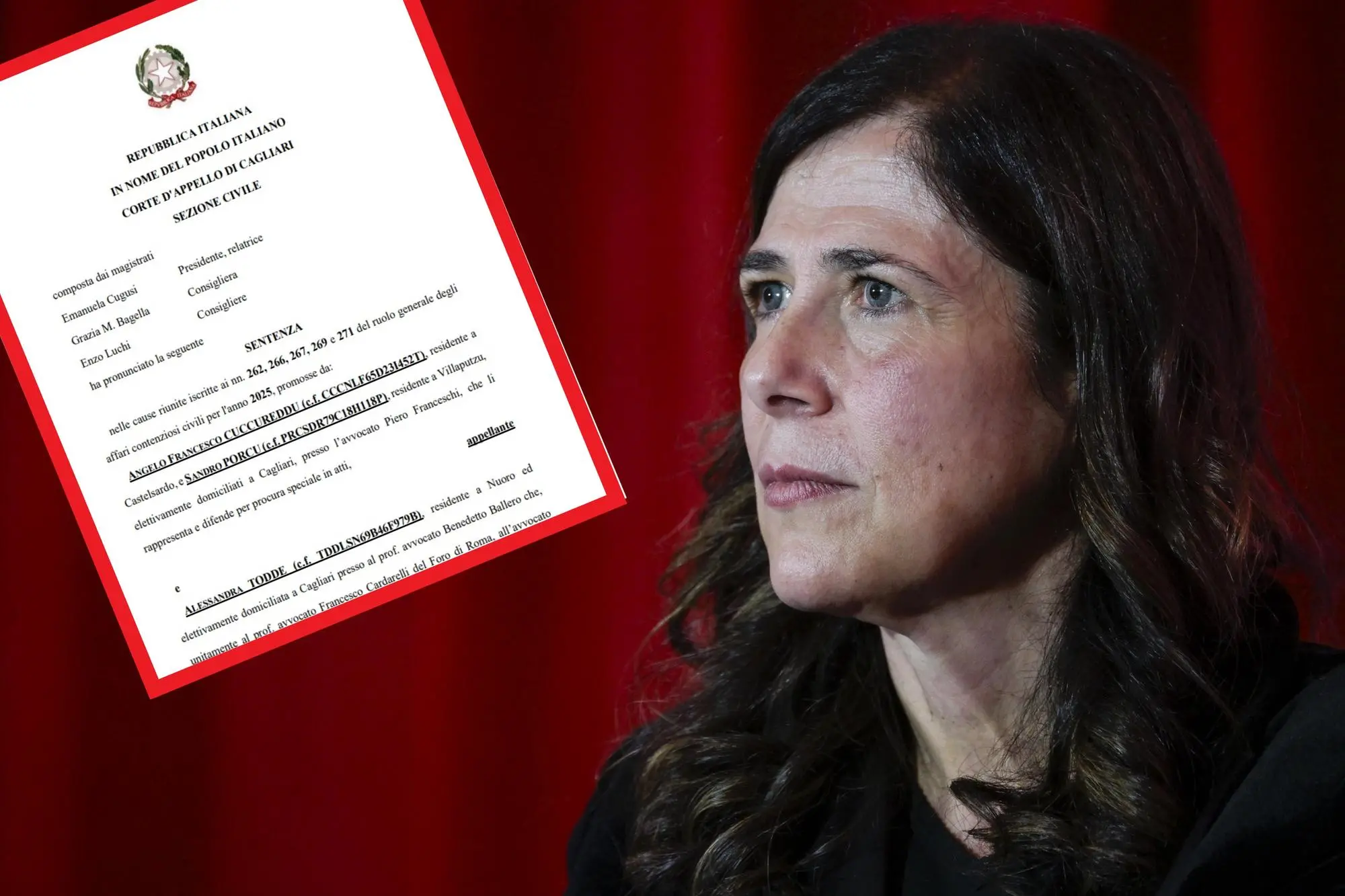
Per restare aggiornato entra nel nostro canale Whatsapp
Alessandra Todde committed "significant" irregularities in reporting her campaign expenses for the 2024 regional elections. But she did submit some of them. And the Court—which upheld the effectiveness of the injunction issued by the regional electoral guarantee board—erred in ruling that the errors were so serious as to constitute a "failure to file," which, according to the law, would have resulted in the disqualification and termination of the legislature.
This is the gist of the ruling by the Cagliari Court of Appeal, civil division—presided by Emanuela Cugusi—which ruled on the appeal filed by the governor against the first-instance verdict that upheld the validity of the earthquake decree issued in December.
The 91-page ruling rules out lawyer Riccardo Fercia's right to defend the case on behalf of the guarantee panel, establishes that the law governing regional councilors' financial statements also applies to presidential candidates, confirms Todde's €40,000 fine, and mitigates the worst of the dangers.
Crucial to the stability of the legislature was the Constitutional Court's ruling, issued while the case was pending. The Court cited the text of the injunction order, which stated : "Todde was not accused of failing to file the expenditure declaration and financial statement." Only failure to file (exceeding the legal spending limits) is grounds for disqualification. Other violations carry a penalty. This applies even if a proxy was not appointed and a dedicated bank account was not opened to receive all campaign funds. The Five Star Movement candidate failed to do so. For this reason, she will have to pay a €40,000 fine.
The Court of First Instance, however, had "reclassified" the irregularities committed by Todde. In short: by first declaring that he had incurred expenses, then later denying them, and after providing documents of expenses incurred by the Five Star Movement committee, he had, according to the first-instance judges, made such a mess that, in the end, his financial statements were deemed legally non-existent. The consequence? Forfeiture.
And it is the challenge to this reconstruction that hits the mark, according to the Court of Appeal that ruled today.
"The rationale behind the entire reclassification of the violation from 'irregularity' to 'failure to file' by the Court," the ruling states, "is based on the assumption that it would not have been possible to assess the 'non-compliance' of the financial statement because the candidate had never filed her own financial statement. This assertion, however, is presented as factual, while it is contradicted by the documentation submitted in the case."
The candidate, in fact, "carried out concrete actions aimed at fulfilling her reporting obligation: she submitted a declaration certifying the absence of personal expenses (€0) and, for the sake of transparency, attached the statement from the electoral committee that had covered the campaign costs. Although this documentation was deemed 'non-compliant' by the supervisory body," hence the findings of irregularities, "it nevertheless constitutes a material presentation of documents aimed at reporting her position." Furthermore, "following the 'non-compliance' complaint, the candidate submitted the official form 'Regional Elections - Declaration without expenses'."
It follows that "the Court's assertion that the candidate never submitted a financial statement is factually incorrect. The Court's more specific conclusion is that the documents filed are, in its opinion, so flawed as to be considered 'legally non-existent.'" This assessment, however, concerns the merits of the act's compliance and cannot transform a fulfillment, even if irregular, into an ontologically distinct conduct such as failure to submit. More explicitly," going into even more detail, "it is the Court that, by qualifying the document as 'legally non-existent,' determines the impossibility of conducting a comparison. However, this qualification cannot retroactively affect the nature of the proceedings initiated by the administration, which were based on the existence of a document to be examined and deemed 'non-compliant.'" The legislature is safe. As is Alessandra Todde.
Comandini's comment
The Court of Appeal's ruling, which definitively rejects any possibility of dismissal for President Alessandra Todde, is certainly good news for the Sardinians and for Sardinia, which needs administrative stability and continuity. It is undoubtedly a recognition of President Todde's good faith. Now, together, we must continue the mandate the Sardinians have given us, unleash greater energy within the Regional Council, and advance the reforms we have begun.