

Testing of the new Aster 30 missile launch system at Quirra
The Navy: "The geopolitical context is complex, this is how we ensure the safety of our ships." Meanwhile, other explosive devices have been scattered in the sea around the testing site for months.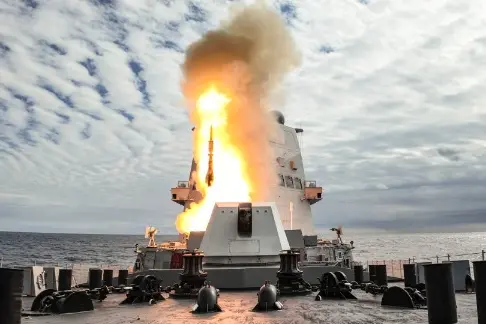
Per restare aggiornato entra nel nostro canale Whatsapp
The Italian Navy is testing a new missile launch system and is announcing it as a way to flex its muscles: an Aster 30 missile was fired from the Montecuccoli offshore patrol vessel off the Quirra Range using the SAAM ESD POA (Surface-to-Air Anti-Missile – Extended Self Defense), considered "one of the most advanced naval air defense systems currently available" on the international arms market.
The test was conducted in recent days, but only yesterday did the Ministry of Defense confirm its use in the Sardinian theater: in a statement, it was emphasized that the equipment installed on the military vessel "represents a significant technological leap in the field of naval defense . It is designed to counter increasingly sophisticated and rapid air, missile, and remotely piloted threats." In a constantly evolving geopolitical context "characterized by the emergence of new military technologies and increasingly complex operational scenarios, such capabilities are essential to guarantee the safety of naval units and forces deployed at sea."
At Quirra, as is often the case, support for the Navy was provided "by the national defense industry, particularly Leonardo and MBDA." The Navy also stated that "evolving threats, increasingly faster, more precise, and more difficult to intercept, require defense systems capable of operating in an integrated manner, leveraging highly advanced sensors, software, and weaponry. With the success of this operation, the Navy has taken a further step forward in the fleet modernization process."
The official statement doesn't explain what happened to the missile. The test is described as successful. But the same thing happened after May 30th, when another Aster 30 and a Stinger were fired in the same quadrant of the sea. Only, it was later discovered that both had ended up on the seabed. The Defense Staff had hypothesized two impact points to recover them: months later, they're still there. Lost.