

Sardinia's decline: over 85,000 residents lost in 20 years, 1.7 billion euros wasted
Demographic data are increasingly disastrous for the island: only northeast Gallura is bucking the trend. Elsewhere, especially in the center, those who can produce are leaving. The opportunities? They depend on the CAP.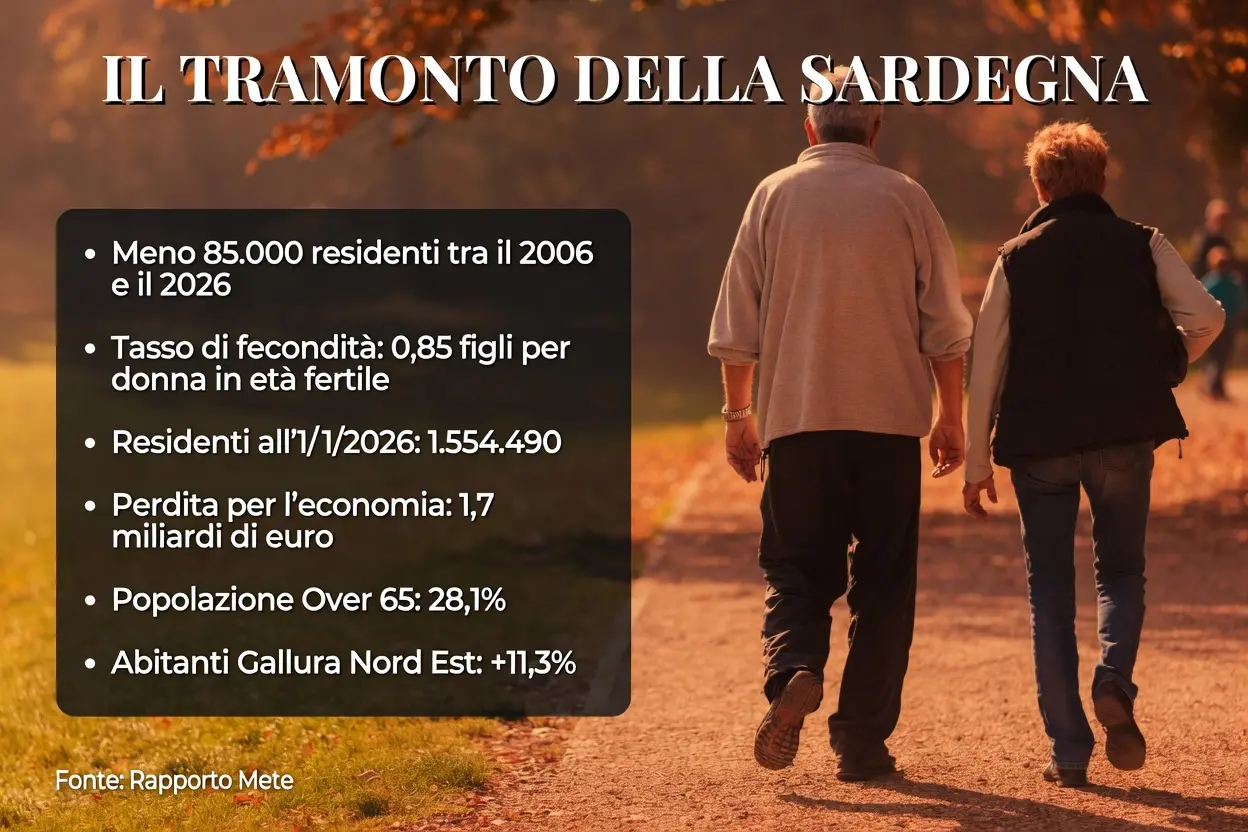
Per restare aggiornato entra nel nostro canale Whatsapp
Sardinia is experiencing a "demographic decline," a definition that accurately describes an unprecedented process of erosion of its human and productive geography. The loss of over 85,000 residents over the twenty-year period from 2006 to 2026 is not an abstract calculation, but a tangible wound: this demographic decline is equivalent to the simultaneous disappearance of the entire population of key centers such as Assemini, Monserrato, Quartucciu, and Selargius combined. This is what emerges from the 2026 Destinations Report by Crei-Acli and Iares.
In this scenario, Sardinia emerges as a true "borderline case" in the European and national landscape, anticipating dynamics of decline that are still in their infancy elsewhere.
As of January 1, 2026, the resident population stood at 1,554,490. The fertility rate has slipped to the extreme limit of 0.85 children per woman, the lowest figure in Italy and among the most critical in the entire European Union, in a merciless comparison with the generational replacement threshold set at 2.1.
According to the report, this demographic fragility is intrinsically linked to a structural economic weakness: the vicious cycle of depopulation and low incomes erodes the region's productive capacity by an estimated €1.7 billion. The income gap is emblematic of the citizenship gap: where the average Italian taxpayer declares €100, a Sardinian on average declares €86. With a population over 65 reaching 28.1%—making Sardinia the second oldest region in Italy after Liguria—and a share of young people under 15 plummeting to 9.4%, the projections for 2050 are dramatic: the working population is set to fall below the critical threshold of 50%, jeopardizing the very sustainability of the regional welfare system.
The "new diaspora" is documented by the 133,256 AIRE members, a community that ideally represents Sardinia's second city. The most alarming figure lies in the quality of this flow: 70.4% of migrants are between 18 and 64 years old, a sign of a massive transfer of vitality and skills abroad. Conversely, the foreign population, despite only accounting for 3.7% of the total —making the island the last region in Italy in terms of non-Italian residents— performs a crucial demographic buffer. The economic contribution of these 57,754 new citizens is significant, with an added value of €1.2 billion in key sectors such as agriculture and tourism. However, the analysis reveals a profound anomaly in the Sardinian "care economy": unlike the rest of the country, where foreign labor dominates the sector, in Sardinia, domestic care is predominantly entrusted to local workers, the report explains.
Over the past twenty years, the 19-25 age group has contracted by 29.6%, and the flight to universities in central and northern Italy has increasingly become a "prize for the wealthy classes, transforming university mobility into a factor of hereditary social stratification." The geography of Sardinia's decline reveals extreme territorial polarization, a "two-speed" Sardinia where the statistical average masks divergent realities.
On the one hand, the resilience of urban and tourist hubs is evident, with Northeast Gallura standing out as the only area experiencing significant growth (+11.3%), acting as a demographic magnet thanks to the development of the service sector and port infrastructure. On the other hand, inland areas are experiencing population declines exceeding 25% in some municipalities, resulting in the disappearance of essential services and the failure to guarantee constitutional rights.
"The loss of nearly 8,000 residents in the last year highlights the urgent need for a strategy based on 'territorial justice,'" it is noted. "It is no longer acceptable that the ability to start a family or access health services depends solely on a zip code. The polarization between dynamic coastlines and a vanishing interior requires a political vision that recognizes equality of opportunity as the only path to the survival of the entire region."
(Unioneonline)