

"Illegitimate adjustments, money to be returned": the Court upholds the class action lawsuit against Abbanoa.
The court ruled against the water management company that had demanded €106 million from users. The Unidos committee, which had brought together thousands of Sardinians, was right. Mauro Pili: "Today, the people won."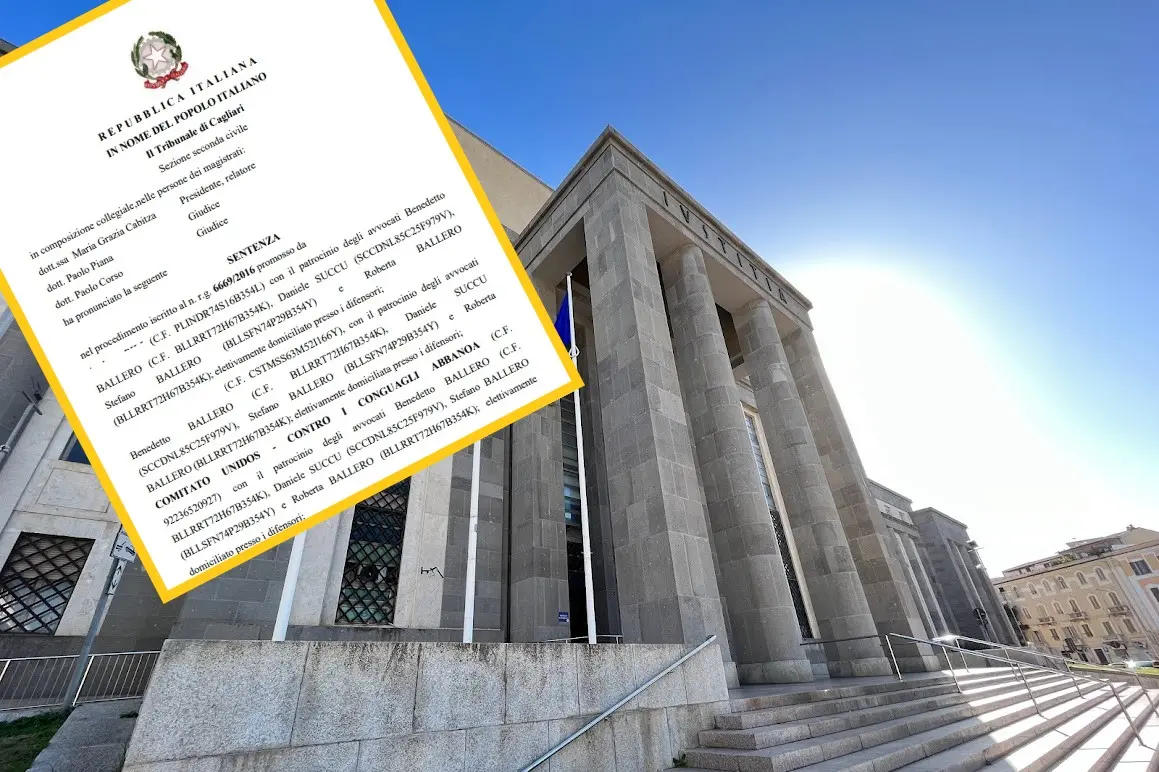
Per restare aggiornato entra nel nostro canale Whatsapp
Abbanoa's collection of adjustment payments for the years 2005-2011 was unlawful: the sums were not owed, and the water utility company will have to return the money to the thousands of Sardinians who, claiming they had previously paid the amounts due, joined the class action lawsuit launched by the Unidos committee led by Mauro Pili. Now the parties—Abbanoa on one side and the citizens on the other—will have to reach a settlement agreement to resolve the dispute over an amount worth approximately €106 million.
This was established by a ruling issued by the Second Civil Section of the Court of Cagliari, presided over by Judge Maria Grazia Cabitza, who issued the provision with colleagues Paolo Piana and Paolo Corso.
The case dates back a long time and concerns a flurry of bills that Abbanona sent to numerous Sardinians in 2014 as a settlement for previous bills dating back to the period 2005-2011. This was based on a recalculation, using a new tariff method, carried out in 2012. This was a flawed method, according to the court. Such flawed management, according to the appeal, that "this approach sometimes affected users who, during the reference period (2005-2011), were not even holders of supply contracts, and therefore for consumption that was impossible for them, or at least not attributable to them."
According to the authors of the class action , "Abbanoa should have calculated the previous items on the basis of the operating costs that, under the legislation in force in the period in question (2005-2011), it had proven it could recover in relation to the individual reference years, to then be divided among the users based on the actual consumption of each in the reference year, and not instead, as happened, in a flat rate manner on the basis of overall costs considered in the broad period indicated on the invoice (2005-2011), and divided on the basis of the consumption recorded solely by the users active in 2012."
Abbanoa, "in contesting the validity of the plaintiff's arguments regarding the illegality of the requested adjustments," in addition to citing Supreme Court rulings that it claimed had established principles that would have legitimized its action, "argued that no illegality or incorrectness could be contested since, in requesting adjustments for prior-2012 items from users existing in 2012, it had merely implemented what had been legitimately established by the competent administrative authorities."
The Court of Cagliari, in accepting the class action, did not establish how much is owed and to whom. This is partly because it has been inundated with requests for restitution . However, it did establish that, "given the extremely high number of petitions (approximately 12,000) and the resulting work still required for each of them, it deems it appropriate at this stage of the proceedings, having established the merits of the class action, to limit itself to indicating the uniform criteria to which the parties must adhere in order to reach an agreement that will put an end to the dispute."
And here it is, the criterion: " The sums requested for prior items "adjustment payments for the years 2005-2011" as per the invoices attached to this lawsuit are not owed either by the plaintiffs or by water service users throughout Sardinia who promptly joined the proposed class action." And "Abbanoa S.p.A. is obligated to return any sums already received for prior items "adjustment payments for the years 2005-2011" from the plaintiffs and users who, by promptly joining the class action, have demonstrated that they have already paid them."
"The decision," declared Mauro Pili, upon learning of the judges' ruling, "reaffirms a principle of general importance: the recovery of public service costs cannot be done retroactively, opaquely, and unbalanced to the detriment of users, nor can it pass on to citizens management errors or decisions made without adequate transparency." The sums, Pili recalled, "were requested many years later, unexpectedly, and often accompanied by the threat of service suspension, and were calculated according to a criterion that burdened a limited number of users, particularly those active in a single year, with costs accumulated over a long period of time. This ruling," he concluded, "affirms a fundamental principle : citizens cannot be asked to pay, years later, for mistakes and choices made behind their backs. Today, the Sardinian people, who knew how to resist and fight, are victorious."
(Unioneonline/E.Fr.)