

Cagliari, the City Council is now changing strategy and rejecting the Bonaria-Poetto section.
The administration is reorganizing resources and focusing on high-frequency buses. The councilor: "We want to provide rapid responses while avoiding further construction projects."The decision represents a turning point for the future of urban mobility: the Municipality is changing its strategy and rejecting the extension of the light rail line from Bonaria to Poetto. Initially, two years ago, the decision was made to modify the route: no longer via Viale Diaz, and the ascent towards Ponte Vittorio, but instead via the "cut" at Piazzale Marco Polo, the extension to Viale Ferrara, also to connect Sant'Elia, and finally to San Bartolomeo, and the exit onto Viale Poetto.
The news
The idea of bringing the metro to Marina Piccola is no longer viable. There are too many inconveniences related to the construction site, the completion timeline is too uncertain, and it's too risky to ask the citizens of Cagliari to make further sacrifices for an infrastructure that, until its completion, would mean disrupted traffic, frantic traffic, and frayed nerves. In short, more years of resilience for the patrol car. In its place, a new plan is taking shape based on bus rapid transit (BRT), a rubber-tyred public transportation system that promises performance very similar to a surface metro, but with lower costs, shorter construction times, and, above all, a significantly smaller impact on the city during the construction phase. "We have submitted to the Metropolitan City a proposal for the reorganization of the resources currently earmarked for the construction of the Bonaria–Poetto light rail link, for a total of over €43 million," confirms Roads Councilor Yuri Marcialis.

The plan
Palazzo Bacaredda therefore believes it is more sustainable to focus investments on a system of fast buses that will run primarily on dedicated bus lanes, with high frequencies, equipped stops, and priority traffic lights at intersections. This decision stems primarily from the experience gained with the ongoing construction of Line 3 Repubblica-Matteotti "and the need to ensure timely responses compatible with the city's needs," explains Councilor Marcialis.
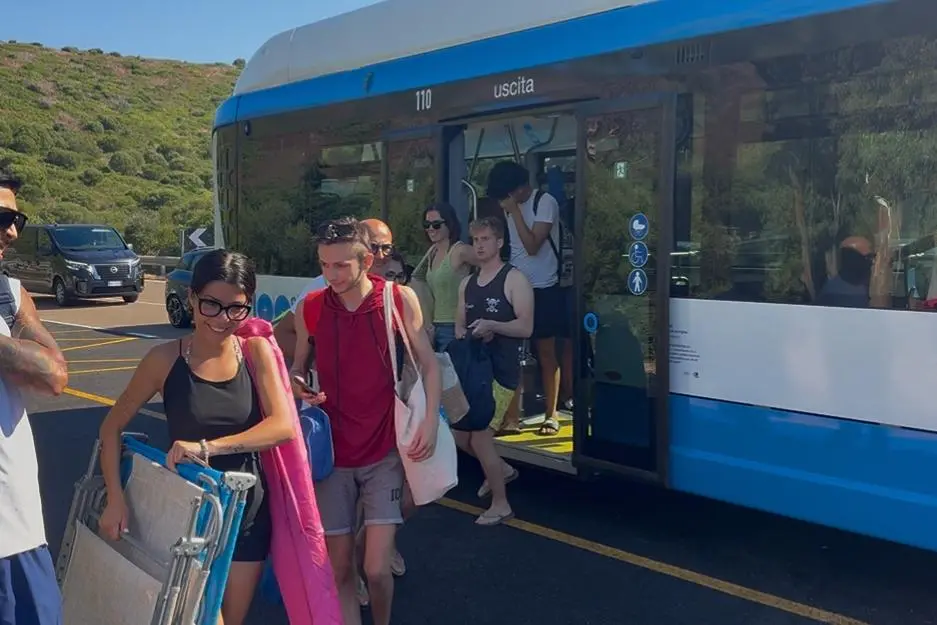
The goal remains unchanged: to quickly, frequently, sustainably, and efficiently connect Cagliari's city center, Poetto, the Sant'Elia area, the stadium, and Quartu Sant'Elena, encouraging Cagliari residents to leave their cars in the garage and use local public transportation more. "To achieve this, the City proposes the construction of a BRT line, served by 18-meter electric buses, with dedicated bus lanes and frequencies similar to those of a light rail system," the councilor reiterates. He adds: "The system would guarantee service levels similar to those envisaged by the tram solution, with high transport capacity, regularity, accessibility, and competitive travel times. The proposed solution would also allow the service to be directly extended to Quartu Sant'Elena, strengthening the truly metropolitan character of the project."
The advantages
The proposed restructuring would allocate the €43 million to a coordinated set of strategic interventions for urban and metropolitan mobility. Specifically, nearly €18 million would be allocated to the construction of electric charging infrastructure to support the electric bus fleet, and €2 million to ancillary works required to activate the BRT line (projects entrusted to the CTM). Furthermore, the Municipality could use €6.5 million to redevelop areas and access routes to the metro stops, with interventions in strategic areas such as Caracalla, Terramaini, Mercalli, and Palestrina, while just under €3 million would be used to strengthen the metro-tram platform between Piazza Matteotti and Piazza Amendola and to upgrade the Via Pirastu crossing. "The remodeling would therefore not only ensure rapid connections between Cagliari, Poetto, and Quartu via the new BRT system, but also improve accessibility to public transport hubs, strengthen metropolitan connections, redevelop important urban spaces, and complete strategic infrastructure for sustainable mobility throughout the region," Marcialis explains.
Attention now turns to the next administrative steps and the finalization of the new project. "The proposal is currently being examined by the Metropolitan City, which is responsible for evaluating the request for reorganization of resources. The administration is awaiting their response."
Mauro Madeddu
(1 – continued)