

No more "yes" to the end of the Italian national anthem: the government's "purist" choice and Mattarella's decree
It was not in the original text of the Risorgimento song, and it also disappears from the official version.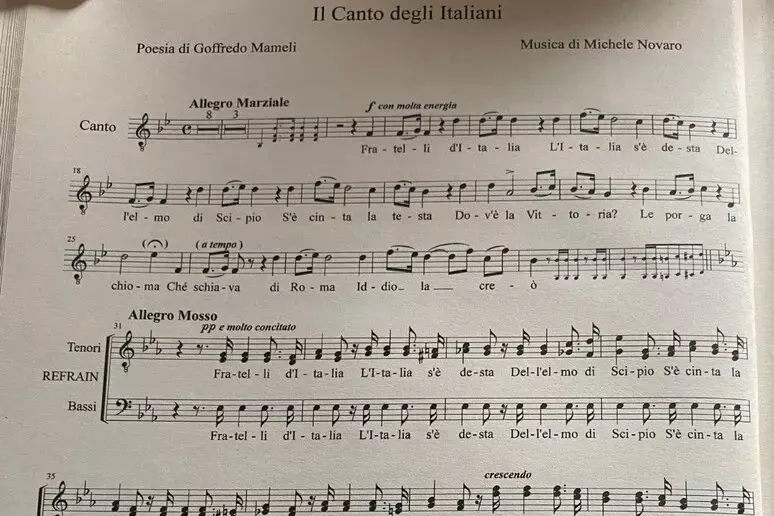
(Handle)
Per restare aggiornato entra nel nostro canale Whatsapp
No more shouting "yes" at the end of the Italian National Anthem, the Risorgimento song written by Goffredo Mameli ( a Genoese born into a noble family originally from Lanusei ) and set to music by Michele Novaro in 1847. This is established by a decree of the President of the Republic dated March 14, 2025, adopted upon the proposal of Prime Minister Giorgia Meloni and published in the Official Journal on May 7. The peremptory order is contained in the "sheet" of the Defence General Staff dated December 2, as reported by Il Fatto Quotidiano.
The document, sent to various agencies, including the Guardia di Finanza, and signed by Major General Gaetano Lunardo, head of the 1st Department of the Army General Staff, states that the Defense General Staff "has ordered that, during military events and ceremonies of institutional importance, whenever "Il Canto degli Italiani" is performed in the sung version, the final "yes!" must not be pronounced."
A "purist" request for a change, advanced by the military and accepted by President Sergio Mattarella, because that "yes" was missing from the original text of Goffredo Mameli's "Il Canto degli Italiani" and Michele Novaro's original musical score. After the line "We are ready to die, Italy called," only music follows. The resounding "Yes!" was added by Novaro only later, alluding to the Italian people's oath to fight to the death.
It was 1847, and the Genoese composer Michele Novaro was busy in Turin as choir director at the Carignano Theatre when he received a poem from Genoa, composed by the young Goffredo Mameli: "Brothers of Italy..." Novaro was filled with enthusiasm, and according to reports, he almost immediately wrote a musical commentary to the patriotic text. Thus was born "The Song of the Italians," which within a few months became the most popular anthem of the Risorgimento, at a time when patriotic songs in Italian or dialect were springing up everywhere.
Genoa, therefore, is the capital of the Anthem, composed in the mid-nineteenth century by two young artists who dedicated their lives to the independence cause: Mameli died defending the Roman Republic, while Novaro worked tirelessly to contribute to the cause as a composer and organizer of events.
After the Second World War and the proclamation of the Italian Republic , Il Canto degli Italiani was chosen, on October 12, 1946, as the provisional national anthem, a role it has retained ever since, remaining the de facto anthem of the Italian Republic . Over the decades, various parliamentary initiatives have followed to make it the official national anthem, culminating in Law No. 181 of December 4, 2017, which granted Il Canto degli Italiani the status of national anthem de iure.
(Unioneonline/D)