

Police officer kicked and hammered, one arrested in Turin
Piantedosi: "The antagonists are a danger to democracy." Solidarity from Mattarella and Schlein, Meloni's anger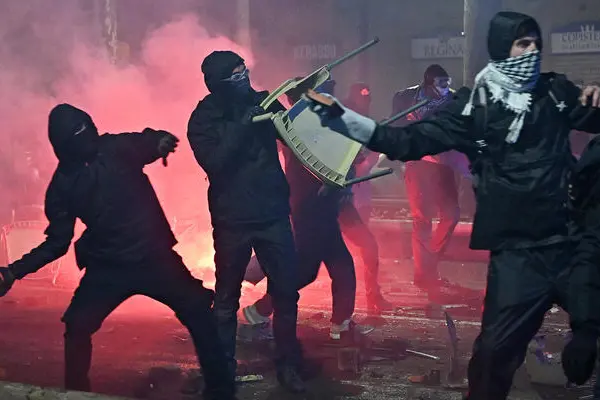
(Handle)
Per restare aggiornato entra nel nostro canale Whatsapp
One of the alleged perpetrators of the violent attack on a Padua police officer during yesterday's clashes in Turin has been arrested. The suspect is a 22-year-old from the province of Grosseto. The arrest was made using the delayed flagrante delicto mechanism. Two other protesters were also arrested for separate incidents.
Meanwhile, the opposition's urban warfare in Turin is igniting political debate. Prime Minister Giorgia Meloni speaks of "violent attacks aimed at targeting the state and its representatives." Interior Minister Matteo Piantedosi calls the opposition "a danger to democracy."
And faced with the images of a police officer surrounded and beaten with clubs and hammers, President Sergio Mattarella also intervened, calling Piantedosi to express solidarity with the attacked officer . From the League to Forza Italia, the majority accused the left of legitimizing certain violent behavior. "Those in Askatasuna are criminals: the only people worse than them are those who defend, pamper, justify, or protect them," thundered Deputy Prime Minister Matteo Salvini.
And the majority is once again pushing for the security package : "This is why the new security regulations the government is preparing are needed," Tajani assures. Piantedosi announced that the package will be discussed next week and work will be done to "propose new regulations." And, according to reports, the 12-hour preventive police detention for known dangerous individuals is being reintroduced. This measure is considered "essential" by those involved in the process to allow peaceful demonstrations.
Democratic Party secretary Elly Schlein expressed solidarity with the police : "The images coming from Turin are unspeakable, revealing unacceptable violence. Our condemnation of the violence is, as always, the strongest, and we hope the attackers are identified as soon as possible."
During the long day in Turin, the opponents waited until dark to break away from the Askatasuna national march in Turin and attempt to break through the police cordons. From there, guerrilla warfare erupted at various points in the Vanchiglia neighborhood, where the social center was located before the eviction on December 18th. Groups of autonomists and anarchists threw bottles, homemade pipe flares, stones, and smoke bombs . This occurred behind the Einaudi University campus, but even earlier at Corso Regina Margherita 47, where Askatasuna had a small building for nearly thirty years. The police responded with tear gas, water cannons, and relief charges, resulting in a standoff that lasted over an hour and a half. Flames were set to dumpsters and even to a police armored vehicle, which the officers themselves put out.
Everything within reach was thrown into the streets, from chairs from closed shops to uprooted street lamps. A police officer was surrounded and kicked, punched, and even hit with a hammer . Bianca Leonardi and her filmmaker, from the Rai Far West crew, were also attacked. Over a hundred officers were injured in total, around thirty of whom were taken to the hospital. Giorgia Meloni went to Turin this morning to visit them .
At least two people were arrested yesterday in Turin and taken to prison. One is a young resident of the Piedmont capital. There are reports of young women being released and charged at large. A total of about ten people were arrested yesterday and taken to the police station for questioning.
Among the injured police officers was a 29-year-old man who was surrounded and kicked, punched, and hammered with unprecedented violence . His colleagues intervened to protect him. Alessandro is now hospitalized in the surgical emergency room, suffering multiple bruises and a hammer wound on his left thigh , which has already been stitched.

The attack on the married police officer, who has a child, lasted just a few interminable seconds, a testament to the urban warfare that gripped the Piedmontese capital for approximately three hours.
The hooded groups called themselves by code names as they attacked the police: Blu, Ugo, Kiwi, Mango. Anarchists and autonomists, divided by their political views, but united during the assault. A single black bloc that, when darkness began to fall over the city, attacked.
(Unioneonline)