


The Roman Ghetto: An Italian Story
Historian Serena Di Nepi reconstructs the events of the Roman Jewish community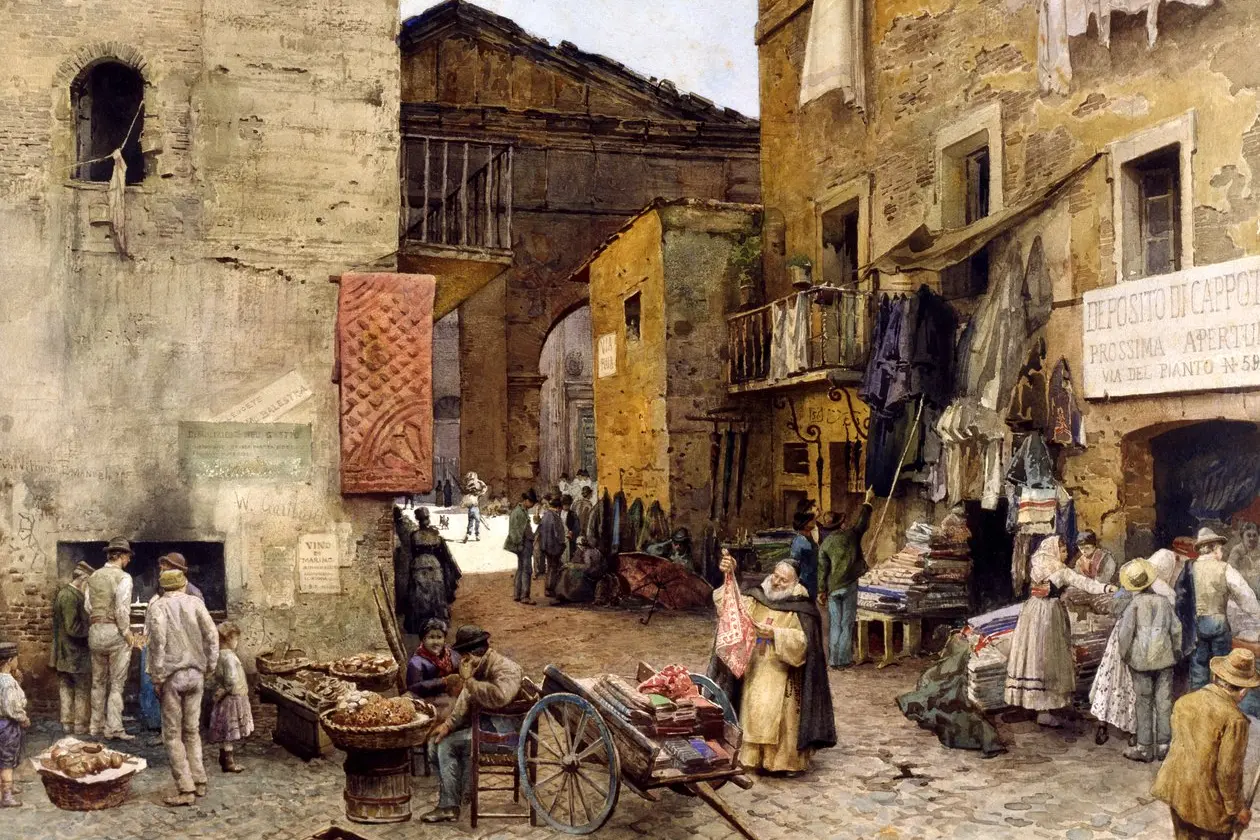
Per restare aggiornato entra nel nostro canale Whatsapp
When we speak of the Roman ghetto, the Nazi roundups of October 16, 1943, immediately come to mind. These roundups led to the capture and deportation of over a thousand Roman Jews . This dramatic event left a deep scar on the Roman Jewish community and rightly lingers in our memory. Yet, on that tragic October 1943, the ghetto itself had ceased to exist for over seventy years, since 1870, when it was "dismantled" with the end of the Pope's temporal power and the annexation of Rome to the Kingdom of Italy.
Before that fateful year of 1870, things for the Jewish community of Rome – but the discussion could be extended to half of Europe – had been very different and marked by a very specific experience: the ghetto, an area of marginalization and segregation for Jews, reserved for them alone, an area of permanent constraint established by law. An area characterized by isolation through a physical barrier in which only controlled entrances were open during the day and blocked at night, during which residents were prohibited from leaving. The ghetto, as it was conceived from the mid-16th century until the 19th, was therefore an institution with very specific characteristics, regulated starting with the papal bull Cum nimis absurdum of Pope Paul IV (1555), which established the Roman ghetto.

But what did it mean to live in a place of exclusion and marginalization such as the ghetto? Historian Serena Di Nepi explains it in her book Il ghetto di Roma (Carocci, 2026, pp. 176), a volume that traces the profile of the Roman Jewish community through the major historical events of these three centuries, from the Italian wars to the Reformation, the Enlightenment, and the Risorgimento. Over the course of these three centuries, the ghetto underwent some changes, but retained some of its characteristics as a means of institutionalized coercion and discrimination. The ghetto was the crystallization of the control that the Church had exercised over Jewish communities for centuries, the creation of an artificial place to hold Jews awaiting their conversion and within which to exercise coercive and punitive means to encourage and accelerate that conversion. It was, in short, a punitive "tool" imposed on Jews, forcing them to abandon their homes, their cities, and their relationships. It was the most obvious expression of a system that forced the sale of property, the abandonment of shops and trades, and the concentration of people in a single, enclosed space where they lived in cramped, overcrowded quarters. Even as the population grew, the ghetto's space remained the same. For this reason, the houses were tall, jutting out onto narrow streets, divided into floors with very low ceilings to maximize available space. At the same time, over the decades, ghetto residents, no longer able to pursue certain professions or maintain regular contact with the outside world, became increasingly impoverished. The lives of Jews in these segregated zones were dominated by a fundamental uncertainty due to the precariousness of existence within the ghetto walls, amidst overcrowding, proselytizing pressure, and growing poverty. At the same time, over time, Jews also experienced growing cultural marginalization, due to the loss of much of their contact with the outside world. A retreat that found its most evident testimony in the Roman ghetto, the one most controlled by the Church and the last to be dismantled in 1870. A testimony that speaks of poverty, backwardness, and passivity that would strike many visitors in the nineteenth century.
At the same time, the book Il ghetto di Roma reveals how, over this long period, Roman Jews were able to cope with discrimination, forced baptisms, economic hardship , and, for the most part, to remain Jews even under difficult conditions. Serena Di Nepi thus retraces the events of a group determined to maintain its religious difference in a hostile and persecutory society , yet, in its own way, capable of welcoming a minority. She does so through the story of journeys, conflicts, encounters, more or less well-known protagonists, precious objects, and missing books. With the unification of Italy, the ghetto was dismantled precisely because it was an icon of an era of intolerance , which was thought to be over, yet which remained and remains engraved in the memory of Rome's Jews, who still today consider the neighborhood a unique and significant space in their lives.
