

The near future of AI? Filippo Poletti explains.
The different applications of artificial intelligence, and the new role of the supervisor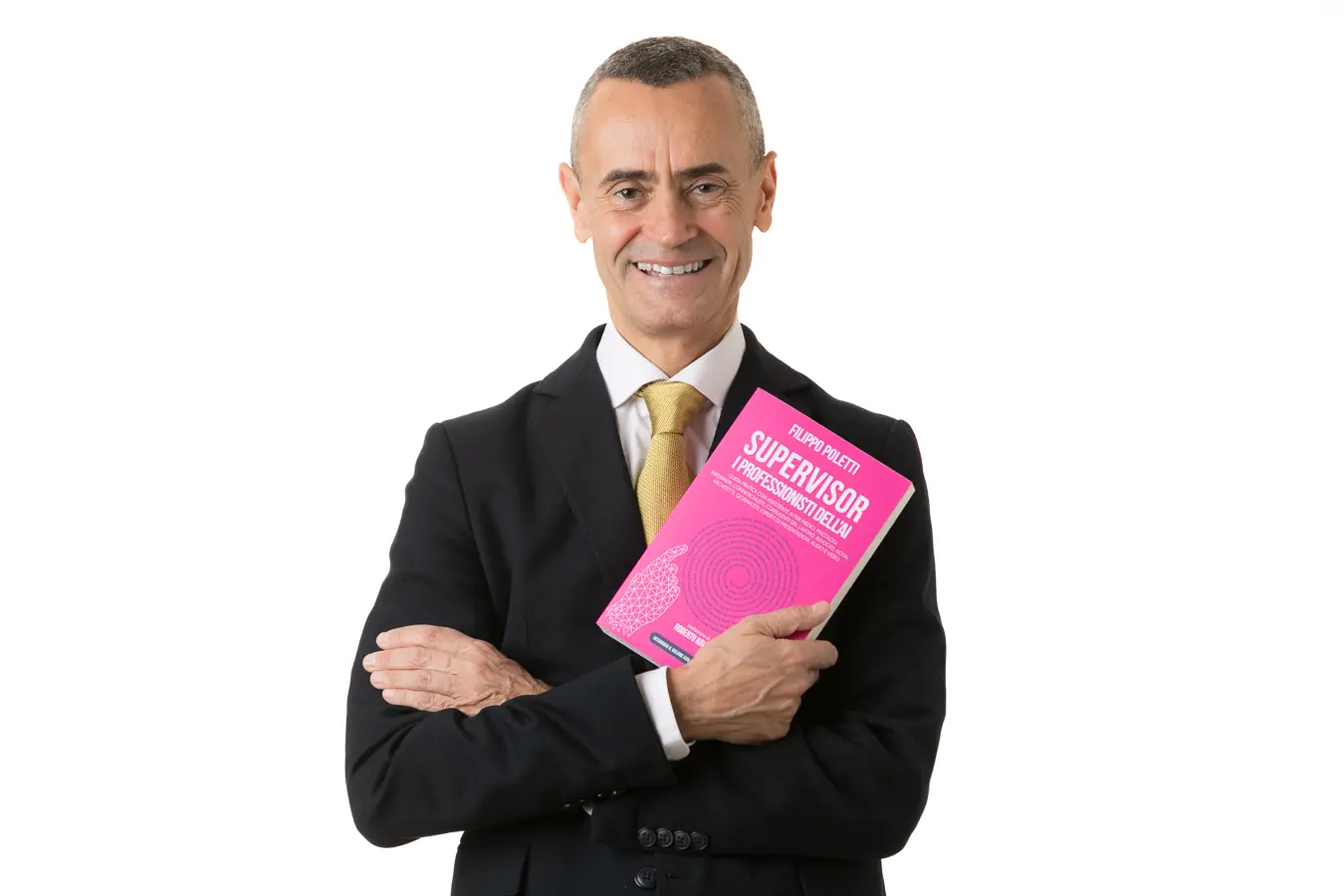
Per restare aggiornato entra nel nostro canale Whatsapp
2026 will be the year of artificial intelligence's "groundwork": investments made in the digital market during 2025 will see the practical adoption of AI in companies and professional firms, leading to their reorganization through process redesign. In short, artificial intelligence can already become a strength in the work of professionals in various ways, acting as a powerful ally that amplifies their human value. AI represents an opportunity for medium- and large-sized companies as well as professional firms, enabling them to increase operational efficiency, reduce fixed costs, and enhance the quality of services offered to clients. It's not about replacing professionals, but rather empowering them, freeing them from repetitive and low-value tasks to allow them to focus on what really matters: strategic thinking, critical judgment, and client relationships. This is the focus of the book Supervisor. AI Professionals (Guerini e Associati, 2025, pp. 376).
But what does a supervisor mean in the field of artificial intelligence? We asked Filippo Poletti directly:
The AI supervisor is a new professional role born from the need to guide the interaction between human and artificial intelligence. This role is not simply a "technical verifier," but a professional with ethical, legal, psychological, and organizational skills. Their role is to integrate AI into complex processes without distorting human responsibility and autonomy, translating technological potential into concrete value for clients. The supervisor operates in various areas, such as "technical supervision" (i.e., critically evaluating algorithmic outcomes), ethical orchestration (ensuring compliance with principles such as fairness and transparency), and "relational mediation" (preserving the human dimension of the professional relationship).

Can you give us some practical examples of how a doctor or other professional uses AI?
Artificial intelligence offers physicians a wide range of applications to improve the efficiency, safety, and quality of care, from administration and documentation to planning and personalization of care. Consider, for example, the automatic and contextualized transcription of visits, now possible with MioDottore's Noa Notes rather than DeepScribes and TD Listener: Noa Notes can convert conversations with patients into structured text in real time, allowing the physician to focus on listening. Or, in the field of programming, consider predictive models capable of integrating large amounts of clinical, behavioral, and environmental data to develop predictive models, identify risks, and personalize therapies with AWS HealthLake and Microsoft Azure for Health. Or, again, support for prognosis and therapy selection with so-called 'prognostic counseling' and patient selection for experimental or precision medicine treatments with NVIDIA Clara and Google DeepMind.
And in other areas?
"Considering another field, the legal field, a lawyer can use artificial intelligence to optimize and enhance many professional activities, transforming their role from material executor to supervisor and strategic decision maker. The main uses include streamlining legal research (with the analysis of regulations, case law, and legal doctrine in seconds), advanced document analysis (with the comparison and summary of rulings), drafting support (with the preparation of formally coherent drafts of contracts, court documents, legal letters, and opinions), and risk prediction and analysis. Today, a lawyer can use AI to estimate the probability of success of cases, based on similar precedents and the quantitative analysis of trial data."
Another peculiarity of the book is that it offers readers the possibility to interact with Virgilio AI…but what exactly are we talking about?
Virgilio AI is the AI assistant based on advanced information retrieval and various generative language models, the first made available in Italy to readers of a nonfiction book: it is not a cheat sheet, but a real 'sage' with whom you can communicate in writing or vocally. Virgilio AI, in fact, is a cognitive assistant that combines the live and dynamic memory of search systems with the reasoning and communication capabilities of ChatGPT, DeepSeek, Gemini, and Voyage AI. It can be accessed free of charge from your smartphone by scanning the QR code on the first page of the book Supervisor, the AI professionals: it answers questions asked about the contents of the book in 35 languages, from Italian to Chinese, Hindi, Spanish, Arabic, Russian, or French, selectable in the navigation menu. If two thousand years ago Virgilio spoke Latin, Virgilio AI today, thanks to artificial intelligence, is able to communicate in 35 languages about a book written in Italian. It is a new book-reading experience that breaks down the barriers language barriers”.
But should we then stop being afraid of AI?
I often say: what scares us is not so much AI, but the fact that we no longer have points of reference in our work. The three most widespread fears, which I encountered in speaking with hundreds of professionals in Italy during 2025, are the fear of incompetence (e.g., 'I don't understand anything about AI'), the fear of replacement (e.g., 'AI will replace me'), and the fear of loss of control (e.g., 'AI does everything, I can't trust it'). These fears are addressed by changing the interpretative framework: for example, from 'AI will steal my job' to 'AI will take away the most repetitive parts of my job.' And then, by making friends with AI, that is, by experimenting with it: my advice, repeated several times in the 376 pages of the book, is to put AI to the test. AI is not a fad, but rather an identity revolution in our work that requires us to acquire three new skills in 2026: The first is the prompt mindset, understood as the ability to question AI. Engaging with AI isn't like doing a Google search; it's much more. The second skill is agency, or the human ability to make things happen by actively intervening in intelligent systems and exercising causal power. Mastering agency doesn't simply mean knowing how to do something, but guiding AI. The third and final necessary skill is vibe working, or constant symbiosis with machines: it doesn't consist of automating our work with AI, but of freeing it from technical constraints and disciplinary barriers.
