

Oristano, elementary school children on Via Bellini become "teachers" for future teachers.
The "Memory of the Hand" project arrives at the Faculty of Primary Education in Cagliari.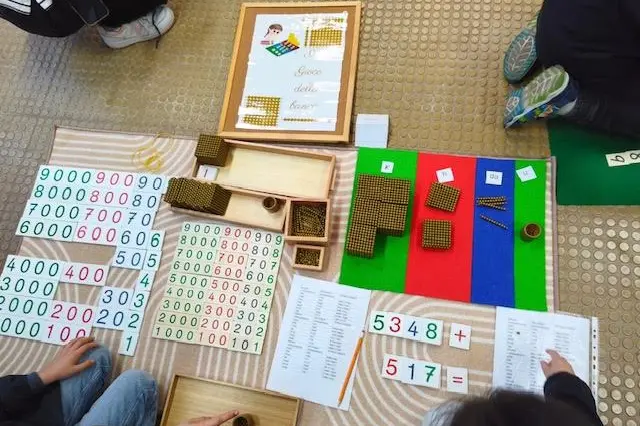
Per restare aggiornato entra nel nostro canale Whatsapp
The roles have been reversed: this time, it's the "grown-ups" who are learning from the little ones. A classroom at the University of Cagliari has been transformed into a theater of knowledge. Classes 2B and 2C at the primary school on Via Bellini, part of the Istituto Comprensivo 1-2 of Oristano, experienced something unusual and precious: the children, aged seven and eight, acted as guides, explaining, and demonstrating to the future teachers . Their attentive and curious interlocutors were the interns from the Faculty of Primary Education Sciences.
The initiative is part of the "Memory of the Hand" project, which school principal Tiziana Laconi has welcomed and supported since its inception a year ago.
The project takes its name from one of the founding principles of Maria Montessori's thought: the idea that the hand is not merely an executive instrument, but a cognitive organ, an extension of intelligence. And this is precisely what the children of Via Bellini demonstrated at the University, with the disarming ease of true experts.
Teachers Barbara Rosetti and Maria Paola Secci have led these two classes since the experiment began. They have built, day after day, a learning environment that follows Montessori principles: structured and self-correcting materials, freedom of choice and movement, and respect for individual time. The workshop was coordinated by university tutors Barbara Raspa and Raffaela Ledda, who accompany the interns on their journey to becoming professionals.
"Seeing Montessori materials not in the showcases of an educational museum, but in the living hands of children who use them confidently and know how to describe them, was a rare learning experience for the future teachers," explain teachers Barbara Rosetti and Maria Paola Secci. "Each tool was presented by one or more students with terminological precision and genuine emotional engagement. The experiment underway in the classrooms on Via Bellini compares to a public school context, where the method cannot be applied in its entirety—as is the case in private Montessori schools—but is adapted, grafted onto the ministerial curriculum. This makes the experience even more significant: it demonstrates that Montessori principles are not the exclusive preserve of privileged environments, but can nourish everyone's school."
At the end of the workshop, the trainees were able to try out the instruments themselves, accompanied by the children who kindly and expertly corrected their mistakes. The experimentation will continue throughout the rest of the school year.