

Cagliari, discussion on public transportation reform: "We need a turning point for citizens and the region."
From the debate comes the request for a new regional plan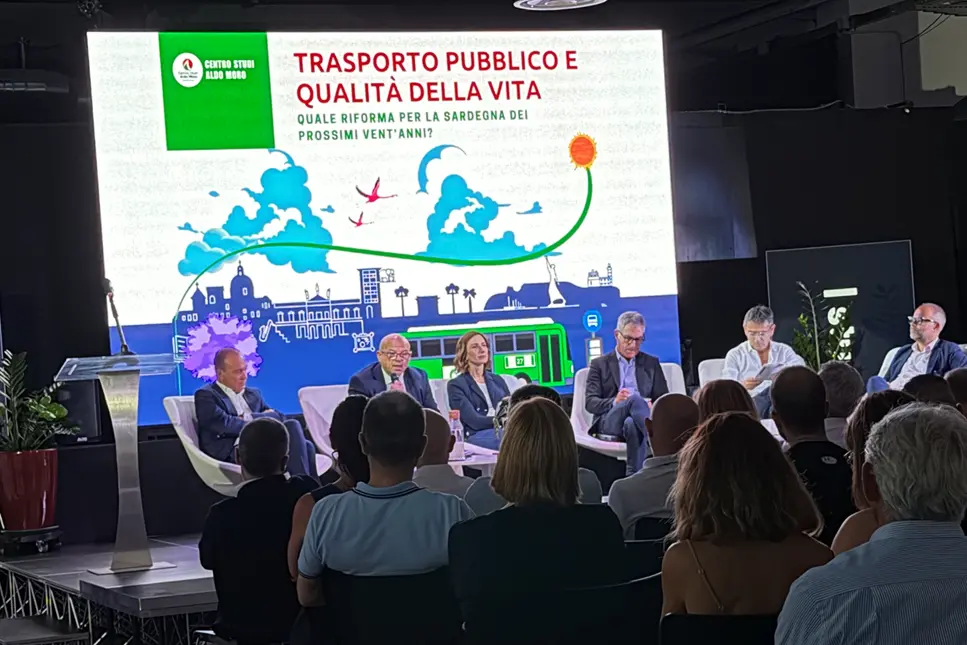
Per restare aggiornato entra nel nostro canale Whatsapp
Public transport, the debate promoted in Cagliari by the Aldo Moro Study Center, clearly stated: "It's time for a reform that puts citizens, regions, and development at the center." The initiative fostered discussion among institutions, administrators, and companies in the sector, building on the introductory speech by Honorable Gianluigi Piano, member of the Regional Council's Transport Commission, who placed local public transport at the center of a vision that views it not simply as a service, but as a strategic lever for improving quality of life, strengthening economic competitiveness, promoting territorial cohesion, and combating depopulation. This approach informed the discussions developed during the conference, which identified the new Regional Transport Plan, the Three-Year Services Plan, and a comprehensive reform law as the tools needed to guide Sardinia toward the renewal of service contracts, scheduled for December 31, 2026.
Regional Transport Councillor Barbara Manca emphasized that a reform of this magnitude, and even more so the expansion of public transport services, requires adequate financial support. She therefore called for a progressive increase in resources allocated to local public transport from the current €170 million, recognizing that more widespread and efficient services require structural investments.
ARST's CEO, Giovanni Mocci, and CTM President, Fabrizio Rodin, then offered an updated overview of their respective companies' critical issues and prospects. In particular, Rodin highlighted how user demand is increasingly oriented toward increased service frequency, a more widespread network, and an expansion of services beyond the areas historically served by CTM.
Cagliari's mayor, Massimo Zedda, expanded the discussion to include mobility across the entire metropolitan city, emphasizing the need to integrate public transport with urban planning and other mobility infrastructure.
The final political perspective was outlined by the regional secretary of the Democratic Party, Silvio Lai, who focused the discussion on the strategic importance of public transport for the future of Sardinia. He proposed continuing the in-depth study through a new discussion based on an analysis of the island's real mobility needs and the demographic, social, and economic factors that determine them. This will support the definition of the reform with an updated framework consistent with the profound changes underway.
Lai then outlined the reform vision on which to build the future of public transportation in Sardinia: public transport can no longer be considered an expense to be contained, but a genuine value multiplier, on a par with healthcare and education, because it represents one of the conditions that allow people to live, work, and choose to stay in the region. After more than twenty years without a genuine reform of the service contracts of ARST and the public transport companies of Cagliari, Sassari, Nuoro, and Olbia, we must courageously embark on a new era of reform, overcoming the Region's weakness and the remaining resistance, enhancing a pluralistic public transport system, and building an integrated public transport system, founded on participatory governance and focused on citizens and new mobility needs.
The Aldo Moro Study Center will continue this process of discussion in the coming months, promoting further opportunities for in-depth discussion to contribute to the definition of a reform capable of meeting Sardinia's needs and supporting the development of the island's mobility system.