

Cagliari, a panoramic walk and the new staircase: a revolution in Sant'Elia
The old village is changing. The urban redevelopment project will connect the Lazzaretto, the amphitheater square, and the church. Sea-facing lookouts are emerging amidst the greenery.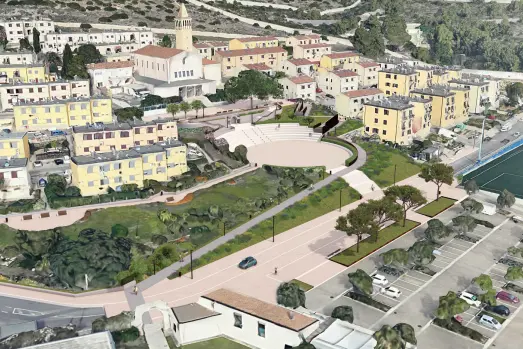
Per restare aggiornato entra nel nostro canale Whatsapp
A scenic promenade immersed in greenery, new sea views, and squares reimagined as meeting places, culture, and social gatherings. Sant'Elia is preparing for a major urban regeneration project that aims to enhance the village's landscape and architectural heritage, improving the usability of public spaces and reconnecting some of its most iconic sites: the Lazzaretto , Piazza Anfiteatro Franco Oliverio , and the parish of Sant'Elia .
The project, called "Sant'Elia Regeneration, Reconnection of Infrastructure Components and Landscape-Environmental Redevelopment," is part of the PN Metro Plus and Città Medie Sud 2021-2027 program, within the framework of urban regeneration policies. The design was entrusted to the professional firm d'A. d'A. project associati, led by architects Gabriele Manca and Donatella De Rinaldis .
The centerpiece of the project will be the creation of a new promenade , a pedestrian path starting from the Lazzaretto and crossing the green areas until reaching Piazza Franco Oliverio and the Church of Sant'Elia . This connection is designed to accompany visitors through the landscape, offering new rest stops and panoramic views. The path will be constructed primarily of granite, and along the route there will be rest areas and panoramic viewpoints, known as miradors, allowing visitors to stop and enjoy the sea view.
Another significant project will involve the space in front of the parish church of Sant'Elia . The section of Via Gavino Gabriel in front of the church will be integrated into the new churchyard. The redevelopment will be completed with new flowerbeds, the restoration of existing vegetation, and the installation of LED street lighting. The removal of a portion of the parapet will also open the square to the urban park, improving the visual and physical continuity between the religious space and the surrounding greenery.
The project also includes a new stairway connecting to Piazza Franco Oliverio and the removal of the green space between the existing stairways overlooking Via Sant'Elia and Piazzale del Lazzaretto. The project aims to restore the overall perception of the site and enhance the church's presence in the urban landscape.
The redevelopment will also include Via Borgo Sant'Elia , which will be transformed into a space with the characteristics of a square, while maintaining vehicle circulation in the central section. The roadway will have a total width of seven meters, divided into two 3.50-meter lanes, one for each direction. The pedestrian areas will be enhanced with architectural paving coordinated with that already present in Piazzale del Lazzaretto.
The Franco Oliverio Amphitheater Square will also undergo a redevelopment project aimed at strengthening its role as a public space for events, performances, and cultural initiatives. The project includes resurfacing the architectural concrete flooring and resurfacing the steps with Orosei marble. The steps will be integrated with warm, amber-colored LED light strips, designed to enhance their design and create a dramatic effect in the evening. The intention is to strengthen the functional and cultural relationship between the square and the Lazzaretto, encouraging a more varied program of musical, theatrical, and cinematic events, both outdoors and indoors. The square will thus contribute to the neighborhood's cultural life year-round.
The plan also includes the restoration of the internal path within the urban park connecting Piazza Franco Oliverio to Via Borgo Sant'Elia , the redevelopment of the sidewalks on Via Borgo Sant'Elia, and the improvement of pedestrian connections to Via Fasano and the sports areas. The redevelopment of the village is part of a broader strategy by the Municipality of Cagliari, which aims to strengthen the connection between Sant'Elia and the rest of the city by enhancing its environmental, cultural, and natural heritage. The goal, according to the plans, is to transform currently fragmented spaces into a continuous and recognizable system, in which squares, gardens, and paths can become meeting places, opportunities for cultural enjoyment, and privileged access points to the coastal landscape. The challenge will be to restore Sant'Elia to a new urban center, enhancing its historical and landscape characteristics and strengthening the connection between the village, the sea, and the city of Cagliari .