Sparks fly between Vannacci and Monti: "Throw away the Green Deal, no to forms of subordination." The former prime minister: "Fascist rhetoric."
The leader of Futuro Nazionale took a dig at the former Prime Minister sitting next to him.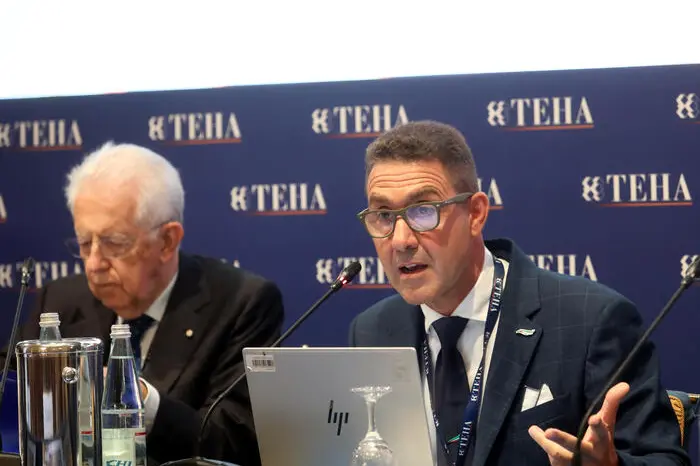
Per restare aggiornato entra nel nostro canale Whatsapp
From a Europe "at risk of irrelevance" to a European budget that risks "a new capital tax," including a defense of the principle of unanimity for Brussels' decisions ("it's a guarantee"), a "no" to a single European army, the hope that certain matters can be returned to individual member states ("competences are not irreversible"), and a call to "throw away the Green Deal."
Speaking from the stage at the Cernobbio Forum, Roberto Vannacci, leader of Futuro Nazionale, took several jabs, both at former Prime Minister Mario Monti, sitting next to him, and at European Council President Antonio Costa, who opened the second day at Villa d'Este this morning. The first issue, he said, was the low birth rate: "Rather than a ReArm Europe, perhaps a ReBorn Europe would have been better, because with these birth rates, a future isn't guaranteed." The general began from afar, from the Maastricht Treaties, and provocatively asked the Cernobbio audience: "If we were to take a blank sheet of paper today, would we rewrite them the same way?" From there, he questioned "the inertia that always exists in changing the European architecture." The Eurozone "once produced 30% of global GDP, today about half. There is industrial desertification and layoffs in the automotive industry." If, after 30 years of integration, the Old Continent "has lost competitiveness, we cannot prescribe the same medicine without explaining why it hasn't worked until now."
Vannacci repeatedly emphasizes Europe's fragmentation in energy, taxation, markets, and financial services, while criticizing the single currency and environmental transition . He calls increasing gas imports from Russia while supporting Ukraine a "contradiction." From here, he launches his vision of Europe, where if it isn't there, everything is in ruins, and calls for "a return to the sovereignty" of individual states. He also criticizes the debate on the next European budget, which must not translate "into more money for Europe, otherwise it will be a new tax that we, the citizens, will pay." In his vision of the European Union, he repeatedly insists, "we will not accept forms of subordination," and defends unanimity as a principle: "It's a guarantee. If a proposal doesn't convince everyone, don't change the voting method, but improve the proposal." And here he invokes the concept of "subsidiarity, doing well together what we can do," but "we'll do the rest at home," because "the powers assigned to Brussels so far must not become irreversible." His summary thus appears succinct: "Europe risks becoming irrelevant." The idea of a European army has also been rejected from his perspective: "It hasn't taken off, and badly." His proposal, then, is for an EU that "eliminates useless institutions, bureaucracy, and throws the Green Deal overboard because it needs technological diversification." And, he concludes, "stops becoming fluid." In short, "let's keep what works and give back to the nations what they require in terms of identity, responsibility, and democratic control, because integration without consensus becomes imposition."
To his right, former Prime Minister Mario Monti replies: "I'm old now, but I will fight your attempt to reconstruct the rhetoric of fascism to the last of my strength." "I don't see in you the reconstitution of the Fascist Party," says Monti, "but one aspect of fascism, the most insidious, is already in place. I see in you," he continues, "the reconstruction of the narrative, the rhetoric of the spirit of fascism; more or less, you declare the superiority of Italy, of Italians, and, we mean, of the Italian race." "I have never considered the Italian population a priori inferior," explains Monti, "but not necessarily superior to other populations. Here the Calimero complex kicks in, it insinuates that we are proud of our Italianness—and so am I—and that we are not respected enough, so we demand more respect; we will show them and make them pay." "I'm terrified," he concludes, "of a psychological reconstruction of a 'little Italy' and of the fact that since we're unable to provide more growth for our citizens with the current governments because we care about their votes, not their well-being, then the population will have to be satisfied by giving credence to its identity."
(Unioneonline)