

Charity, a crisis of confidence: 49% of Italians no longer believe in it after the Pandoro-gate scandal.
It was not just a media scandal, but an economic and cultural watershed.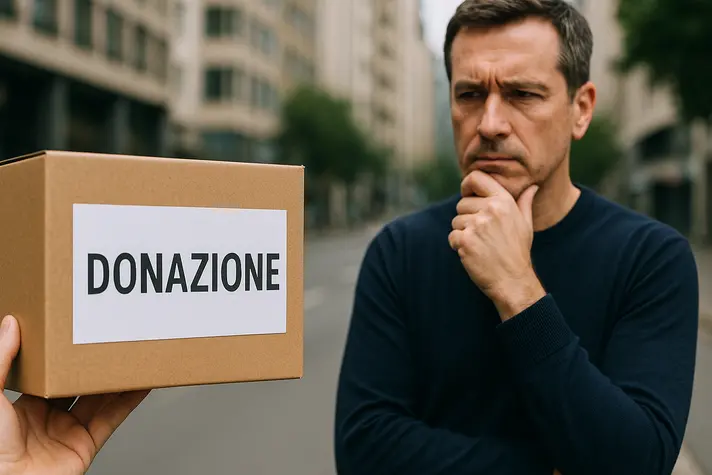
Per restare aggiornato entra nel nostro canale Whatsapp
In the years of designer "solidarity" eggs and pink pandoro cakes with a charitable purpose, something has broken . The word "donation," once synonymous with altruism, today requires careful consideration for many Italians.
The numbers confirm it: nearly one in two Italians (49%) say they don't trust charities, NGOs, and foundations. This is the lowest level since 2019, despite—or perhaps because—nonprofits continue to manage a significant economic mass.
A new investigation by Truffa.net, a portal specializing in fraud information and prevention, reconstructs what happened after the Pandoro scandal and other cases of charity being used as a marketing tool . By cross-referencing international data on trust, updated numbers on NGOs, donors, and volunteers, and the main proceedings of the Italian Competition Authority (AGCM) and Italian courts, a uniquely national paradox emerges: a rich, structured, and global sector that, however, operates on an increasingly fragile foundation of trust.
Between 2022 and 2023, Italians' trust in NGOs and foundations dropped from 54% to 49% , paralleling the Pandoro-gate scandal and other cases of misleading charity advertising. A historic low.
In 2024, a tentative recovery is visible, quickly offset by the launch of the Ferragni trial and the resurfacing of similar issues. The result is an Italy that is bucking the trend of the rest of the world: globally, trust in NGOs is nearly 60%. A ten-percentage-point gap that speaks to a cultural problem rather than an economic one.
Distrust has a direct impact on behavior. Only 13% of bank account holders report having donated to charitable causes in the past twelve months. This is a clear minority, with a clearly defined profile: more often men (52%), between the ages of 45 and 64, with medium-high education and above-average incomes. Donors are primarily qualified professionals, self-employed workers, and well-off retirees, while young people with precarious contracts and low wages remain marginalized.
Geography also matters: donors are concentrated in urban areas.
Yet, within an average adult audience, Generation Z stands out, representing 21% of those who donate. They're well-informed, highly active online, sensitive to environmental and political issues, and often among the first to remember and discuss scandals like Pandoro-gate.
But Italian nonprofits are far from marginal. NGOs engaged in international cooperation and humanitarian aid manage annual budgets of over €1.4 billion, rely on more than two million private donors, approximately 29,000 staff, and over 52,000 volunteers.
Added to these numbers are the banking foundations , which in 2024 alone allocated more than €1.2 billion to culture, research, local welfare, and the environment. This vast, professionalized, and international universe, however, must contend with an increasingly scarce intangible capital: trust.
The investigation retraces the key events that fueled mistrust: from the Balocco-Ferragni case, with the "Pink Christmas" pandoro presented as linked to the purchase of a hospital machine already funded, to the Ferragni and Dolci Preziosi-branded Easter eggs linked to the social enterprise "I Bambini delle Fate." All the way to the Antitrust Authority's fine on GoFundMe for a lack of transparency regarding commissions, and the Turin Court's April 23, 2024, decree regarding a campaign in which the donation had already been made but was communicated as proportional to sales. Different episodes, but united by the same dynamic: charitable language that does not correspond to real economic mechanisms.
"The picture that emerges is of an Italy where trust in charities is low, but attention is extremely high," explains Eli Carosi, expert at Truffa.net and author of the survey. "Fewer people donate than in other advanced countries, but those who do are more aware, informed, and demanding. These citizens read AGCM press releases, are familiar with expressions like 'unfair commercial practice,' search for the term 'Pandoro-gate' on Treccani, and comment on companies' and influencers' charity campaigns on social media."
(Unioneonline/Fr. Me.)