

But what do you eat?
Curiosities, oddities, and rituals surrounding food in forty stories told by Luigi Ferrando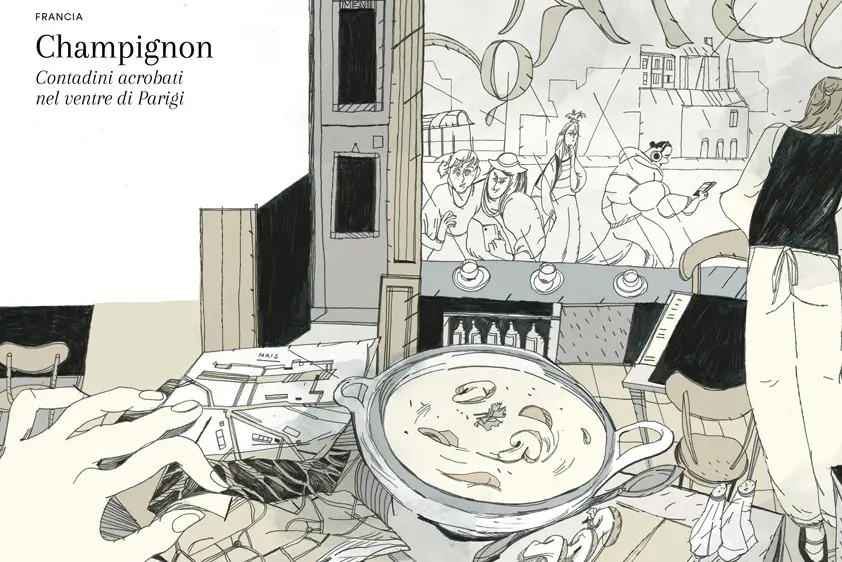
Per restare aggiornato entra nel nostro canale Whatsapp
What distinguishes women and men from the other animals that populate the Earth? Three manifestations of human intelligence: art, religion, and cuisine! Truly, "we are what we eat," as the German philosopher Ludwig Feuerbach said, because what is more natural, more cultural, more social, and more human than preparing our own food? This is confirmed by a journey through illustrated images and words among the world's foods that cannot fail to fascinate and amaze: Cibaria (Slow Food Editore, 2025, pp. 256). Forty stories, told in a highly personal style by Luigi Ferrando and beautifully illustrated by Gabriele Pino, guide us to the places—sometimes remote, sometimes not—where incredible foods are produced or harvested.

Some of these foods are good, others repulsive. Some will disappear, others will soon end up on our tables. Some you may have already tasted, others you'll be hearing about for the first time. They range from Japanese fugu—prepared while the fish is still alive, taking care not to retain too much of the animal's poison in the bites—to the ritual of covering one's head when eating ortolan bunting. And then there's Nepalese honey with psychotropic properties and Alaskan akutaq, Eskimo ice cream made from an emulsification of whale blubber, Nordic blueberries, and ice, all the way to products much closer to home like balsamic vinegar and our casu marzu, a typical example of a traditional food condemned without appeal by food and hygiene (or perhaps hysterically hygienic) regulations. Cibaria dedicates beautiful pages to casu marzu, pages that can lead us to some not-so-trivial reflections. Cheese with flies cannot be sold, despite its millennia-old tradition, despite its proven lack of toxicity. At the same time, there is no problem consuming preservatives, colorings, thickeners, sweeteners, and all the "anti-" additives made available or created as needed by the food industry. What is unpleasant about casu marzù is that it can appear repugnant, disgusting, or perhaps simply anarchic, free-spirited, a symbol of a cheesemaking process that cannot be categorized at an industrial level. Therefore, cheese with flies is absolutely banned, only to later announce that insects will be the food of the future, that they will save the world, especially if genetically modified and sterilized by a large multinational.
In short, the story of the casu marzu demonstrates how a book like Cibaria helps us understand that food has not only a cultural but also a political value . It expresses ourselves, our choices, our independence. Our freedom to eat, for example, the casu marzo, or not, without legislative blessings or curses from above.