

Trump and Xi at the White House: "We are great friends," "Don't support Taiwan's cause."
Chinese leader's state visit: "The two powers must coexist and cooperate, tremendous progress has been made."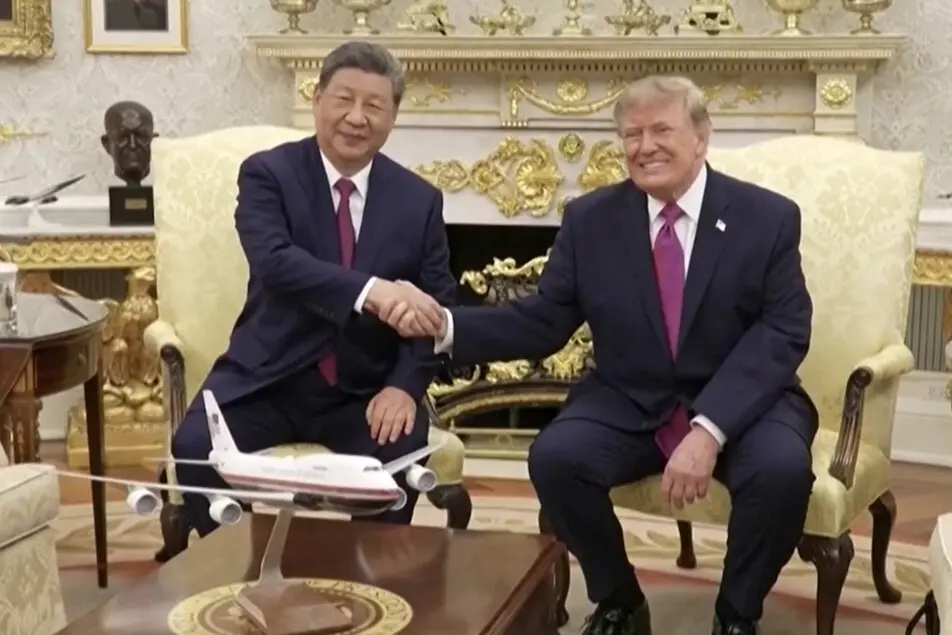
(Handle)
Per restare aggiornato entra nel nostro canale Whatsapp
A red carpet, military personnel in full dress uniform from various US forces, and a flyover by B-2s and F-22 Raptors honored the state visit of Xi Jinping and his wife, Peng Liyuan. Donald Trump and First Lady Melania welcomed the Chinese presidential couple to a spruced-up White House with a high-profile welcoming ceremony, concealing the profound differences weighing on bilateral relations.
The two world leaders delivered speeches in the Grand Foyer, highlighting the "personal and friendly relationship" they have developed over the years. Trump praised the "enormous progress" made with Xi and outlined the day's topics of national security and technology with decisions that "can foster peace and prosperity for decades to come."
Xi, in turn, said he was ready to cooperate because the two nations "would benefit from cooperation and lose from conflict." The two countries must "coexist and cooperate" as major global powers, avoiding the "Thucydides Trap," the theory that describes the risk of war when a new, emerging power challenges an already dominant one. To this end, there should be more joint initiatives in trade and the regulation of artificial intelligence, while maintaining ongoing military dialogue.
Behind the ceremonial pomp, which has created bipartisan discontent in Congress, and the leaders' ostentatious friendship, lies a contradictory relationship. Trump is pushing to end the war in Iran, but China buys oil from Tehran and exports components used for drones and missiles that target American troops . Xi's direction on the conflict is to return "to the terms of the June memorandum" and to negotiations.
The US and China are engaged in a race for supremacy in artificial intelligence and have long disagreed on trade issues . Trump anticipated in Truth that China does not want limitations on AI, while Xi in his speech emphasized the importance of AI remaining "under human control."
Meanwhile, tensions in the Indo-Pacific are rising with the rapid military buildup of the Dragon, worrying the Pentagon and close US allies in the region. Meanwhile, US fears are growing over China's nuclear expansion, with estimates showing Beijing on track to deploy over 1,000 nuclear warheads by 2030.
The most direct Mandarin message was on Taiwan , the red line par excellence. China, CCTV reported, citing Xi's words in the bilateral meeting, hopes the US will maintain the correct posture of "opposing Taiwan independence" and handle the Taipei issue "with caution." For Xi, the issue of reunification with the democratic island must not be postponed to future generations. The US, he reiterated, "must lay a solid foundation for Sino-US strategic cooperation and the development of bilateral relations."
Xi, in other words, outlined the Mandarin position for "coexistence" between superpowers, while one of the goals of the two leaders is to build a more predictable relationship and, potentially, combined with the conclusion of some agreements.
(Unioneonline)