

Maduro appears in court with his feet shackled: "I am the Venezuelan president and I am innocent; I am a prisoner of war."
Officials charged former Venezuelan leader and his wife. He is being defended by Assange's lawyer.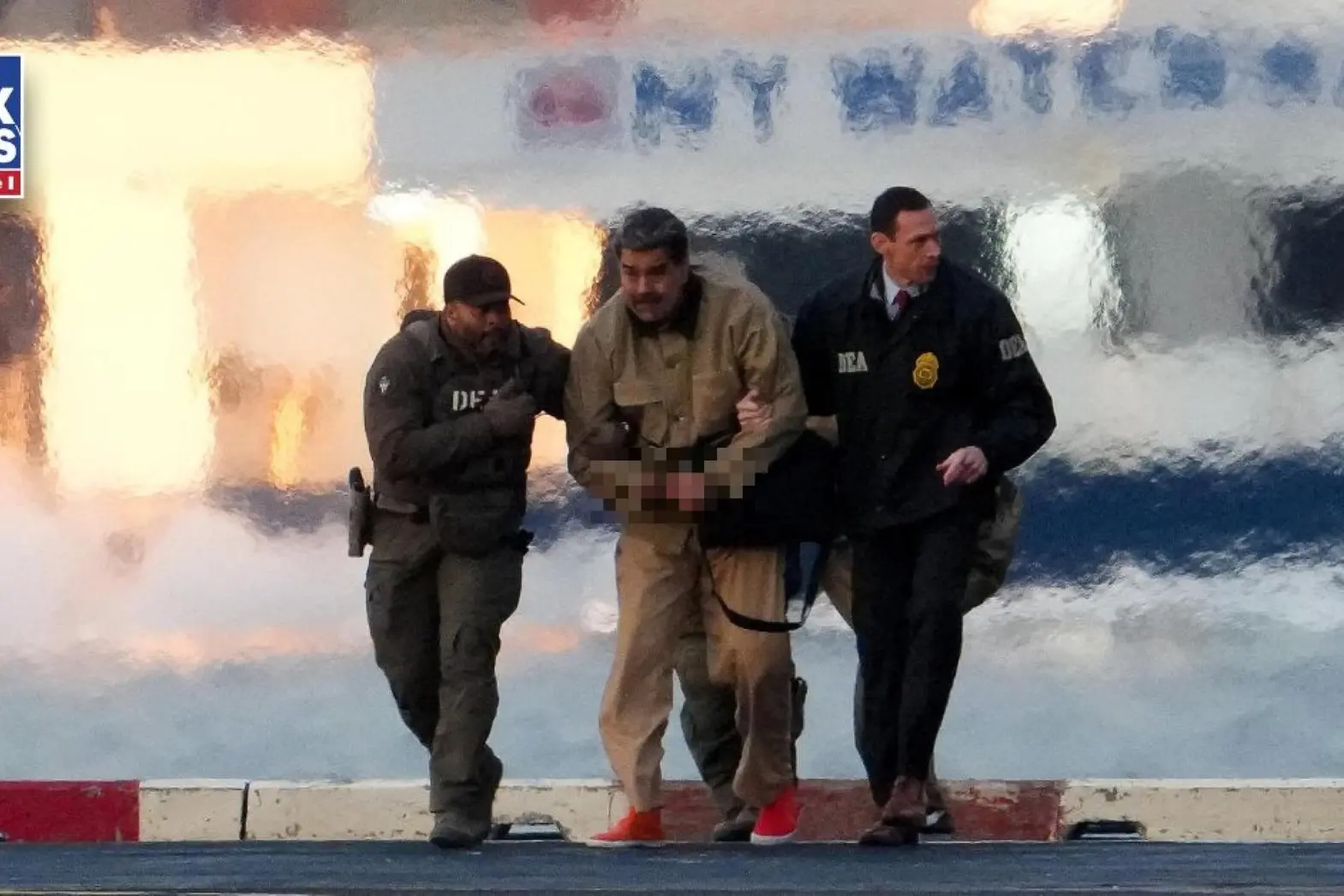
Maduro escorted by DEA agents upon his arrival at the courthouse (ANSA)
Per restare aggiornato entra nel nostro canale Whatsapp
"I am Nicolas Maduro, I am the president of Venezuela and I am innocent. I was kidnapped in my home in Caracas."
This was the statement made by the former Venezuelan leader in court in New York, where his drug trafficking trial began today, January 5th. Maduro was in the courtroom with his feet shackled and wearing a blue short-sleeved shirt over an orange prison jumpsuit.
The former president arrived in court escorted by DEA agents, who took him from the Metropolitan Detention Center in Brooklyn. His wife, Cilia Adela Flores, was also in court with him.
The judge, 92-year-old Alvin Hellerstein, an ultra-Orthodox Jew , briefly read the charges (international drug trafficking, terrorism, use of weapons of war) and assured that his job "is to ensure a fair trial."
Then it was Maduro's turn, identifying himself in Spanish, adding that he was the "president of Venezuela" and proclaiming his innocence. "I was kidnapped. I was captured in my home in Caracas. I am innocent, I am not guilty." Maduro did not see his indictment before appearing in court. "I have it in my hand now for the first time." When the judge asked him if he wanted it read, Maduro replied through an interpreter: "I prefer to read it myself." Leaving the courtroom, he reiterated, again in Spanish: "I am a prisoner of war."
His wife Cilia Flores also proclaimed her innocence and, confirming her identity, called herself the "First Lady of Venezuela" .
The hearing lasted about forty minutes and served to formalize the indictment of the deposed Venezuelan president. The next hearing will be held on March 17.
Maduro is represented by Barry Pollack, the lawyer who represents Julian Assange . The lawyer who negotiated a deal with the US government last June that led to Assange's release has stated that he will not seek bail for the former Venezuelan leader at this time, but may do so in the future. Cilia Flores is represented by Mark Donnelly, a former prosecutor for the Department of Justice.
LIVE OF THE DAY
State of emergency comes into effect in Venezuela, hunt for traitors
The Venezuelan government of interim President Delcy Rodríguez today issued a decree establishing a state of emergency throughout the country amid what it describes as an "external aggression" by the United States. Article 5 of the decree orders all security forces to "immediately search for and capture any person implicated in supporting or promoting the armed attack by the United States against the country." In this context, the National Union of Venezuelan Press Workers (SNTP) denounced the detention today of at least seven journalists near the National Assembly building, where the inauguration ceremony for the new Parliament and the swearing-in of the interim president were taking place. According to the SNTP, three journalists have already been released, while the immediate release of the other four is being requested. Various social media posts also report numerous checkpoints and car searches on highways around Caracas by police and pro-government civilian militias.
France at the UN: "The US is undermining the foundations of the United Nations."
"The military operation that led to the capture of Nicolás Maduro is contrary to the principle of peaceful resolution of disputes and the principle of the non-use of force. The proliferation of violations of the UN Charter and international law by states vested with responsibility as permanent members of the Security Council undermines the very foundations of the international order." Paris's Deputy Ambassador to the UN, Jay Dharmadhikari, stated this in the Security Council, warning that violating the Charter "undermines the foundations of the United Nations and weakens international peace and security."
Maduro with his feet in chains: "I'm a prisoner of war."
"I am a prisoner of war." Nicolas Maduro said this in Spanish as he left the courtroom, where his feet were shackled and he was wearing a blue short-sleeved shirt over an orange prison jumpsuit. American media reported.
After the hearing, Maduro leaves the courtroom
Nicolas Maduro leaves the courtroom at the end of his first appearance before the U.S. justice system. The hearing concluded with the judge scheduling the next hearing for March 17.
Maduro's lawyer: "He has health problems, his wife too."
Nicolás Maduro has "health problems," his lawyer Barry Pollack said, adding that Maduro's wife also has medical problems and may suffer a fracture following the U.S. military operation.
Maduro's next hearing is on March 17.
The next hearing for Nicolas Maduro is scheduled for March 17, Judge Alvin Hellerstein announced. American media reported.
Maduro's lawyer: "We're not asking for bail, perhaps in the future."
Barry Pollack, Nicolas Maduro's lawyer, said he will not ask for bail for his client at this time, but may do so in the future.
Maduro's wife: "I am Venezuela's First Lady, I am innocent."
Cilia Flores, Maduro's wife, confirmed her identity in court and stated, "I am the First Lady of Venezuela," according to US media reports. "I am completely innocent," she added.
"I'm a good person"
"I am a good person," Nicolas Maduro said in court, according to American media reports.
Maduro: "I'm innocent, I'm the president."
Nicolas Maduro identifies himself to Judge Alvin Hellerstein in Spanish: he confirms that he is Maduro and the president of Venezuela. He then adds that he is in the courtroom "kidnapped. I was captured in my home in Caracas." This is reported by American media. "I am innocent, I am not guilty," he added, pleading not guilty to the charges against him. "I am the president of Venezuela, I was captured in my home in Caracas," Maduro said, noting that he had not seen his indictment before appearing in court. "I have it in my hand now for the first time," he added. When the judge asked him if he wanted a reading, Maduro replied through an interpreter: "I prefer to read it myself." His arms rest on the armrests, occasionally clasping them in a prayerful gesture, and he lowers his head. He fidgets, looks around, and then bows his head again.
Maduro's judge: "My job is to ensure a fair trial."
"My job is to ensure a fair trial," Judge Alvin Hellerstein said as he opened the hearing marking Nicolas Maduro's first court appearance. Hellerstein then went on to outline a brief version of the charges against Maduro.
Maduro in the classroom
Nicolas Maduro entered the courtroom for his first appearance before the American justice system at the New York courthouse. He is wearing headphones, presumably for translation. The former Venezuelan leader does not speak English, CNN reports. In the courtroom, Maduro is next to his lawyer Barry Pollack. His wife, Cicli Flores, is seated nearby.
Maduro defended by Assange's lawyer
Nicolas Maduro will be represented in court by Barry Pollack, Julian Assange's lawyer. CNN reports this, citing released court documents. His wife, Cicli Flores, will be represented by Mark Donnelly, a former prosecutor with the Department of Justice. The New York Times initially reported that Maduro would be represented by David Wikstrom, a public defender of criminal justice. Wikstrom represented the brother of Juan Orlando Hernandez, the former Honduran president convicted of similar crimes to Maduro and later pardoned by Donald Trump. Pollack negotiated a deal with the US government last June that led to Assange's release, ending a nearly 15-year dispute. Pollack has been at Assange's side since 2021, when the WikiLeaks founder took refuge in the Ecuadorian embassy in London.
US to the UN: "Drug Trafficker Arrested, We're Not Occupying Venezuela"
"We are not occupying Venezuela; this was a police operation. Pursuant to decades-old legitimate charges, the United States has arrested a drug trafficker who will now stand trial in the United States, under the rule of law, for crimes committed against our people over the past 15 years," US Ambassador to the UN Mike Waltz said at the Security Council. "Maduro has been indicted by a grand jury and faces very serious criminal charges," he added. "The overwhelming evidence of his crimes will be presented openly."
Russia to the UN: "The US is committing cynical crimes. Free the Maduros."
"There is, and cannot be, any justification for the crimes cynically perpetrated by the United States in Caracas. We firmly condemn the United States' act of armed aggression against Venezuela, in violation of all norms of international law," Russian Ambassador to the UN, Vassily Nebenzia, told the Security Council. "We call on the US leadership to immediately release the legitimately elected president of an independent state, Nicolas Maduro, and his wife," he added. "Any conflict between the United States and Venezuela must be resolved through dialogue."
Maduro's wife represented in court by a Texas lawyer
Cilia Flores, Nicolas Maduro's wife, will be represented in court by Mark Donnelly, a Texas lawyer who assisted in the impeachment of Texas Attorney General Ken Paxton. NBC reports.
UN: "International law not respected"
UN Secretary-General Antonio Guterres is "deeply concerned that the norms of international law were not respected in the military action of January 3" in Venezuela, and recalls that "the UN Charter prohibits the threat or use of force against the territorial integrity or political independence of any State." "The rule of law must prevail," he said at the Security Council meeting, in a speech delivered on his behalf by Head of Political Affairs Rosemary DiCarlo. DiCarlo then emphasized her "deep concern about the potential intensification of instability in the country, the impact on the region, and the precedent it could set for relations between States."
Protesters outside the New York courthouse chanted, "Hands off Venezuela!"
Around a hundred protesters gathered outside the New York courthouse to protest the situation in Venezuela. Many waved Venezuelan flags and held signs reading "Free Nicolas Maduro and Cilia Flores now" and "USA, hands off Venezuela." Some, however, thanked Donald Trump for removing the former leader.
Rodriguez in office for 90 days with the possibility of extension
The Constitutional Chamber of the Venezuelan Supreme Court granted Delcy Rodríguez an initial 90-day term, in accordance with Article 234 of the Constitution. This term may be extended by another three months if approved by the National Assembly. Had a full vacancy been declared, the constitutional text would have required presidential elections to be held within 30 days. However, the Supreme Court avoided making a substantive ruling on the definitive nature of Maduro's absence, leaving that assessment open to a later stage.
Maduro's lawyer
Nicolas Maduro will be represented in court by David Wikstrom, a public defender appointed by the court. Wikstrom represented the brother of Juan Orlando Hernandez, the former Honduran president convicted of similar crimes to those Maduro was accused of and later pardoned by Donald Trump, the New York Times reports. Wikstrom is also the father of Derek Wikstrom, one of the prosecutors in the case against the former New York mayor.
Colombian President: "Ready to take up arms."
Colombian President Gustavo Petro says he's ready to take up arms against US threats. "Even though I haven't been a soldier, I know war and clandestinity. I swore never to take up arms again since the 1989 Peace Pact, but for the homeland I will once again take up the weapons I don't want. I'm not illegitimate, nor am I a drug trafficker," Petro wrote on X in response to the US administration's latest claims that he is a potential target following the capture of Venezuelan President Nicolas Maduro. "The only asset I own is my family home, which I'm still paying for with my salary. My bank statements have been published. No one has been able to say that I've spent more than I earn. I'm not greedy. I have enormous faith in my people, and that's why I've asked them to defend the president from any violent and illegitimate act against him. The way to defend myself is to seize power in every municipality in the country." The order to the public forces is not to shoot at the people and to shoot instead at the invader."
Trump wanted the deal, he changed his mind
Until just six months ago, Donald Trump wanted to reach an agreement with Nicolas Maduro. During an Oval Office meeting last July, the president told his aides that he wanted an agreement that would allow American companies to pump Venezuelan oil, suggesting he favored diplomacy. Secretary of State Marco Rubio, however, reported the Wall Street Journal, was opposed and warned Trump against trusting the former Venezuelan leader. After months of trying to persuade Maduro to resign in exchange for amnesty for his crimes, Trump opted for military action in late December. Trump's obsession with Venezuelan crude has sparked an underground struggle among his advisors and the oil lobby to define the White House's policy toward Venezuela. Trump, the Wall Street Journal highlights, has made clear to his advisers that he is interested in a deal with Caracas that would serve his America First agenda, including cooperation on migrant deportations, rather than promoting a democratic transition.
UN Security Council meeting at 4pm
The UN Security Council meets this morning at 10:00 a.m. local time (4:00 p.m. Italian time) on Venezuela. The legality of the US capture of former President Nicolas Maduro will be at the center of the debate, but Washington is unlikely to face strong criticism from its allies for its military operation. Russia, China, and other Venezuelan allies have accused the United States of violating international law, but Washington's neighbors, many of which opposed Maduro, have been less vocal regarding any concerns about the use of military force. Many legal experts say the action ordered by Donald Trump was illegal, but as a permanent member of the Security Council with veto power, the United States will be able to block any attempt by the Fifteen to hold it accountable. And so far, no draft resolution on the issue appears to be under discussion.