

The Sardinia Radio Telescope surpasses its limits
Important step forward in research thanks to the new super-resolution technique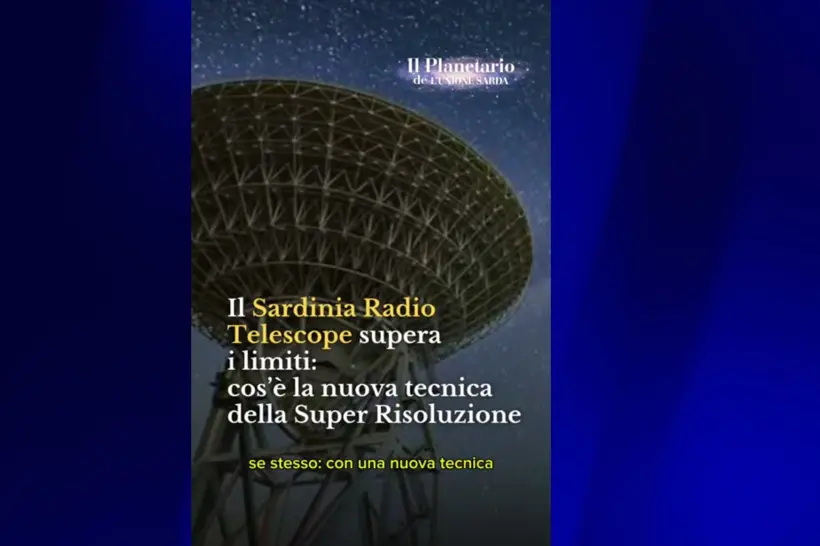
Per restare aggiornato entra nel nostro canale Whatsapp
The Sardinia Radio Telescope has made a major leap forward in astronomical research thanks to a new technique called super-resolution , developed by scientists at the National Institute for Astrophysics. This innovation allows the large Sardinian radio telescope to observe the universe in greater detail than previously possible due to traditional physical limitations.
In astronomy, a telescope's resolving power indicates its ability to distinguish very small details in observed celestial objects: the higher the resolution, the sharper the image obtained. This value typically depends on the instrument's size and the wavelength used, factors that set a physical limit that is difficult to exceed.
The new technique allows us to go beyond this limit by exploiting a unique feature of the Sardinia Radio Telescope: its moldable surface, i.e., a system of movable panels that can be adjusted with extreme precision . Through this advanced configuration, the telescope is able to better correct the received signal and obtain more detailed radio images.
The result is particularly important because it opens up new perspectives in the study of galaxies, stars, and distant cosmic phenomena, improving the ability to analyze structures that were previously barely distinguishable.
This scientific success is not unique to Sardinia: the technique could also be applied to other radio telescopes around the world, making the Sardinia Radio Telescope an international benchmark in radio astronomy.
Edited by Manuel Floris – Astrophysicist and director of "Il Planetarium de L'Unione Sarda"
