


The era of Sinner and Alcaraz
Nathan Giri in “Cambiocampo” talks about the revolution that has projected tennis into the future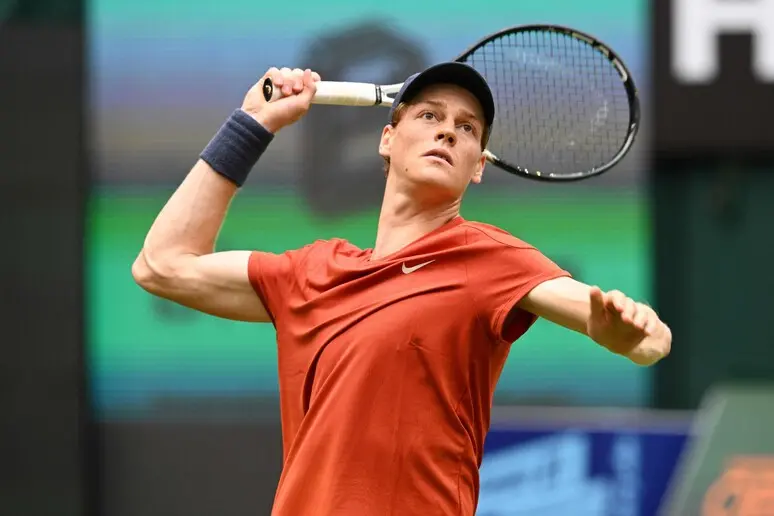
Per restare aggiornato entra nel nostro canale Whatsapp
It's tennis's moment, not just in Italy, a land of champions and minor champions in recent years, but globally. The racquet sport is experiencing a true golden age, especially for men, and at the same time, a revolution that is rapidly changing the nature of the game.
This is what American sports journalist Giri Nathan tells us in his Cambiocampo (Altrecose, 2026, pp. 272, also e-book, translated by Luca Sofri).
It all began for Nathan one day in September 2022, with a bad decision. He'd spent ten sweltering days in the press box watching match after match of the US Open tennis tournament, then writing about it all evening. Exhausted, he took the subway to Brooklyn earlier than usual to watch a quarterfinal at home on TV. "And that's how I managed to miss the match between Carlos Alcaraz and Jannik Sinner, and with it the chance to glimpse an extraordinary future. I watched the opening rallies on the subway, streaming on my smartphone, knowing deep down that I'd made a grave mistake."
That day began the transformation of tennis in recent years. For more than two decades, Federer, Nadal, and Djokovic had dominated men's tennis, and it was hard to imagine what would happen when they retired—perhaps a new future for all the players they had crushed. Instead, suddenly, two twenty-year-olds took center stage, dividing up all the Grand Slams of 2024 and 2025 and creating a new tennis built on their game, their rivalry, and their contrasting yet complementary nature. A new story began, and from that day on, Nathan followed it all, match by match, blending the genres of commentary and fiction, in a tale that makes you want to search for videos of those scenes, those rallies, those victories and those defeats.

But to understand what has really changed thanks to Sinner and Alcaraz, we first asked Nathan what the main characteristics of the Federer, Nadal, and Djokovic era were:
They ushered in an era of powerful baseline play, regardless of the surface. Rallies became longer and required greater agility and stamina. Players had to combine offensive and defensive skills, and they couldn't survive if they had technical flaws in their forehand or backhand. Players became more complete. Federer, Nadal, and Djokovic also professionalized the sport. They invested in training and recovery, and hired large teams of specialists to support them during tournaments. This is now the norm among top players.
Which of these three champions did you love the most and why?
“I loved Federer at the beginning (for his style) and Nadal at the end (for his heart).”
How do Sinner and Alcaraz differ from Djokovic, Federer, and Nadal? What innovations have they brought?
Sinner and Alcaraz grew up with modern racket technology. From the beginning, their shots have been designed to optimize these technologies. They use lightweight, high-speed rackets, with strings that generate a lot of spin on the ball. Watching them play, they hit the ball with even more force than in the previous era. They also slide their feet on all surfaces, an innovation introduced by Djokovic; younger players have studied it, and it's now a very common technique on the tour, but Sinner and Alcaraz execute it to perfection. They've also changed the geometry of rallies. The era of Federer, Nadal, and Djokovic was characterized by long points with lateral movement. But Alcaraz's passion for the drop shot also created a lot of back-and-forth movement. Sinner and Alcaraz now cover even larger areas of the court. Tennis is becoming even more physically and technically demanding.
What do you particularly like about Sinner?
“I like his two-handed backhand, one of the best ever. I like his calmness, even under pressure during the match. He seems to approach every point with the same focus and determination.”
And what about Alcaraz?
“I like the contrast between his powerful shots and his more refined ones. He always keeps you on the edge of your seat, wondering what's going to happen next. I like that he seems comfortable inventing new moves when the situation calls for it. And I like that he doesn't take himself too seriously.”
Finally... why so much love for tennis?
“It's an extreme expression of a person's style. We learn a lot about players depending on how they choose to interpret the sport. For a writer, it's a pleasure to combine the technical analysis of their game with my human understanding of them. I hope readers will appreciate the opportunity to observe these players from all perspectives.
