Ten years ago, timeless icon David Bowie died.
From Ziggy Stardust to the Thin White Duke, 50 years of success. A documentary chronicles the last few years.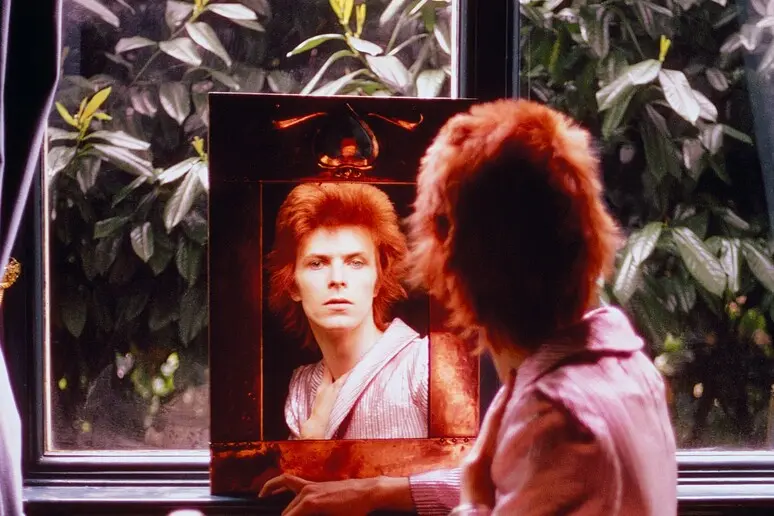
Per restare aggiornato entra nel nostro canale Whatsapp
"Tomorrow belongs to those who feel it coming." Never before has a slogan coined to promote an album, 1977's "Heroes," captured the essence of an artist who changed music and intercepted trends and social transformations. His ability to reinvent himself and embrace new possibilities for expression is the legacy that remains ten years after his death, making him a timeless icon who continues to fascinate. A permanent exhibition was recently dedicated to him in London, and a BBC documentary and a new book by Paul Morley, one of rock's most authoritative biographers, are about to be released.
David Robert Jones is the real name of David Bowie, born in London on January 8, 1947, and died in New York on January 10, 2016, after a battle with cancer. With his distinctive style and his differently colored eyes, the result of a youthful brawl, he spanned a career spanning five decades and featuring hits, starting with small bands in the early 1960s and culminating in "Space Oddity," the song used by the BBC as the theme song for the moon landing in 1969. The big breakthrough came with "Ziggy Stardust," glam rock and a call to sexual fluidity, then "Aladdin Sane" established the iconic image of the lightning bolt on his face, still copied by so many today. In the 1970s, the other mask, the Thin White Duke, with synthesizers and silence, captured a Berlin still divided into two undeniable vibrations. The 1980s brought stadium success with "Let's Dance" and a performance at Live Aid, while the 1990s saw electronic experimentation and hard rock with the group "Tin Machine." Then in the early 2000s, at the height of his artistic maturity, Bowie suffered a heart problem during a tour and withdrew from the scene, dedicating himself almost exclusively to family life with his wife Iman and their daughter Lexi.
Bowie sensed the future and projected it not only into music but also into society. He was one of the first artists to understand that the internet would transform the industry's economy and its relationship with the public, and he launched Bowie Bonds, a financial innovation that allowed him to buy the rights to his songs. After playing various characters on his final album, Blackstar, released on January 8, 2016, his 69th birthday and two days before his death, Bowie, after months of illness faced in silence, revealed himself: in the videos promoting the album, he appears lying in bed or with his eyes covered by bandages, a blind prophet foretelling his own end. The black star on the vinyl cover (for some an astronomical symbol, for others esoteric, for still others a reference to cancer) contains a hidden image: when the light hits it, a myriad of stars appear . A swan song with many messages to decipher, in his own style.
"His death is no different from his life, a work of art. Blackstar is his farewell gift," explained Tony Visconti, a longtime friend and producer. Another farewell gift from Bowie is Lazarus, the opera performed in an off-Broadway theater, an ideal sequel to the film The Man Who Fell to Earth, his 1976 film debut. He actively collaborated on this project in the final months of his life, and on December 7, 2015, just weeks before his death, he attended the theatrical premiere, his last public performance. Demonstrating the living legacy of his work, last September in London the Victoria and Albert Museum inaugurated the David Bowie Center, a permanent archive of over 90,000 items selected to trace his creative process. And on January 9, Paul Morley's book "David Bowie: Beyond Space and Time" was published, yet another journey into the artist's universe. Meanwhile, the BBC documentary entitled The Final Act is about to be released: it recounts Bowie's final period and the lucid awareness with which he transformed his end into a new creative act.
(Unioneonline)