

Trump slams the Pope, Baturi: "The Church doesn't fear the world."
The Archbishop of Cagliari on the US President's unprecedented attack on Leo XIV: "The future belongs to men of God and peace."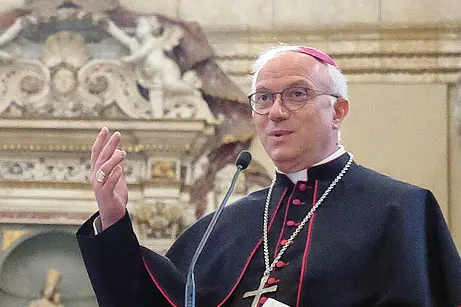
Per restare aggiornato entra nel nostro canale Whatsapp
"The controversy raised by US President Trump and his vice president, Vance, against the Pope and the Catholic Church offers, paradoxically, an opportunity to highlight some fundamental issues." In an international context marked by new tensions and criticisms directly affecting the role of the Church, the Archbishop of Cagliari, Giuseppe Baturi, invites us to reflect on the true meaning of its presence in history. At the heart of the analysis is the very nature of the ecclesial mission, which cannot be reduced to a simple political dynamic. At the heart of the analysis are the words of Pope Leo XIV , who responded to the US president by making it clear that " I am not a politician and therefore I do not enter into direct polemics. It is a way of saying that the Church moves through history with the mandate of the Lord without fear of men ."

Thus, the Pope's position is clear and detached from any logic of partisanship, refusing to become "part of a political dynamic that pits some against others. The great temptation is to reduce the Church to abstract pronouncements or those serving a logic of power. Not being afraid means affirming the otherness of the Church and the Christian message with respect to any power dynamic."
Faced with a vision that tends to identify religion with one side against the other, the Church's response is radically different. Recalling the Pope's words, the Archbishop highlights the deep roots of conflicts: "The dynamics of war are dynamics that have to do with the idolatry of self, power, and money, with an emphasis on oneself... a delusion of omnipotence . Those who think of themselves as absolute need either accomplices or instruments and enemies, tending to associate the former and repress the latter."
In this scenario, a clear statement from the Church can be uncomfortable: " A clear and unequivocal position of the Church can be annoying, but it is not the individual expression of an eccentric person... it is precisely a thought, I would say, of political theology ." The ecclesial response, however, is not ideological but evangelical: "The Pope responded that we are responding to the message: the message of the resurrection, the message of peace, and the risen Christ announces peace." "It is a peace based on justice and human dignity and on that love that does not hesitate to forgive. This is our message, the one with which we address people so that they may hear the cry of their conscience."
The Archbishop also clarifies the relationship between faith and social life: "It is true that the Church must speak of morality, but morality, that is, love of God and humanity, brings political consequences. It cannot fail to also involve the declination of elements of our social life." At the heart of this is the proclamation of a God who unites and does not divide: " We affirm a God of peace, a transcendent God who understands all... and who can be the source of a brotherhood greater than rivalry ." In recalling the recent vigil for peace, the intensity of the Pope's appeal emerges forcefully: "He prayed to God to lay down weapons from the hands of the powerful, to inspire thoughts of peace. But he also prayed to humanity. His cry, 'Stop, listen to the children,' is a cry addressed to humanity."
A word that calls for personal and communal responsibility: " The Christian believes in people, he believes that deep within their conscience there is always a good they can draw upon ." From here arises a task entrusted to all: "He has charged all of us to be instruments of peace, reconciliation, acceptance of others, healing wounds." A gaze that also begins with the wounds of the present: "Let us think of how many wounds, even in our society, are caused by violence, recklessness, and the denial of the value of others."
And which opens up to a perspective of hope : " The future belongs to men of God, to men of peace, to those who seek truth, justice, freedom, who are open to forgiveness." Speaking of peace , concludes the Archbishop, is not escapism but responsibility : "Speaking of peace is not an introspective retreat or an abstraction, it means speaking of paths to the future, of possible paths for a better coexistence ."
(Unioneonline/vf)