

In Valledoria, the church of "Cristo Re" is reborn after the fires, while the hunt for the arsonists continues.
The building was restored after the attacks. Bishop Tamponi: "The community wants to reclaim this spiritual place."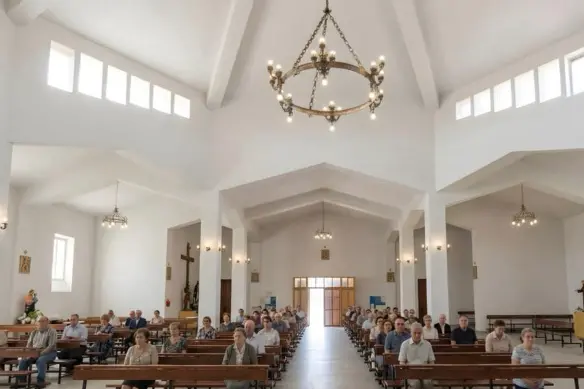
Per restare aggiornato entra nel nostro canale Whatsapp
"Restoring the Church of Christ the King means not only making it accessible, but it also sends a positive signal to a wounded community that has expressed its desire to reclaim its spiritual home."
In front of the parish, the identity center of the village of Valledoria, "disfigured" by two arson attacks on January 5th and 8th , Don Francesco Tamponi, director of the Office of Ecclesiastical Cultural Heritage of the Tempio-Ampurias diocese, spoke of rebirth.
Yesterday morning he illustrated the restoration project of a large part of the building, made possible thanks to the resources allocated by the Sardinia Region, funds amounting to 400 thousand euros which will be used to begin the urgent renovation work of the liturgical hall, that is, the space that houses the faithful, the two sacristies and the basement.
Also present were the mayor of Valledoria, Marco Muretti, and former regional councilor Gian Franco Satta. The project briefs include an investment plan totaling €800,000, necessary to complete the work.
The reconstruction comes almost a year after the arson attacks on Sunday, January 5th and the following Wednesday. These attacks were aimed at intimidating the then priest, Father Francesco Martino Mocci, who was removed for security reasons from his office as parish priest of the parishes of Christ the King and Our Lady of Fatima by the bishop of the diocese of Tempio Ampurias, Monsignor Roberto Fornaciari. Transferred to La Maddalena, in the hamlet of Moneta, Father Mocci was appointed assistant parish priest of the Agony of Our Lady of Fatima.
In Valledoria, after the appointment of Don Francesco Cossu as deputy, Don Pietro Pruneddu took over last September. However, the town has not forgotten the violence of those days, when a inferno broke out, rendering unusable the load-bearing structures above the sacristy and the stairs leading from the basement to the ground floor of the church, the liturgical hall, one of the spaces requiring a complex and lengthy cleaning.
The fire had destroyed the window frames and covered the artists' works kept inside with soot, such as the large ceramics by Marco Silecchia.
"In 1971, when the then parish priest, Don Nicola Ruzzu, fought and obtained the resources to build the church, from that moment on the parish became a symbol of identity for the entire community, preserving fragments of an older history, predating the construction of Valledoria," explains Don Tamponi.
"After that terrible fire, the town wants to reclaim that place of faith, chosen for baptisms, weddings, and community gatherings."
Four areas suffered the most damage from the fire: the catechism rooms located in the basement, the two sacristies, and the presbytery. Four classrooms were also devastated by the fire, as well as the stairs leading to the liturgical hall, which were cluttered with paper and flammable materials, which allowed the flames to spread to the mezzanine and vault of the church.
Meanwhile , investigations continue to identify the arsonists. It is believed that at least two people were involved—people in possession of the parish keys, who knew the church and the priest's whereabouts and habits.
In their first act of arson, they set fire to the end of a corridor adjacent to the church, leading to the conference room and the Caritas offices, which also house three other spaces. The blaze started in the two rooms along the entrance hall, where the greatest damage occurred. When the faithful rushed to put out the flames, the arsonists circled the church, entered through a small iron side door, and, using the keys, entered the basement to strike again, setting fire to the catechism rooms.
The second time, they attacked behind the parish house, on the other side of the street. As soon as Mass ended, the faithful, seeing smoke rising, ran toward the priest's residence. At that moment, the arsonists again entered the church basement, through the stairs completely covered in paper, from which the fire broke out, destroying the sacristy door and the rest of the church.