

Fragile adolescents, families cannot be left alone
The event promoted by the Epoché association and hosted on Wednesday by the Fondazione di Sardegna, in Cagliari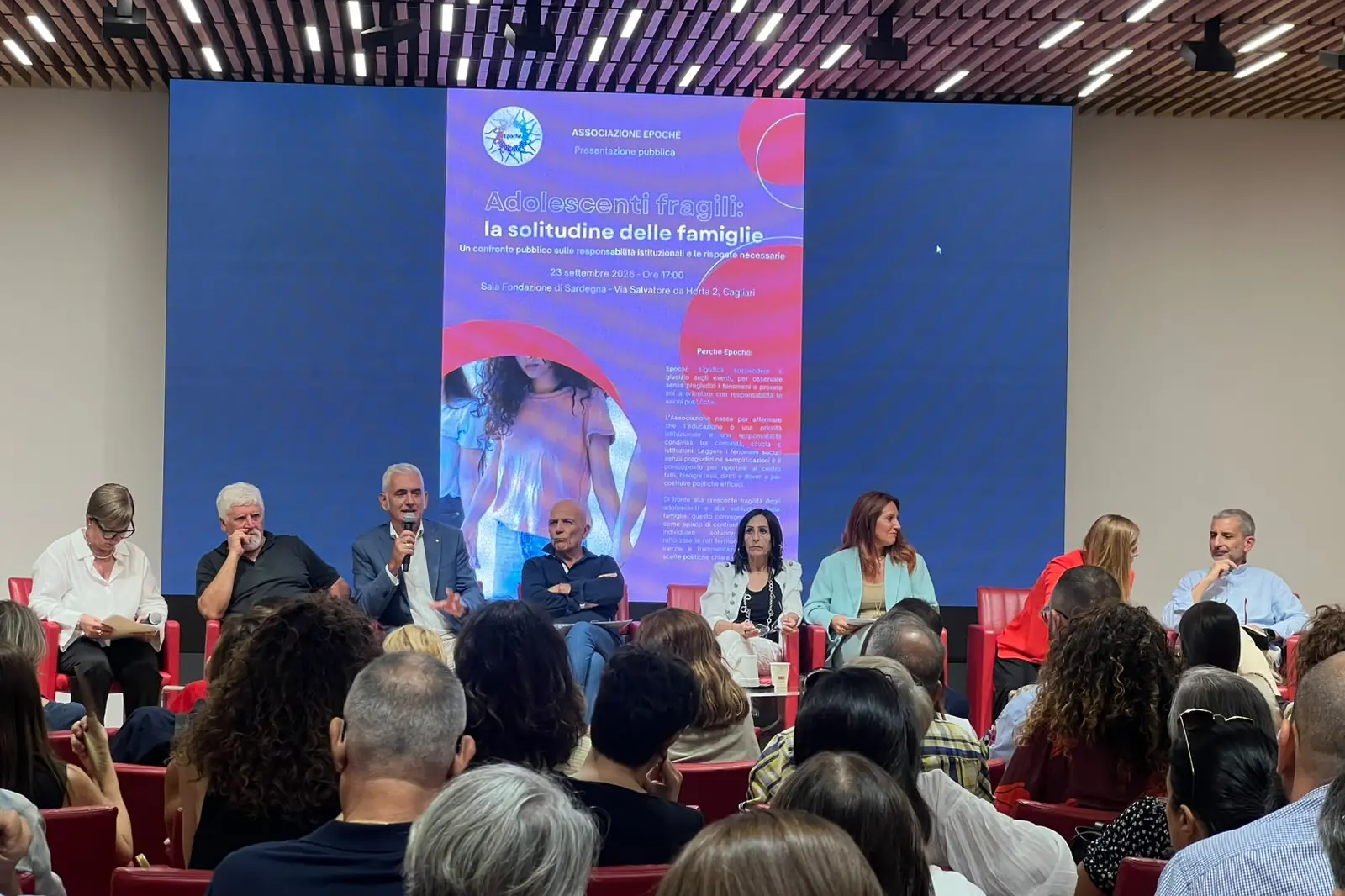
Per restare aggiornato entra nel nostro canale Whatsapp
Adolescent distress cannot be addressed by leaving families alone. This is the powerful message that emerged from the conference "Fragile Adolescents: The Loneliness of Families," promoted by the Epoché association and hosted Wednesday by the Fondazione di Sardegna in Cagliari.
A well-attended event, both in person and via livestream, which brought together healthcare professionals, schools, social services, and institutional representatives. The goal: to discuss the challenges facing adolescents today and the need to develop more effective prevention and intervention tools.
The meeting was opened by Caterina Deidda , president of the Epoché association, who highlighted the profound changes affecting young people and families. "We cannot continue to provide old answers to new needs," she emphasized, highlighting the priority of intervening before a situation of fragility turns into profound suffering or an emergency.
A challenge that, according to Epoché, concerns not only health services, but the entire community. Schools, institutions, social services, and families must be able to rely on a network capable of communicating and responding promptly. "Education must return to being a collective responsibility," was the call made during the meeting.
The moment dedicated to "Restare" by Martina Marras , presented by Michela Calledda , was also particularly intense. This testimony represented one of the most significant moments of the day, bringing to the forefront the concrete experiences of those who experience the difficulties of adolescent distress.
Numerous institutional representatives were present. Micaela Morelli , vice president of the Fondazione di Sardegna, spoke to offer greetings; Giuseppe Meloni , vice president of the Sardinia Region and councilor for Planning and Budget; Giulia Andreozzi , councilor for Public Education for the Municipality of Cagliari; and Rosanna Mura , regional ombudsman.
The discussion then delved into the critical issues and possible responses, with contributions from Alessandro Coni , health director of the Local Health Authority (ASL) 8 and director of the Mental Health Department of Cagliari; Silvio Maggetti , child neuropsychiatrist; Lorena Cordeddu , director of Social Services for the Municipality of Quartu; Roberto Scema , director of the Villamar Comprehensive Institute; Alessandro Montisci , ASARP psychiatrist; Carla Fundoni , president of the Health and Social Policies Commission of the Regional Council of Sardinia, and Daniela Falconi , president of ANCI Sardinia.
A common understanding emerged from the various interventions: an effective network cannot depend solely on the sensitivity or availability of individual workers. Collaboration between services must be transformed into a structured system, capable of leveraging skills and professionalism and, above all, supporting children and families before situations become critical.
"We can't ask families to find their way through services, skills, and institutions on their own, precisely when they are most vulnerable," Deidda reiterated. Hence the need, according to Epoché, to invest in prevention and build a network that doesn't just exist on paper, but is actually accessible to people.
The meeting was closed by Anna Cau , Sardinia's regional guarantor for children and adolescents, who reiterated the main themes that emerged during the discussion and emphasized the importance of ensuring continuity in the dialogue between institutions, professionals, and families.
The conference thus shed light on an issue that increasingly concerns the community: adolescent distress cannot be considered solely a private problem for families. For the Epoché association, the Cagliari meeting therefore represents not a point of arrival, but a step in a journey aimed at strengthening prevention and developing solutions that ensure neither children nor their caregivers are left alone.