

Carabinieri and CRS4 team up for the forensic science of the future
Agreement reached in Cagliari for 3D crime scene reconstruction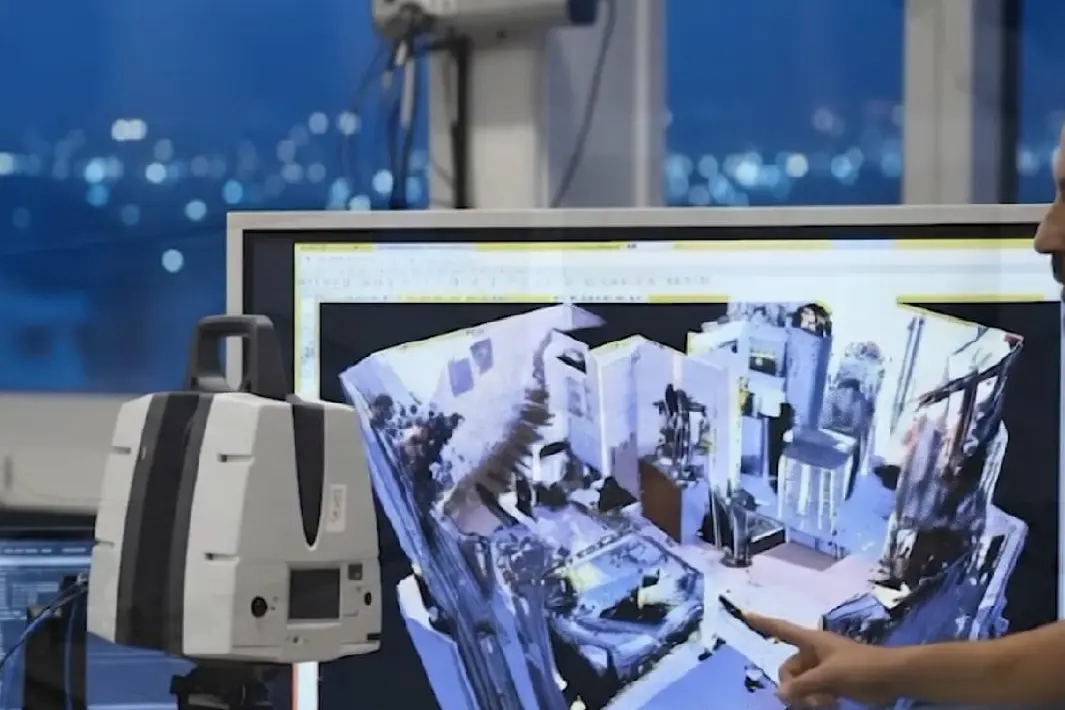
Per restare aggiornato entra nel nostro canale Whatsapp
Technology at the service of justice. A scientific collaboration agreement was signed today in Cagliari between the Carabinieri Scientific Investigations Group (RaCIS) and CRS4, the Center for Research, Development and Advanced Studies in Sardinia, with the aim of developing new digital tools for forensic investigations and the three-dimensional reconstruction of crime scenes.
The agreement is part of the three-year framework agreement signed between the two institutions in April 2025 and aims to create innovative solutions capable of extracting dimensional information from photographs not originally conceived for 3D modeling.
This is a particularly significant challenge in forensic investigations, where investigators often have to reconstruct criminal events and dynamics from dated images or those taken without photogrammetric criteria. Thanks to new technologies currently under development, it will be possible to obtain metric data relating to the shape, size, and position of objects, blood traces, ballistic impact wounds, and environments, resulting in accurate three-dimensional models of investigative scenarios.
In the project, RaCIS will make available its operational experience in the field of technical-scientific investigations , collecting images of varying quality and proceeding with the three-dimensional reconstruction of simulated scenes and traces using photogrammetric techniques and laser scanning.
CRS4, through its Visual and Data-Intensive Computing (ViDiC) sector, will contribute advanced skills in mathematical modeling, visual and geometric computation, and complex data processing , developing algorithms capable of analyzing and contextualizing the detected traces in three dimensions.
The agreement also provides for the dissemination of results through scientific conferences and publications in specialized journals, with the aim of making the knowledge developed available to the national and international scientific community.
"The agreement represents a virtuous example of synergy between institutions, where science is put at the service of justice and the community," said Massimo Carpinelli, sole director of CRS4. "The partnership with RaCIS, whose technologically advanced facilities I recently had the opportunity to visit, represents a collaboration of great strategic importance for CRS4."
The commander of RaCIS, Brigadier General Michele Cucuglielli, also expressed satisfaction: "The agreement is part of a broader strategy aimed at building a network of scientific collaborations with Italy's leading universities and research centers. Thanks to the continuous progress of science and technology, we develop innovative methodologies that, once validated and published, are applied in our laboratories to support real-world cases. Collaboration with the research community is the true driver of innovation and training."