

Oristano marvels at Buttafuoco and Rossi in the art gallery.
A metaphor ran through the evening like a red thread, returning several times during the conversation.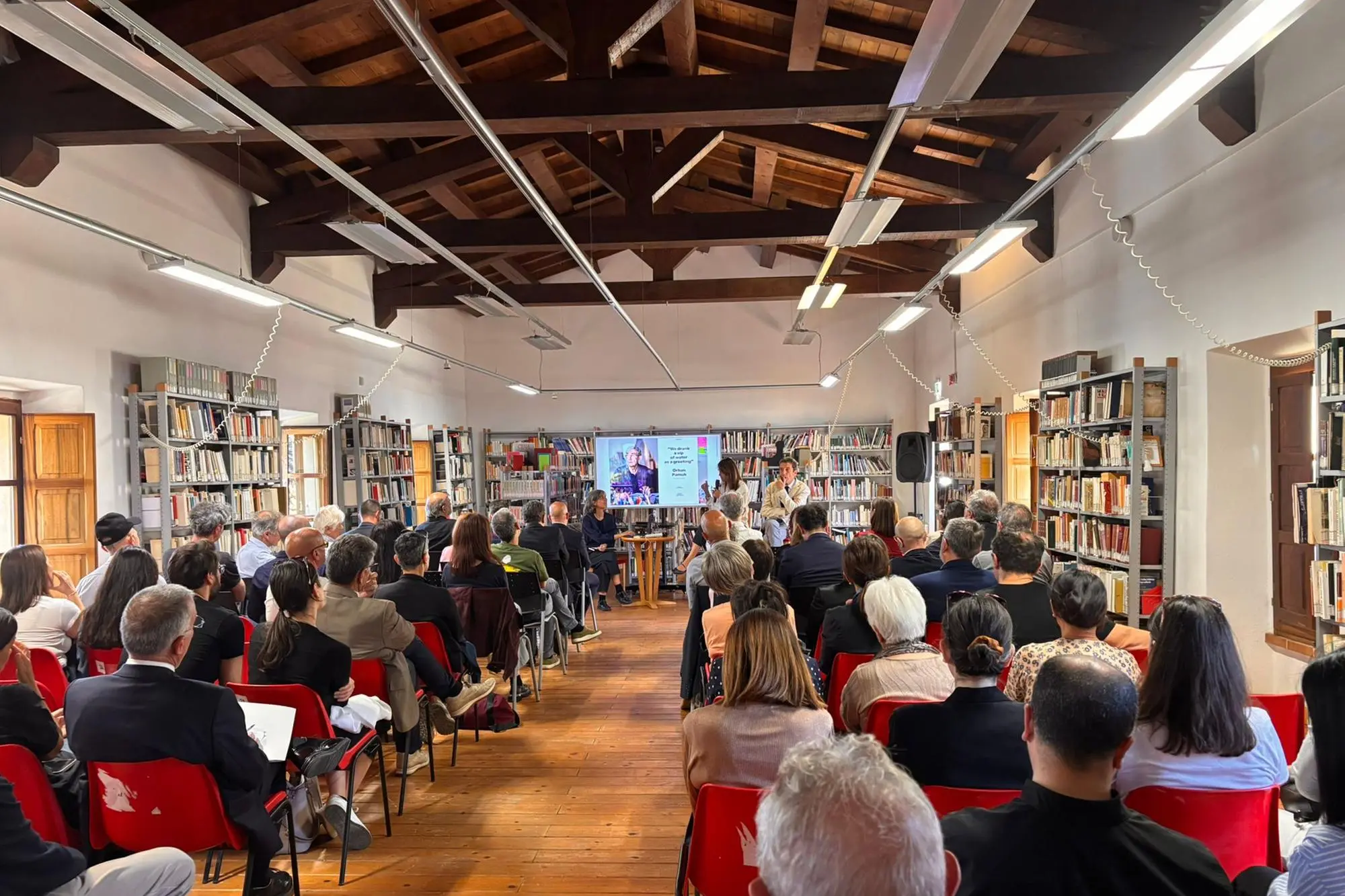
Per restare aggiornato entra nel nostro canale Whatsapp
Last night, at the Pinacoteca di Oristano, there was an atmosphere rarely felt. That of culture that isn't exhibited, but rather present. A large and diverse audience filled the hall to attend the presentation of "Alfabeti/Alphabets," the magazine of the Venice Biennale, brought to the city by two exceptional guests: Pietrangelo Buttafuoco, President of the Biennale, and Debora Rossi, Editorial Director of the Magazine and Head of the Historical Archives . Engaging with them, opening spaces for reflection without ever slipping into the decorative, was the host, Silvia Loddo, Director of the Pinacoteca, who has a far from formal connection with the Biennale, having worked for the institution in the field of archival research.
A metaphor ran through the evening like a common thread, recurring repeatedly throughout the conversation. A hen that goes out, searches for seeds, and returns, always bringing with her something new and precious. A simple, almost domestic image, yet extraordinarily effective in describing what "Alfabeti" aims to do, and what art, in its most authentic form, has always done. Gather. Return. Enrich. It is in this tension between departure and return that the magazine finds its raison d'être. Not a publication to be leafed through absentmindedly, but an object to be inhabited, just as one inhabits a place. And Buttafuoco spoke of places, with his characteristic expressive force. The importance of being in the full sense of the term, of staying in a place, recognizing a community, building together. A concept that stands head-on in opposition to the logic of beehive constructions, those anonymous and serial architectures that empty existence of meaning, that generate alienation instead of belonging. Dwelling is a cultural and political act even before it's a physical one. It's no coincidence, then, that a magazine like "Alfabeti" was launched in Oristano, home to artists accustomed to getting their hands dirty with ceramics. "There's a profound coherence in this choice," Buttafuoco emphasized. "No place is innocent, no detail ever is. And a project that deals with language, with the search for truth, with the need to nourish it, finds a home in Oristano that recognizes it."
Debora Rossi, instead, opened a window on travel, both physical and civilized. A journey in the footsteps of Marco Polo, from Venice to Mongolia, from India to the Middle East, all the way to China. All that is impulse, she explained, is oriented toward two poles: Africa and Asia. Realities far removed from the imagination we are accustomed to, yet capable of sowing tangible and dazzling legacies over time, expressions of an undying vitality. Millennial civilizations that seek contemporaneity not by denying their roots, but by starting from them. A world that pulsates, that moves, and which the magazine attempts to describe with the seriousness of those who know that every written word corresponds to a truth.
And then there's paper. "Alfabeti" is a printed magazine, not out of nostalgia or snobbery, but out of conviction. Because paper is matter, substance, presence. It can be touched, bent, worn. It resists time precisely because it physically passes through it. In an age that dematerializes everything, choosing paper is almost an act of resistance, or rather, of fidelity to beauty. And it is here that the evening found its deepest center. Wonder does not dwell in the abstract. It dwells in the concrete, in matter, in hands that knead, fingers that turn a page, the hen that pecks and grows rich. It is something that happens, if you are willing to let yourself be surprised by it. Oristano, last night, remembered this.
