

Michele Mari transcends controversy and wins the 2026 Strega Prize. Third place for Pitzorno
Eighty-four votes for the Sassari-born writer and "La Sonnambula," her novel about a psychic in late-19th-century Sardinia. According to Matteo Nucci,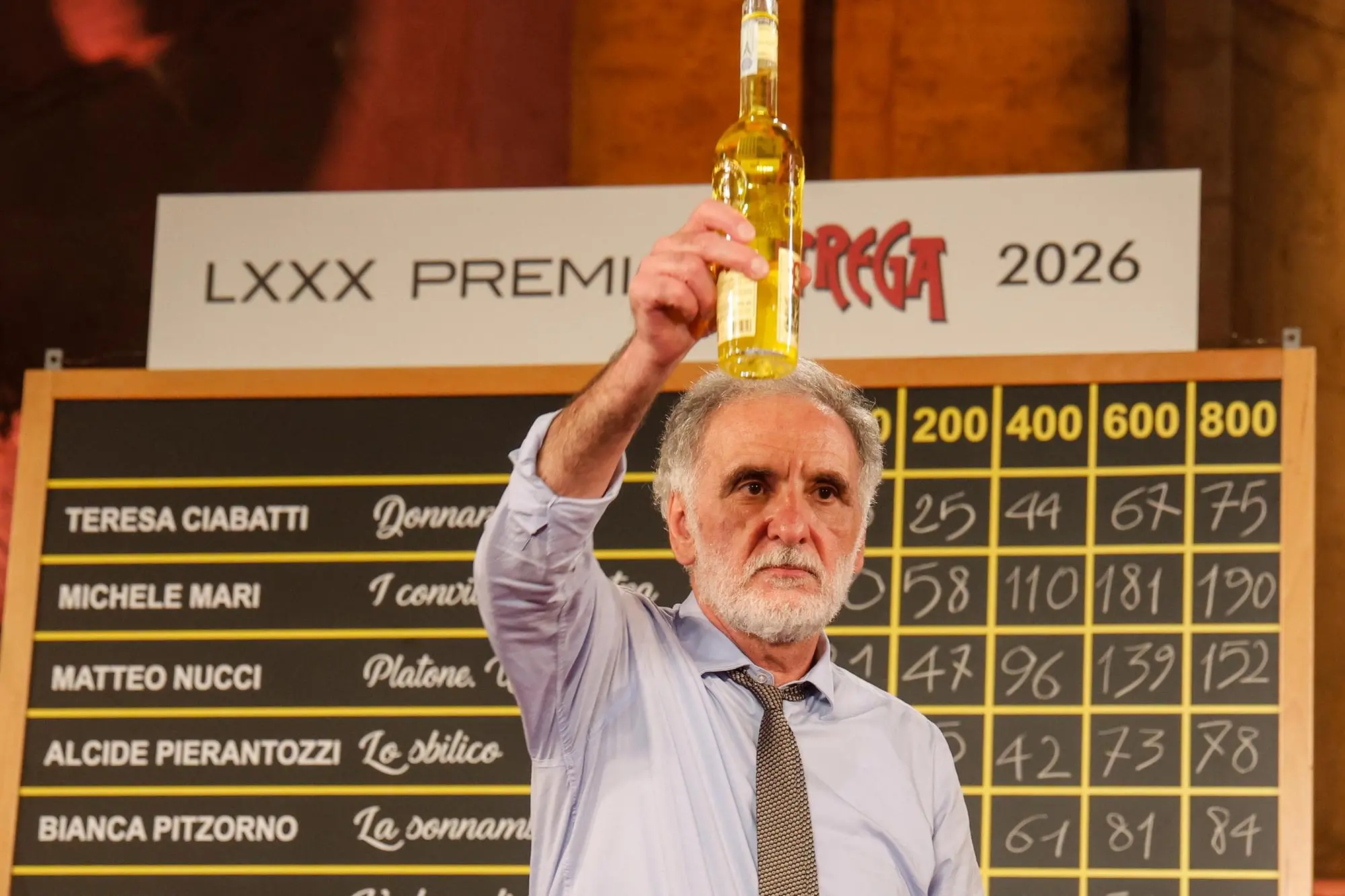
Michele Mari Wins the 2026 Strega Prize (Ansa - Giuseppe Lami)
Per restare aggiornato entra nel nostro canale Whatsapp
The overwhelming favorite, Michele Mari, overcomes the controversy and wins the 2026 Strega Prize with 190 votes. The heated debate that followed the controversy over the Michela Murgia case did not affect the victory of "I convitati di pietra" (Einaudi), with which the writer, in his first time winning Italy's most coveted literary award, had already won the Strega Giovani Prize.
Third place went to Bianca Pitzorno, 83, who made the finals despite mobility issues, with "La sonnambula" (Giunti), 84 votes, in which she gives voice, somewhere between reality and fiction, to Ophelia, a psychic in late 19th-century Sardinia. The film has sold very well since its release on January 5, 2026.
"I'm not smiling because it would turn out to be a sneer, a sneer unsuitable for the occasion. I thank all the readers who supported me, all the readers who didn't, and who I've met on this rather demanding tour, to put it mildly," the writer said upon announcing his victory, clutching a bottle of Strega liqueur he barely drank. His heartfelt thanks "to my wife and children, whom I invite to come up here on stage immediately," he added.
At the final evening in the newly restored Piazza del Campidoglio, where the awards ceremony was held for the first time, the Minister of Culture Alessandro Giuli, absent in 2025 because he hadn't received the books, and the Mayor of Rome, Roberto Gualtieri, were also present in a peaceful atmosphere. "Rome is a city that increasingly loves literature and books. From this year on, the prize lives within the city, in many arenas. In these times, there is a need for literature, culture, and critical thinking," Gualtieri emphasized.
Mari, 70, had seen speculation swirling about his resignation or exclusion from the prize. These possibilities, however, were not covered by the regulations, which the Bellonci Foundation had drawn attention to, emphasizing that "the Prize is a competition between works." The hope that the spotlight would return to books and literature was finally realized. The writer never seemed particularly upset, not even during the final stages, which were marked by a profound silence about a chapter he wanted closed, even though the path to triumph seemed more uphill.
Now he's enjoying the victory of his choral novel, which recounts a playful pact of blood and money that turns into a fierce competition among classmates at a Milanese high school, Berchet, in 1974, after their final exams. A lottery that will bind them for life and death. "I made a pact with my school friends that if I win, I'll buy them dinner," he said during the live broadcast. "Ever since I've been writing and publishing books, they've told me, 'Smile, laugh, I can't do it,'" he said.
For Matteo Nucci (already shortlisted in 2017), who cited the Palestinian genocide, and his substantial "Plato. A Love Story" (Feltrinelli), which focuses on the theme of eros as a source of knowledge in a journey that reconstructs the life of the great philosopher, his battles for justice, and his pivotal encounter with Socrates, a comeback and the award seemed easier, especially given the 38-vote gap in the top six. But everything went as planned, and he retained second place with 152 votes. Bianca Pitzorno came in third, Alcide Pierantozzi fourth, also a finalist for the 2026 Campiello Prize with "Lo sbilico" (Einaudi), in which she courageously recounts her experience with mental illness, a blend of autobiography and novel, which received 78 votes . Teresa Ciabatti, winning her third Strega Prize, came in fifth, with 75 votes. This intense dialogue with the super boss Giuseppe Misso, "aka 'o Nasone," also explores the responsibility of writing. During the live broadcast, the writer became emotional and quoted Valeria Parrella, who in her latest book says that in every corner of the world, "there's always a little girl who gets in the way, and that girl is Murgia." Elena Rui came sixth with "Vedove di Camus" (L'orma), 64 votes.
The live broadcast, airing on Rai3 from 11:00 PM, was hosted by Pino Strabioli and Gloria Campaner, who performed on piano. It was streamed from the Casa del Cinema, Parco degli Acquedotti, Corviale, and Macro arenas, where visitors can also visit the current exhibitions, including the one dedicated to the Strega Prize, free of charge. Andrea Bajani, winner of last year's edition, presided over the polling station. A total of 643 votes were cast, equal to 80.4% of those eligible to vote.
The count was preceded by a dinner on the terrace of the Protomoteca overlooking the Imperial Forums. In attendance were Culture Minister Giuli, who sat at the table with Mayor Gualtieri and the president of the Bellonci Foundation, Giovanni Solimine. At other tables were the president of the Italian Publishers Association, Innocenzo Cipolletta; the president of Più Libri più liberi, Annamaria Malato; and writers such as Dacia Maraini, Sandro Veronesi, and Chiara Valerio, who arrived with Teresa Ciabatti; and the director of the Turin Book Fair, Annalena Benini.
(Unioneonline)
