

Lorè's Ark: Olbia marks the first stop on Jovanotti's tour, known as "the lucky guy" for sixty years.
Anticipation for the super live of the singer who in four decades of career has been able to change skin and language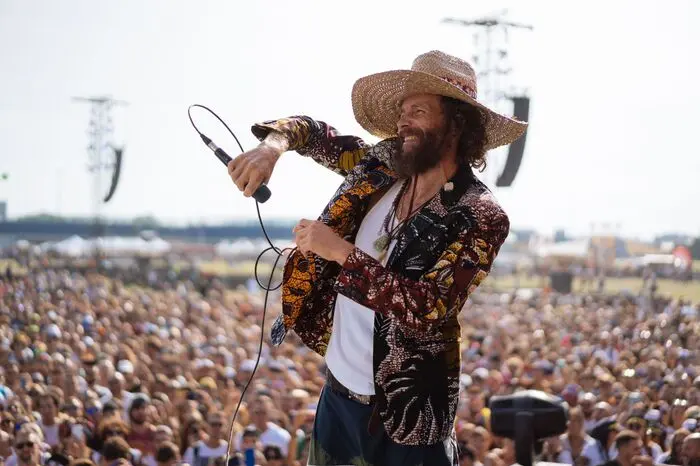
Per restare aggiornato entra nel nostro canale Whatsapp
At 15, he was convinced: he would become a painter. At school, he was brilliant at drawing and already imagined his future with his hands covered in paint, surrounded by frescoes and mosaics. After all, Lorenzo Cherubini had grown up in the heart of Rome, just steps from the infinite heritage that is the Vatican City. Life, however, had another canvas in store for him.
Joy, pain
"If I hadn't wanted to change, today I'd be in a mineral state." This, in a line from "Estate," is the essence of Jovanotti, the artist in constant motion who will be at the Olbia Arena tomorrow night for the first stage of the Jova Summer Party 2026 - L'arca Di Lorè . Over a 40-year career, he has morphed into a different style and style, moving from early rap to singer-songwriter, from dance to world music, to become one of the few artists capable of uniting opposing generations. He'll turn 60 on September 27th, but for everyone, he'll always be that "lucky guy" who never lost his will to live. Embracing joy, which makes you forget you exist, and pain, which makes you feel you do.
The heart of Rome
Lorenzo Cherubini grew up in the Balduina neighborhood, in a large family: he was the third of four children of Mario Cherubini, a Vatican City State employee, and Viola Cardinali. His peers dreamed of soccer or movies, but he fell in love with the radio. He spent hours listening to voices and songs, collected vinyl records, and stumbled upon that new language from across the ocean: hip hop. He began working as a DJ, and it was behind the decks that he learned to read the crowd and know when to change the tempo. He told his family that he wouldn't even try to enter the Vatican's renowned restoration school, and his father Mario was deeply disappointed.
“For President”
But opportunity was just around the corner, thanks to Claudio Cecchetto's intuition. Having joined the Radio Deejay stable under the stage name "Joe Vanotti," which due to a typo became "Jovanotti," he made his debut in 1987 with "Walking." In 1988, he released "Jovanotti for President," and for a generation raised on cassettes and discos, songs like "Gimme Five," "Go Jovanotti Go," and "La mia moto" became catchy hits. Every radio and TV station was courting him: just listening to him wasn't enough; that boy with the colorful caps, baggy pants, and constant smile was a breath of fresh air. And on Italia 1, he hit the big time with "1, 2, 3 Jovanotti," the program where 883 made their debut under the name "I Pop."
The choice
But it's the 1980s, military service is mandatory, and Jovanotti, too, has to go. On January 14, 1989, along with a thousand comrades, he takes the oath of office at the Turinetto barracks in Albenga. He will serve 12 months, the mandatory term of service for the Italian Army at the time. When he returns, something inside him has changed. "I knew people thought I was a slob," he would say years later. He faced a choice: continue riding the wave of easy success or change everything and take a risk. He has no doubts. The Jovanotti of the 1990s is different: more personal lyrics, new influences on funk, soul, and reggae. Rap itself is no longer a rhythmic game to mechanically sway heads, but a tool for telling the world. With "Lorenzo 1992," he was unafraid to tackle social, political, and environmental issues, while "Lorenzo 1994," which sold 600,000 copies, marked his definitive consecration. It included "Penso positivo," a generational manifesto, and "Serenata Rap," dedicated to his future wife, Francesca Valiani. These were also years of travel: Africa, Latin America, the United States, and Asia became a constant source of inspiration, and from there emerged the explosion of percussion and tribal rhythms that is "L'ombelico del mondo." "L'albero," from 1997, which contains "Bella" and "Questa è la mia casa," also grew his civic engagement with humanitarian organizations and awareness campaigns. In 1998, his "magical girl," his daughter Teresa, was born, and to her he dedicated "Per te" from the album "Lorenzo 1999." The same album also spawned "Un raggio di sole," which won that year's Festivalbar.
Freedom
With the new millennium, Lorenzo Cherubini was now an artist free to experiment. In 2005, he released "Buon sangue," followed by "Safari" in 2008, a diamond album that included "Fango," dedicated to his brother Umberto, a flight instructor who died the previous year in a tragic plane crash. In 2011, "Ora" debuted at number one with hugely successful singles such as "Tutto l'amore che ho," "Le tasche piena di sassi," "Il più grande spettacolo dopo il Big Bang," and "La notte dei desideri." It also went on to achieve multiple platinum records.
“The human body”
Every concert is a celebration, a collective ritual, and it is from this idea that the "Jova Beach Party" was born in 2019. When everything seems to be going swimmingly, fate presents him with a bill. In July 2023, while on vacation in Santo Domingo, he is the victim of a serious accident on his bicycle, his great passion. The result: a broken collarbone and femur in three places, several surgeries, and a rehabilitation that will last months. He faces darkness, gives himself time to recover, and then, once again, manages to transform the difficulty into energy. An experience that will give rise to the album with the evocative title: "The Human Body."
And here he is today. Everything has changed. But Jovanotti remains Lorenzo. Or Lorenzo remains Jovanotti.
