

For example, prosecutors consider the wiretap to be a confession: "He couldn't have known about the USB stick."
The transcript of the car soliloquy and all the other evidence against the 38-year-old man under investigation for Chiara Poggi's murder. His lawyers: "He'll be able to explain."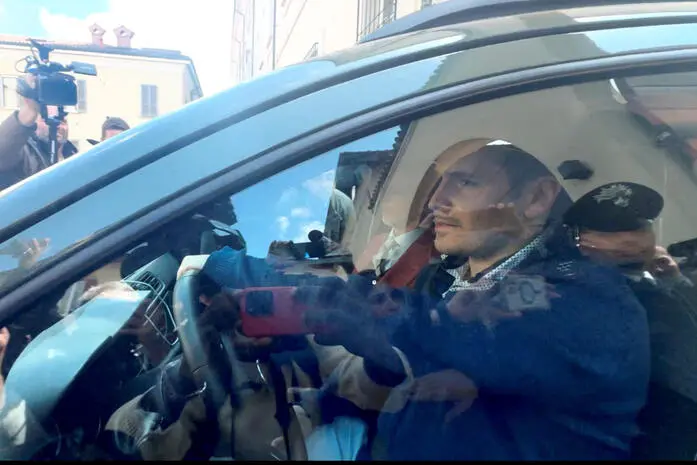
Andrea Sempio (Ansa)
Per restare aggiornato entra nel nostro canale Whatsapp
It's April 14, 2025. Sempio has known for about a month that he's under investigation in the new investigation into the Garlasco crime. He's alone in his car, muttering a few words to himself, out loud. This happens often; he'd already been wiretapped in 2017. But this time he's given himself away, at least according to the Pavia investigators led by prosecutor Fabio Napoleone.
He talks about Chiara Poggi, about the intimate videos of Chiara and Alberto seen on the victim's computer, about their presence on a USB drive, a detail he couldn't have known at the time because it hadn't yet emerged. He talks about those three phone calls to the Poggi home in the days preceding the crime: "I wanted to talk to Marco, I'd forgotten he was in the mountains," he told investigators at the time. Instead, in his soliloquy in the car, he explains that those calls were an attempt to approach Chiara, with whom—according to the investigators' reconstruction—he had become infatuated after seeing the videos.
The interception
Sempio sometimes imitates a female voice, particularly Chiara's, who tells him 'I don't want to talk to you' before hanging up. "Of the three calls," the suspect said, "she said 'I don't want to talk to you' (...) it was like I said 'can we meet up?' (...) and she hung up on me (...) she hung up the phone... Oh, there you are, acting tough, but I've never seen it that way, the interest wasn't mutual, damn it. She says 'I can't find the video anymore' (...) I brought the video (...) he knows it too... Because I saw... on his cell phone... Because Chiara doesn't... with that video and I have it in my pen, that's fine."
"He'll be able to explain," his lawyers said, waiting to hear the wiretaps. Investigators only read them to him yesterday during the interrogation, during which Sempio chose to remain silent. Angela Taccia, Sempio's lawyer and childhood friend, said on television that the 38-year-old was referring to television reports or podcasts that discussed the investigation.
But for the Pavia prosecutors, they're almost a confession. Because at the time, no one could have known about the videos on the flash drive, which Chiara had copied and then deleted. Only those who had seen them could have known of their existence.
The other elements against Sempio
Yesterday, investigators presented the suspect with all the evidence they believe would incriminate him. Not just the wiretap.
There's fingerprint 33, which the Carabinieri who inspected the scene at the time believed was the killer's signature. It was dismissed by the RIS at the time, but according to new analyses, it belongs to Sempio for 15 details.
The DNA on Chiara Poggi's fingernails: geneticist Denise Albani, during the preliminary investigation, estimated a "moderately strong" to "strong and moderate" probability that this partial trace, although "insufficient to identify a single individual," is compatible with Andrea Sempio's paternal line.
The alibi dismantled. The parking ticket in Vigevano, curiously kept for a year: a witness, a friend of Sempio's mother, reportedly said that the ticket wasn't printed by the suspect, but by his mother, who had gone to Vigevano that morning to meet him. Furthermore, crime scene analyses shifted the crime forward by at least an hour—between 10:30 and 12:00, with a "target" between 11:00 and 11:30. Therefore, even if Sempio had printed it, that 10:18 receipt would no longer be an alibi.
Moreover, yesterday, among the various charges leveled against Sempio, prosecutors also accused him of conducting research on the Garlasco case, Stasi, and the DNA found on Chiara's hands. This research was conducted between 2014 and 2015, when he had not yet been investigated. There is also a search string referring to mitochondrial DNA, coinciding with the analyses conducted during Stasi's second appeal trial.
And again, many violent messages, some even justifying rape, were posted on an online seduction forum. These messages were analyzed by Racis experts to develop a criminological profile of the suspect.
The reconstruction
The investigation offers a completely different reconstruction of the crime than the one that led to the conviction of Alberto Stasi, who is currently serving a 16-year sentence.
The attack took place in several stages, starting near the sofa and ending along the stairs leading to the cellar with the fatal blows, at least 12 of which were delivered to the girl's head.
"After an initial struggle," according to the investigators' reconstruction, the killer "repeatedly struck the victim, knocking her to the floor." He then "dragged her" toward the cellar, and when Chiara "tried to fight back by getting on all fours, he struck her again with at least three or four blows, knocking her unconscious." The killer then allegedly pushed the body down the stairs, and when Chiara was unconscious, he struck her again, causing her death.
Sempio is charged with two aggravating circumstances: cruelty due to the brutality of the act and the number of wounds inflicted, and having committed the crime for abject motives, "attributable to hatred following the rejection of his sexual advances."
A friend and contemporary of Marco, Chiara's brother, Sempio was a regular at the house on Via Pascoli, investigators have reconstructed. He spent hours with Marco playing PlayStation and surfing the Poggi household's computer, the same one where Chiara stored some intimate videos of her with Alberto, which Andrea would later stumble upon. From there, an infatuation developed and an attempted approach, taking advantage of Marco and his parents' absence, who were in the mountains. The advances were unwelcome, and the approach was rejected, which, according to the prosecutor's reconstruction, infuriated Sempio. This led to the housebreaking and the assault with a blunt object.
Marco defends him
The prosecutors also played those wiretaps to Marco Poggi and asked him about the video. Chiara's brother, however, said he had complete faith in Andrea Sempio: "We never saw those videos together. I believe he's innocent," he said, adding that he trusted the family consultants, who said the material collected by Pavia prosecutors hadn't altered the crime scene.
Stasis
If the text of Andrea Sempio's wiretaps were confirmed, "it would be horrifying and at that point the objective would be to get Alberto Stasi out of prison as soon as possible": Stasi's lawyer Giada Bocellari said this in the programme 'Realpolitik' broadcast yesterday evening on Retequattro.
Regarding the possibility of joining the civil action, the lawyer noted that "certain conditions are needed. Alberto was the victim's boyfriend. The damages that can be sought in criminal proceedings are criminal damages, not a whole series of other damages that Stasi suffered in the case. Therefore, we'll see and evaluate it."
Regarding a possible request for review, Bocellari noted that "when you file a request for review, you can also simultaneously request a stay of execution, pending the review judgment. Some time ago, not long ago, I said we wouldn't request it, we wouldn't want it, but if the circumstantial evidence were solid and there were wiretaps of this kind, then the situation would probably change significantly."
The lawyer finally said that when Stasi learned of the wiretaps "he had a slightly different reaction, not of anxiety, but of emotion."
Next steps
We're close to closing the investigation, although investigators told Sempio yesterday that it's not over yet. In the coming weeks, the documents will be uncovered, and they will also be transferred to Stasi's defense team so they can proceed with their request for a review, and the request for Andrea Sempio's indictment will be filed.









 on social media: "I'm feeling much better, finally home."")