

Farewell to Arnold Lebeuf, scholar of the science of the Santa Cristina well.
Anthropologist and historian of astronomy, he argued that the Paulilatino monument was a highly precise calculating instrument.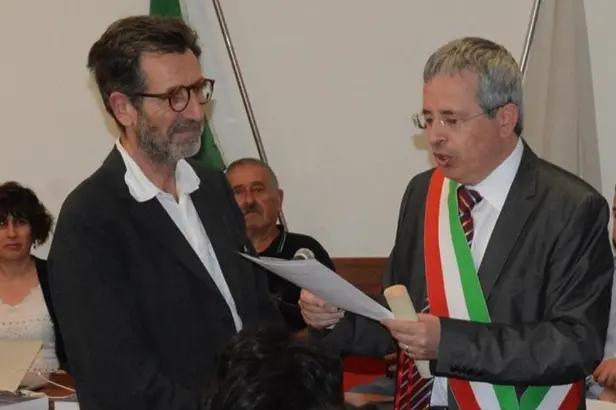
Per restare aggiornato entra nel nostro canale Whatsapp
At dawn on February 10, the scholar Arnold Lebeuf passed away at the San Gavino hospital after a short illness.
A native Frenchman, Polish by adoption, but also a South American through his long studies and finally a Sardinian in the latter part of his life, Lebeuf was an anthropologist and historian of astronomy, trained at the French School of Advanced Studies in Social Sciences. A founding member in 1981 and vice president of the SEAC (European Society for Astronomy in Culture), he was a full professor of history of religions at the Jagiellonian University in Krakow, Poland.
A polyglot with five languages to his credit, his vast scientific interests, pursued with rare intellectual voracity, spanned Mayan, Aztec, and Mesoamerican cosmologies, the European Middle Ages, mythology, ethnoastronomy, and Babylonian cosmology. Central to his research were the cosmological allegories hidden in sacred texts and the symbolic devices through which ancient cultures inscribed the heavens in stone and myth. A monumental undertaking, evidenced by over seventy scientific articles and numerous monographs.
Considered one of the leading scholars of the apparent motion of the Moon and eclipses in ancient civilizations, Lebeuf is particularly well-known in Sardinia for his research on the sacred well of Santa Cristina, in Paulilatino. He learned about it almost by chance in 1973, during a conference in Bulgaria, thanks to an article by Carlo Maxia and Edoardo Proverbio.
The first-hand visit took place only many years later, on the occasion of the 2005 SEAC conference in Isili: an encounter that left a profound impression on him, so much so that he defined the well as "one of the two loves of my life, along with the Pozo de los Astronomos in Mexico."
From that moment, Lebeuf began a radical revision of previous studies. He didn't just point out interpretative inaccuracies, but between 2006 and 2011 he undertook a campaign of extremely thorough surveys, on a site that paradoxically had never been the subject of a proper architectural survey until Franco Laner's in 2011. In May of the same year, he published in Italian the book Il pozzo di Santa Cristina, un osservatorio lunare, which was destined to spark a heated debate.
In that work, Lebeuf argued that the well was not merely a structure conceived according to a refined astronomical geometry of lunar origin, but a true scientific instrument ante litteram, capable of predicting eclipses. The extremely precise identification of the lunistic, mean time, and the presence of a sort of graduated scale made up of identical stone rows led him to interpret the monument as an observation and measurement device of extraordinary accuracy.
Since his retirement in 2017, Lebeuf had moved to Sardara to continue his research. Since 2016, he had been an honorary citizen of Paulilatino, a testament to his deep connection to the area he had helped reinterpret with fresh eyes.
Volcanic, passionate, and tireless, he was consumed until his death by the mysteries of the cosmological allegories underlying ancient religions. His contribution to cultural anthropology, the history of astronomy, and the history of religions remains largely unexplored. He restored the Santa Cristina well to international scientific prominence and opened interpretative avenues destined to spark long-standing debate. Shortly before his death, he confided to me that he had identified and published the interpretative key to the Piedra del Sol, the great Aztec monolith symbolizing Mexico, hoping that the world academy would grasp its significance.
An uncommonly speculative and analytical intelligence, a man literally tormented by celestial movements and their reflections in ancient religions. I once asked him, "Arnold, do you believe in God?" He replied, after a pause, "It's too difficult to answer."