


Cagliari's Marino Hospital, the final act: definitive approval for redevelopment.
Councilor Laconi: "One of the most iconic places on the coast will be reborn."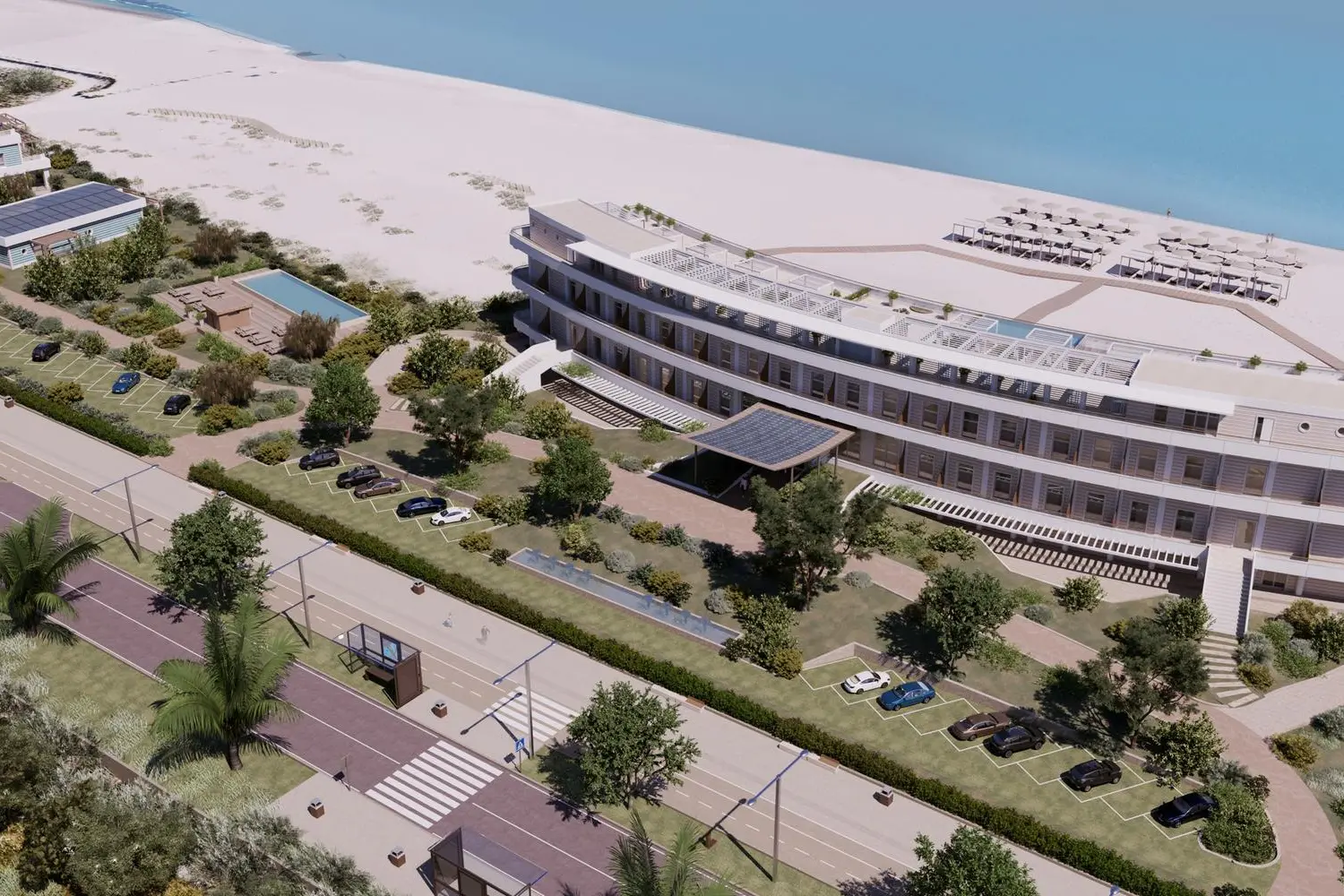
Per restare aggiornato entra nel nostro canale Whatsapp
It's a cliché, but it's a powerful one. A tailored suit. The future of the former Marino hospital, on the Poetto beach, is now: the redevelopment can begin.
The final act, by the Municipality of Cagliari, arrived on December 17th.
Work will begin in early 2026, subject to the mandatory conservation constraints, to revive the old Colonia Dux with 60 new five-star suites and 127 beds.

"One of the most iconic places on the Cagliari coast will be reborn," said Regional Environment Councilor Rosanna Laconi in October. At the time, the authorities had assessed the project's impact on the ecosystem. The assessment was passed, and the green light was given. The final authorization was granted.

The profile of the Marino must be redesigned by Colonia Hotel srl, a company headed by the entrepreneur Sergio Zuncheddu, publisher of the L'Unione Sarda Group .
History is also evident in the name, "paving the way for restoration and transformation projects, in full compliance with landscape and environmental protections," says Laconi. The company won the tender on November 30, 2021. The Region had published it at the beginning of the year. The starting bid was €418,797.60. The best idea counted, but the evaluation of the bids was also based on the price increase. Colonia Hotel proposed a 1,200% increase, putting €12 million on the table to regenerate a piece of Cagliari's seafront. That eighth stop on the city beach, for those who live around here. Almost a code name.

Six people participated in the public tender, with one exception.
The lowest bid, with a 30.92% increase, was submitted by Proma srl. Sha Société Hotelier des Alpes spa rose to 45%, followed by Cosir srl with 977.17% and Hotel Regina Margherita srl with 1.199%. Leading the way, with 1.200%, is Colonia Hotel, scheduled to open in the 2027 season. This luxury hotel will bring the Hotel Abi d'Oru experience to Southern Sardinia. Diana Zuncheddu, CEO, previews the future plans and objectives: "We are creating," she says, "a north-south hub of five-star hospitality, aware that the Colonia Hotel is unique, a unique urban resort, not only because there is no other hotel like it, in terms of history and location, but also because of its profound connection to the city."

It's an identity-based reasoning, not just a commercial one, that will guide the market positioning. "We like to think of our hotels as being historical," continues Diana Zuncheddu, "the Abi d'Oru from 1963, the Colonia Hotel from 1937. One right on the beach, the other right on the sea. One that literally feeds on the Costa Smeralda, the other that lives in Cagliari and for Cagliari." These differences are only apparent, but they must be blended, keeping in mind that luxury is increasingly a universal value. "Commercially, we want to bring the Marino in line with the Abi d'Oru," is part of the challenge. However, "we must beware of losing our connection with Cagliari," emphasizes the CEO. "The Marino needs its city, and the city will finally have its Marino."
The pieces of the design puzzle are obtained from determination 0004119/21.
The regional tender, a pas de deux with the municipality, came fourteen years after the ministerial decree of September 19, 2007, which placed the Marino site under monument protection. Number 85. A protective barrier to respect the site. And it matters little that the Colonia Dux has become a ruin. The value of time and space cannot be erased. It was 1937 when Ubaldo Badas, an architect from Cagliari, began shaping that concrete geometry, with an internal curve, on the beach side, reminiscent of the Sella and Golfo mountains.

In 2007, some thirty years had already passed since the order was issued in the 1980s to vacate the wards of the Colonia Dux and gradually move into the former Esit building, which was itself transformed into a new health center for musculoskeletal disorders. From the tender notice, it took another four years to complete the administrative process. The final authorization document from the Municipality of Cagliari was signed by the SUAPE One-Stop Shop, which, to protect the project, extended the evaluation to the Metropolitan City. The public deed then included both the authorization issued by the Molentargius Park and the permit from the Superintendence of Cultural Heritage. And before that, in addition to the regional offices, including the Department of Urban Planning, the State Property Office of Sardinia, the Departmental Inspectorate of the Forestry Corps, the Hydrographic District, the Local Health Authority (ASL 8), and the Regional Environmental Protection Agency (ARPAS) had expressed their support. This was also supported by the Private Building Department of the Municipality of Cagliari itself.
Naturalistic engineering will be applied "to protect the dune system," while "ecological continuity and landscape harmony" prohibit any stylistic license, both "in the main building" and "in the annexes," namely "the emergency room, the hospital services building, and the former flammable liquids storage facility."
Mayor Massimo Zedda said: "After decades, the building's state of decay has finally been remedied. Besides being an insult to the splendid Poetto beach, it also detracted from Ubaldo Badas's valuable work.
The project proposed by the private individual not only offers aesthetically pleasing solutions, fully respecting the original design, but also pays great attention to environmental protection, with a view to recovery and reuse, without land consumption. The city needs hospitality facilities. New jobs and development will also be guaranteed.
The mayor sets out his position for today and tomorrow: "To regenerate the vast public real estate portfolio, private investment is essential. The former Marino site will be redeveloped while maintaining its current appearance. Ownership remains public, with the Region, which has established a series of requirements to protect the environment."
