Angelo Figus and “Plissé semper plissé” «To subvert a common feeling»
The designer is among the protagonists of the project starting Friday in Cagliari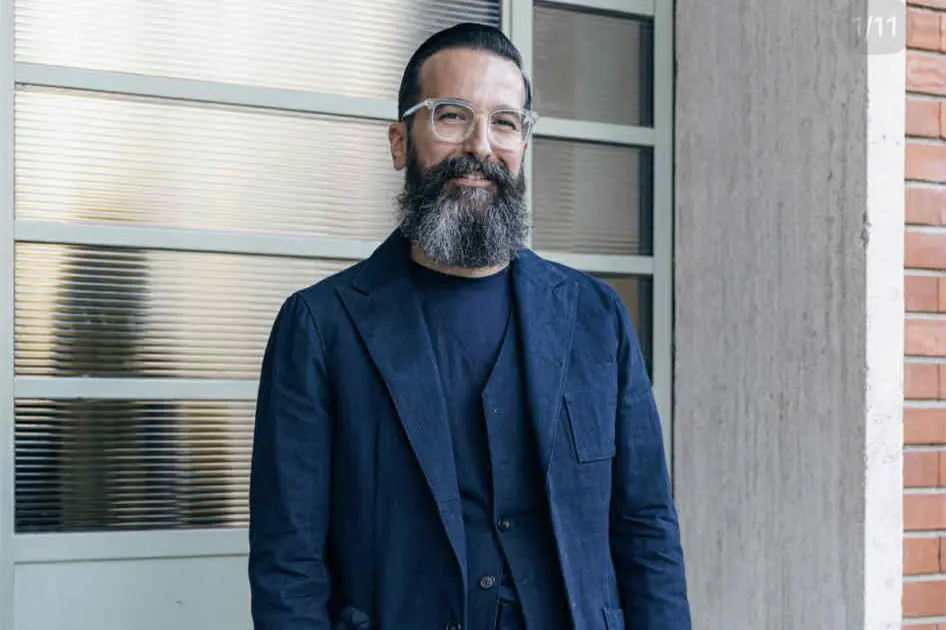
Per restare aggiornato entra nel nostro canale Whatsapp
The adjective is strong, but Angelo Figus uses the words elegantly, and when he defines the tone of the exhibition “Plissé semper plissé,” which opens Friday in Cagliari, at the Cittadella dei Musei, as “subversive,” he means that we should expect something out of the ordinary.

The project, conceived and curated by costume historian Alessandro Lai, and Maria Antonietta Mongiu and Francesco Muscolino of the National Museums, with the support of the Department of Education and the Regional Ethnographic Institute, initiates a surprising dialogue between archaeology and fashion, craftsmanship and costume. The exhibition, held in the spaces of the Archaeological Museum, the Art Gallery, and the Luigi Cocco Collection Regional Ethnographic Museum, says the renowned Sardinian fashion designer, "does not use the traditional language of fashion or the classical museum language, but questions and reinvents them."

The result is a narrative in which the technique of pleating, the art of regularly and systematically folding, is the common thread connecting eight millennia of Mediterranean material culture. Archaeological finds, works of art, artisanal objects, theater and film costumes, and tailoring interact in a play of references. On display, alongside internationally renowned pieces, are the "sculptural" pieces by Figus, a native of Ales, born in 1975, whose eponymous brand produces innovative design accessories. He is renowned for his original exhibition designs, such as those on the Lombards in Pavia, and "Eurasia" and "Civilizations and the Mediterranean" in Cagliari.
She started out as a stylist, but her work soon expanded to other fields.
"Actually, I've always been involved in many different fields. Transversality, ever since my formative years, has been a daily practice: one area feeds the other effortlessly. The great lesson has been learning to keep everything open, without creating confusion: cross-fertilization must remain subterranean, invisible, but lead to a clear and understandable result."
What skills do you bring to the archaeological world?
"A wide variety: interior design, the study of color, the perception of space. I have a strong connection to archaeology, particularly the Nuragic world. I approach these themes in a visionary yet respectful way."
An exhibition, he argues, must stimulate desire. How do you transform historical content into an emotional experience?
Color and shape are fundamental. Geometries influence how we consider an object, how we perceive it as close or distant. Desire arises when distance transforms into proximity. Spectacular technologies aren't necessary: color, material, and shape are enough.
What are the responsibilities of a creative who works on cultural heritage?
It's a huge responsibility, but it shouldn't become paralyzing. Sometimes seriousness is synonymous with rigidity and becomes a barrier to experimentation. Fashion has a great advantage: it's visually free. It can capture, transform, and relay messages with great speed. This agility is often lacking in culture. Conservation is important, and I'm not against it, but we also need to make room for new languages.
In "Plissé semper plissé," fabric becomes storytelling and memory. Could this be a way to restore a cultural dimension to fashion, beyond its commercial nature?
Absolutely. It's one of the reasons I agreed to participate in the exhibition. I believe fashion needs to return to creating culture, an independent culture, not tied to institutions, which are often conservative. Here, the fabric speaks through the fold. It's not fashion in the strict sense, but a cultural operation.
What is fashion for you?
"When I started, fashion was for me a means of personal expression. Today, it's primarily finance. But I think this cycle is coming to an end. It will return to being something smaller, less tied to numbers, and a space will reopen for designers who focus on quality and design ideas, not volumes."
Franca Rita Porcu