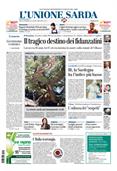


The Sardinians of "Transport 81": stumbling blocks in Cagliari and Sassari to keep the memory alive.
On Monday 9th March the ceremony for the laying in memory of Mario Giovanni Pani, victim of the Nazi-Fascist deportationPer restare aggiornato entra nel nostro canale Whatsapp
On Monday, March 9th, starting at 10:00 a.m., a ceremony open to the public will be held in the main hall of the Siotto High School in Cagliari to lay the stumbling stone in memory of Mario Giovanni Pani, a victim of Nazi-Fascist deportation, born in the city in 1923.
It is an initiative of the Sardinian Institute for the History of Anti-Fascism and Contemporary Society (Issasco).
On Tuesday, March 10, again at 10 a.m., the Department of Agriculture at the University of Sassari, located at Viale Italia 39/A, will host a ceremony to lay the stumbling stones in memory of Dino Col and Giovannico Biddau, who also fell victim to the tragic Nazi-Fascist deportation.
Up until 2024, stumbling stones had been laid in Sardinia in the municipalities of Sestu (Pietro Meloni), Sassari (Zaira Coen Righi), San Vero Milis (Cosimo Orrù), and Burcei (Isidoro Frigau). In 2025, on January 27th, the fifth stumbling stone was laid in Iglesias in memory of deportee Franco Cristiani, and on April 24th in Suelli (Giovanni Pitzalis). Last January 27th, the seventh stumbling stone was laid in Escalaplano to commemorate Luigi Murgia. These initiatives were also made possible thanks to research promoted by Anppia Sardegna and Issasco on the 15 Sardinian deportees of "Transport 81." The goal is to commemorate all the other island deportees in their hometowns.
The "banality of evil" is evident in the story of the Sardinians deported to Germany in early September 1944. Opponents of Nazism and Fascism ended up in the SS's net. It was "Transport 81," as the train carrying 432 passengers was known, plunging into the abyss of concentration camps. Among them were 15 Sardinians whose stories are remembered in the book "The Sardinians of Transport 81," subtitled "Bolzano-Flssenburg 5/7 September 1944," edited by Alberto Bocchetta. This publishing initiative was supported by the National Association of Italian Anti-Fascist Political Persecutors (ANPPIA).
In the preface, Walter Falgio , teacher, researcher, and president of the Sardinian Institute for the History of Anti-Fascism and Contemporary Society, writes: "The careful documentary research carried out with great passion by Alberto Bocchetta, nephew of the partisan Vittore (who was a long-time witness to the Transport 81 affair, ed.), brings to light significant aspects of the gigantic persecution carried out by the Nazi-Fascist regimes during the Second World War, between 1943 and 1945, against any form of political opposition." Alberto Bocchetta himself clarifies that "Transport 81 represents an example not only of the repression of opposition to Nazi-Fascism but above all a removal of labor for Nazi war production." It is an event with many stories, of courage, consistency, and pain, which cannot be forgotten.
Up until 2024 , stumbling stones had been laid in Sardinia in the municipalities of Sestu (Pietro Meloni), Sassari (Zaira Coen Righi), San Vero Milis (Cosimo Orrù), and Burcei (Isidoro Frigau) . In 2025, the fifth stumbling stone was laid in Iglesias on January 27th in memory of deportee Franco Cristiani, and on April 24th in Suelli (Giovanni Pitzalis). Just last January 27th, the seventh stumbling stone was laid in Escalaplano to commemorate Luigi Murgia. These initiatives were also made possible thanks to research promoted by Anppia Sardegna and Issasco on the 15 Sardinian deportees of the recalled "Transport 81." The goal is to commemorate all the other island deportees in their hometowns.
John Pani
A native of Cagliari, he boarded that train. He never returned from the Bergen-Belsen camp. Daniela, Giovanni's brother's daughter, a librarian, has recovered the memory of her uncle, who was killed in the concentration camp by the violence he suffered. "Despite the difficulties, I managed to give some coherence to this story. Giovanni Pani was registered in Flossenburg with the serial number 21735 and was classified as a political prisoner. On September 30, 1944, he was transferred to the terrible Hersbruck subcamp. On March 8, 1945, ill, he was sent to Bergen-Belsen, where he was registered on March 18. Bergen-Belsen was the concentration camp where Anne Frank was held prisoner. The documents relating to this concentration camp were burned by the Nazis." The research stemmed from the desire to shed light on Giovanni's fate. The duty of remembrance was felt first and foremost by his family: "My work began in 2018 when my father, now approaching 90, wanted to know the fate of his older brother. I found my uncle's name in the online database of deceased Italian military internees. I immediately assumed he was one of the many Sardinian soldiers held in German concentration camps. Only after receiving the documentation from the Arolsen Archives did I discover that he had been deported to Flossenburg from the Bolzano concentration camp on September 7, 1944, on the so-called Transport 81." There's a paradox in this story. The Cagliari registry office doesn't have Giovanni Pani's death certificate; he's still officially a ghost.
Giovannico Biddau
He was born in Ploaghe on April 7, 1896. He was a veteran officer of the First World War, deported and died in the Flossenbürg concentration camp during the Second World War on April 4, 1945, after having commanded a regiment of the 15th Infantry Division "Bergamo" with garrison in Dernis (in Croatian, Drniš) in the Šibenik-Knin region of Croatia. He was decorated with two bronze medals and a silver posthumously for military valor.
Dino Col
He was born in Sassari on 14 July 1904 at Via La Cona 11 to Rafaele, a clerk, and Giovanna Angela Motzo. His father, originally from Alghero, was the son of Agostino, a businessman who later became a court usher. Having graduated in Law from Cagliari with top marks, in 1928 Dino Col was deputy district magistrate in Sassari and Iglesias (1929). He became magistrate of Sampierdarena in 1936. After the armistice of 8 September, he joined the Italian Armed Volunteers and was a partisan in the autonomous formations in the Sixth Operational Zone. Col was arrested in the Palace of Justice in Genoa on 27 June 1944. He was then taken to the Student House and then to the IV Section of the Marassi prison, which was under the jurisdiction of the SS. He died in the Flossenburg concentration camp on 31 December 1944. Streets in Genoa and Sassari were named after the magistrate.
Victor Bocchetta
Artist Vittore Bocchetta, one of the survivors, who died in 2021 at the age of 102, recently brought to light an unjustly forgotten page of history. His nephew Alberto is the custodian of his memories: "My uncle was the last survivor of 'Transport 81.'" In 1998, Carla Giacomozzi, director of the Historical Archives of the Municipality of Bolzano, where the concentration camp through which the deportees passed was located, convinced him to return to the Flossenbürg and Hersbruck camps and offer his testimony, especially in schools and through his works. The director of the Flossenbürg Memorial gave him a copy of the list of the 432 Italians of 'Transport 81' (then classified and extremely valuable). From that copy, which contains the personal details of the deportees, it was possible to trace the names of the Sardinians." Who are the deportees? Nine of them were between 34 and 50 years old and had long since moved to Lombardy, Liguria, and Veneto for work. Another five were military personnel from the classes of 1922-1925 who, after September 8, 1943, had chosen not to join the Italian Social Republic. "The Sardinians of Transport 81," concludes Alberto Bocchetta, "were 14 plus another, Vincenzo Barbera, a sailor who claimed to have been born in Cagliari (where he lived for a long time and where his mother was born), but was actually a native of Erice (Trapani)."
Peter Meloni
Pietro Meloni, a Carabiniere from Sassari, also linked his fate to "Transport 81." His granddaughter Carmen is the guardian of his memories. "He was arrested in Rho, where he was serving after leaving Sardinia. With the other 431 deportees, he crossed the gates of the Flossenburg extermination camp on September 7, 1944. From that moment on, he was erased as a person with dignity and a name. It became a serial number: 21505, sewn onto a red triangle on his striped jacket." The city of Rho dedicated a stumbling block to Pietro Meloni in front of his home. A similar initiative was held in San Vero Milis. A stumbling block, unveiled on Holocaust Remembrance Day four years ago, is commemorated by Cosimo Orrù, a magistrate who also boarded the train that departed from Bolzano station bound for Flossenburg.
The other deportees
The light of memory shines on the other Sardinians who lived through that tragic experience: Ugo Miorin from Cagliari, Antonio Pilo from Sassari, Luigi Murgia, born in Escalaplano, Mario Ardu from Ogliastra, originally from Lanusei, Salvatore Becciu, Michele Carraca and Giuseppe Mazza from Ozieri, Franco Cristiani from Iglesias and Pietro Zuddas, born in Villacidro.