

Sardinia at the 2026 Turin Book Fair, from Deledda to the Domus de Janas
The Jane Austen Club workshops introduce children to the characters and stories of the Nobel Prize-winning writer.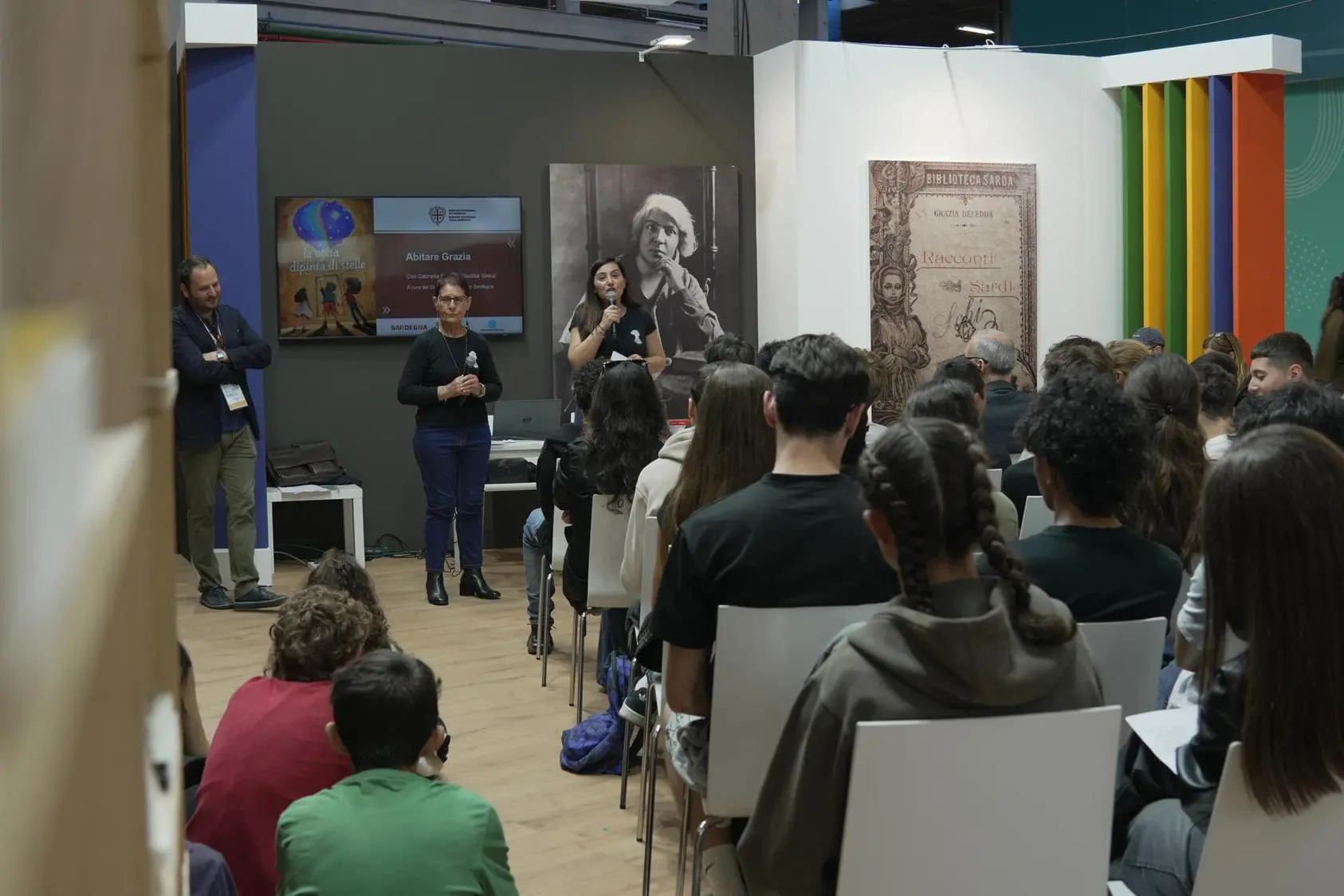
Per restare aggiornato entra nel nostro canale Whatsapp
Passing through the entrance of a domu de Janas (a house of Janas) leads to an arena dominated by the figure of Grazia Deledda, a hundred years after she received the Nobel Prize: this is how the Sardinia Region presents itself at this edition of the Turin Book Fair. The Sardinia Region space is not merely an institutional showcase, but a narrative device: the chosen theme, "The Vault Painted with Stars," draws from Deledda's "The Silver Ring" and engages with the Fair's overarching theme, "The World Saved by Children." Childhood as a cognitive force, the ability to look at the world with wonder before it becomes habit.
On the first day, the Jane Austen Club's workshops dedicated to Grazia Deledda guided young people through the characters and themes of her stories: identity, freedom, the desire for emancipation, the relationship with the land, destiny, and community. The day continued with the figure of this "Sardinian mother," featuring presentations by Franca Carboni, Gonaria Floris, and Elena Gagliardi, a presentation of the film "Quasi Grazia" by Peter Marcias, based on the book of the same name by Marcello Fois, and concluding with Neria De Giovanni's account of Deledda's relationship with Rome.
The second day confirmed this direction. Illustration workshops led by Claudia Piras, a discussion on Grazia Deledda and food with Giovanni Fancello and Stefano Resmini, and the "Literary Places of Sardinia" project with Gianmarco Murru and Giulio Pisano created a mosaic in which stories intertwine with the territory, imagery, cuisine, and geography of the locations depicted. In the afternoon, music by Gavino Murgia introduced the section dedicated to the Domus de Janas, featuring the book by Andrea Gambula and Giuseppa Tanda and a discussion on the inclusion of the Domus as the sixty-first Italian UNESCO site.

Alongside the Spazio Sardegna, the AES also brought to the Fair a reflection on bibliodiversity, with the newly established National Coordination of Regional Publishers' Associations, which brings together organizations from eight regions and represents 225 publishing houses. In a market increasingly concentrated on a few players, regional publishers represent a necessary safeguard of diversity, representing languages and communities that would otherwise risk becoming marginalized in the national discourse.
Today's program, Saturday, May 16, continues with workshops for children led by Diego Corraine, women's emancipation with "The House of the Red Geranium" by Mrs. Agus, and then archaeology, historical fiction, language, and civic themes: from Giovanni Antonio Sanna's "Women in the Shadow of Montevecchio," in the volume edited by Laura Lanza, to the hypogeal tombs of prehistoric Sardinia, from stories about peace written by children to Alghero's Catalan primary school books. Ample space is also given to the figure of Giovanni Antonio Porcheddu, the Sardinian who invented reinforced concrete, and that of his son Beppe, a master of Italian illustration and graphic design in the first half of the last century.
At the halfway point of the Book Fair, with wars looming and the crisis gnawing at wages and certainties, a turnout that promises to be record-breaking attests that books and stories continue to be humanity's greatest refuge, the most powerful way to keep our imagination alive.
