

"High fuel prices are eating away at wages": protests in Cagliari
Grassroots unions take to the streets to protest petrol and diesel price increases.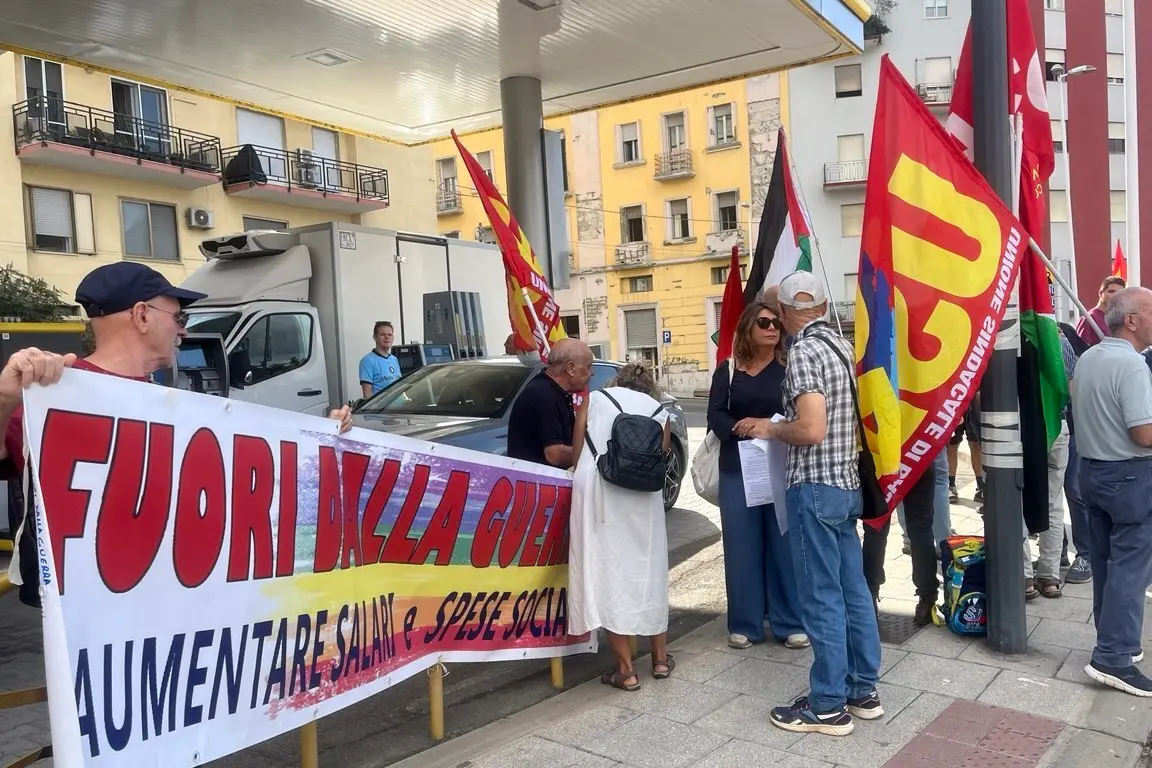
Per restare aggiornato entra nel nostro canale Whatsapp
Prices rise, tanks fill up, and wages empty. This is the paradox revealed yesterday morning in front of the Eni gas station on Viale Sant'Avendrace, where USB and Cobas Scuola organized a sit-in against the high fuel prices and high shopping costs. With drivers pulling in to fill up and students and workers passing by, the protest attempts to bring the cost of the crisis out of statistics and into everyday life. Because the problem, the protesters explain, isn't just how much a liter of gas costs. It's how much it costs to get to work: "You're forced to use the car, so it costs a lot," says Enrico Rubiu of USB. And in Sardinia, where public transport isn't always easy to do without a car, the cost can be particularly heavy.
Teachers penalized
The most immediate case is that of temporary teachers forced to travel between multiple schools. One hour at one school, another at a different location, perhaps in another municipality: at the end of the day, that adds up to miles and gas bills. "Your salary goes towards fuel," Rubiu summarizes, citing the example of those who, from Cagliari, must first travel to Villasimius and then Muravera or San Vito to complete their timetable.
This is a problem the Cobas Scuola sees especially in the Nuoro area. "At the evening school in Nuoro, we discovered that there are 16 commuters," says Andrea De Giorgi. These are workers with "a course entirely made up of segments," who must travel between Dorgali, Siniscola, Bosa, and the entire Ogliastra region. "They have to use their own vehicles" to reach their various offices. And while the cost of filling up their tanks weighs on the workers, the increased fuel costs also affect their shopping carts. "The products travel by road, and therefore they are passed on to the products sold," explains Rubiu. The ones affected, he emphasizes, are especially "basic necessities." The result, according to the protesters, is that it's becoming increasingly difficult for many families to make ends meet.
De Giorgi also warns about the potential consequences of the price increases on air travel. "Airlines are about to raise prices, and this will mean canceling flights to and from Sardinia," he claims. This possibility, according to the Cobas representative, risks further exacerbating the island's economic difficulties: "This will lead to a huge economic crisis for the entire Sardinian community."
The shopping cart
Salvatore Drago brings the issue to an even more concrete level: that of sacrifice. "This year I didn't take any vacation," he says. And in front of his shopping cart, he makes an immediate comparison: "I used to fill it almost with 50 euros, now it takes 100." For the two groups, therefore, the sit-in is also a protest against policies that, in their view, are fueling the cost of living. Their targets are excise duties, extra profits, and the economic consequences of war. "One of the main causes of the rising fuel costs is the war with Iran, and then the increases cascade down to the prices of all other goods." Some necessary interventions today, Rubiu explains, might be "eliminating excise duties and really addressing tax evasion."
The protest won't end with the sit-in on Viale Sant'Avendrace. The USB has already called a strike for October 30th. The goal, the organizers explain, is to refocus attention not just on fuel prices, but on the overall cost of living, where even commuting has become an expense.
REPRODUCTION RESERVED