


"Die ac Nocte": Voices and melodies from the Sardinian Middle Ages close the 2026 Romanesque Afternoons.
The event is open to all, scholars and the simply curious, in what remains one of the most evocative spaces in the city.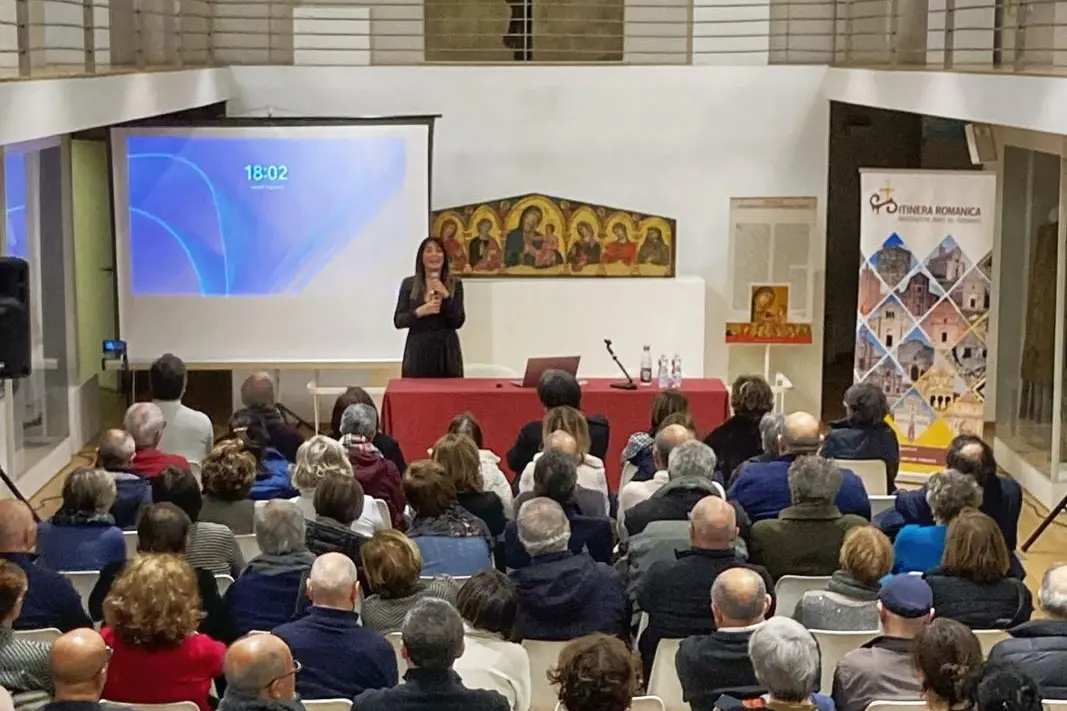
Per restare aggiornato entra nel nostro canale Whatsapp
There is a moment in the history of medieval Sardinia when stone and song merge in a single act of faith. It is the moment that Giampaolo Mele, professor of Medieval Music History at the University of Sassari, is preparing to recount today at 6:00 p.m. in the hall of the Museo Diocesano Arborense in Oristano.
He will be the protagonist of the final event of the "Pomeriggi del Romanesque 2026" (Romanesque Afternoons 2026), a series of conferences promoted by the Itinera Romanica – Amici del Romanesque association, which this year has chosen to explore the theme "Songs and Music in the Middle Ages in Sardinia." The title of the conference, "Die ac Nocte. Worship and Songs in Europe and Medieval Sardinia," already evokes the atmosphere pervading the pages of parchment codices : a never-ending antiphon that, from morning to night, marked life in monasteries and cathedrals on the continent and the island. "Through this journey into the heart of the European and Sardinian Middle Ages," explains Mele, "I want to take the audience into a sonic space that no longer exists today, yet has left extraordinary traces. The melodies that resounded in the cathedrals of Sardinia's Giudicati were not simply ritual ornaments. They were the very voice of spiritual and civil power, the thread that linked the island to the rest of Christian Europe."
The conference will focus on the liturgical manuscripts from Oristano Cathedral, a collection the professor unhesitatingly calls "the most important collection of liturgical books in Sardinia." These are not silent relics, but living testimonies, capable of conveying to the attentive reader the sound of an era. "These are codices that speak," says Mele. "Those who know how to read them still hear the voices of those who wrote and sung them, on the winter nights of medieval Oristano, beneath the vaults of a cathedral of great spiritual and cultural prestige." The narrative unfolds around the 13th and 14th centuries, the decades of Mariano II of Arborea and, later, of his daughter Eleonora, when the Giudicato was experiencing its most brilliant period. In those years, the liturgy was not just prayer, but "national" identity, the affirmation of a civilization. "The sumptuous miniatures that adorned the liturgical books, the parchments finely written in a refined Gothic style, the chants that rose during services," Mele recounts, "all this was not separate from the life of the judicial court. It was an integral part of a dimension that was not only cultic, but also cultural, a profound connection with the Christian universe of the Mediterranean and Europe."
Friday's conference concludes a series that, over the months, has explored the sonic dimension of Sardinia's Middle Ages from ever-changing perspectives. Giuseppina Deligia, art historian and President of the Itinera Romanica Association, draws a satisfied conclusion: "This series has allowed us to explore an aspect of Sardinia's medieval heritage that often remains in the shadows. We have sought to establish a dialogue between scientific research and popularization, offering the public new tools to understand and experience the island's culture." The event is open to all, scholars and the merely curious, in what remains one of the city's most evocative spaces, the Arborense Diocesan Museum, a silent custodian of centuries of art and devotion, which will once again serve as a backdrop to voices distant in time but surprisingly close in spirit.
