

"Abini's Students, Teti's Riches": Salvatore Ligios's Exhibition
The exhibition in the town's municipal library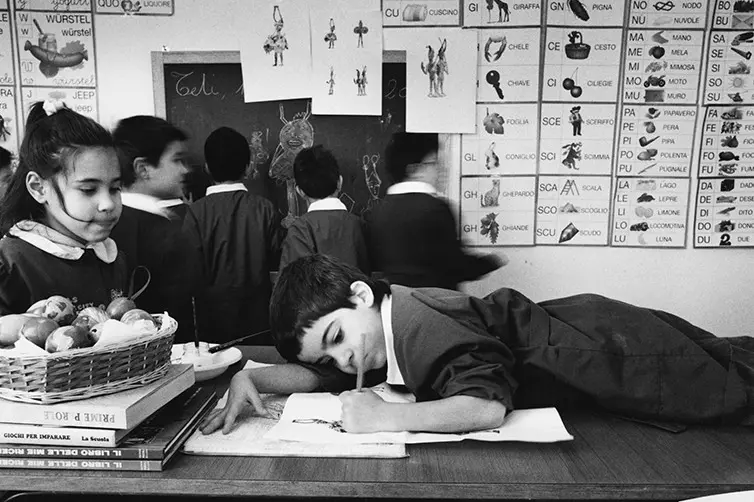
Per restare aggiornato entra nel nostro canale Whatsapp
In the photographs taken by Salvatore Ligios in 2002, the Teti community entrusts its most fragile and powerful face to children, figures suspended between the legacy of the past and the unknown of the future. Their gestures, captured in the naturalness of play or the attentive gaze, become the key to a broader narrative, in which the Nuragic archaeological heritage is intimately intertwined with everyday life.
The images will be on display from December 5th to February 26th in the town's municipal library.
Ligios observes without invading, records without insisting, allowing the presence of the small protagonists to overlap with the millenary forms of the bronzes and the silence of the Sanctuary of Abini.
The exhibition "Abini's Students. The Riches of Teti" is not simply a tribute to a school project that has become a memory; it is an act of collective recognition. Twenty-two years later, the children portrayed are no longer children, but their adult faces still hold the promise contained in the photographs: the ability of a community to see and recognize one another. Each image carries with it the depth of a shared history, the value of a cultural transmission that occurs not in museums or academic essays, but in the elementary gestures of everyday life.
Ligios, with his customary documentary finesse, inscribes photography in a suspended space: between what has been and what continues to happen. Thus, the silhouettes of the Nuragic bronzes, the curious eyes of the children, the Teti Museum, and the ancient stones of Abini form a single narrative, a unified story where archaeology ceases to be a bygone era and becomes living matter, a dialogue, a relationship.
This exhibition invites viewers to confront their own idea of identity: not as an immobile legacy, but as a vital process, continually regenerated by the gaze of those who grow, learn, and imagine. Returning to one's roots, therefore, does not mean confining oneself to the past, but illuminating the present with the awareness of what one has been.
In this encounter between childhood and antiquity, between gesture and memory, between play and myth, the true poetic core of Ligios's work is revealed: the ability to demonstrate that culture is never a relic to be preserved, but a form of life that transcends and encompasses us, always generating new possibilities for the future.
(Unioneonline)
