

Parents and children in the name of enterprise: testimonials from Cagliari
An initiative at the Unione Sarda headquarters with the Bocconi Alumni community on the topic of generational change.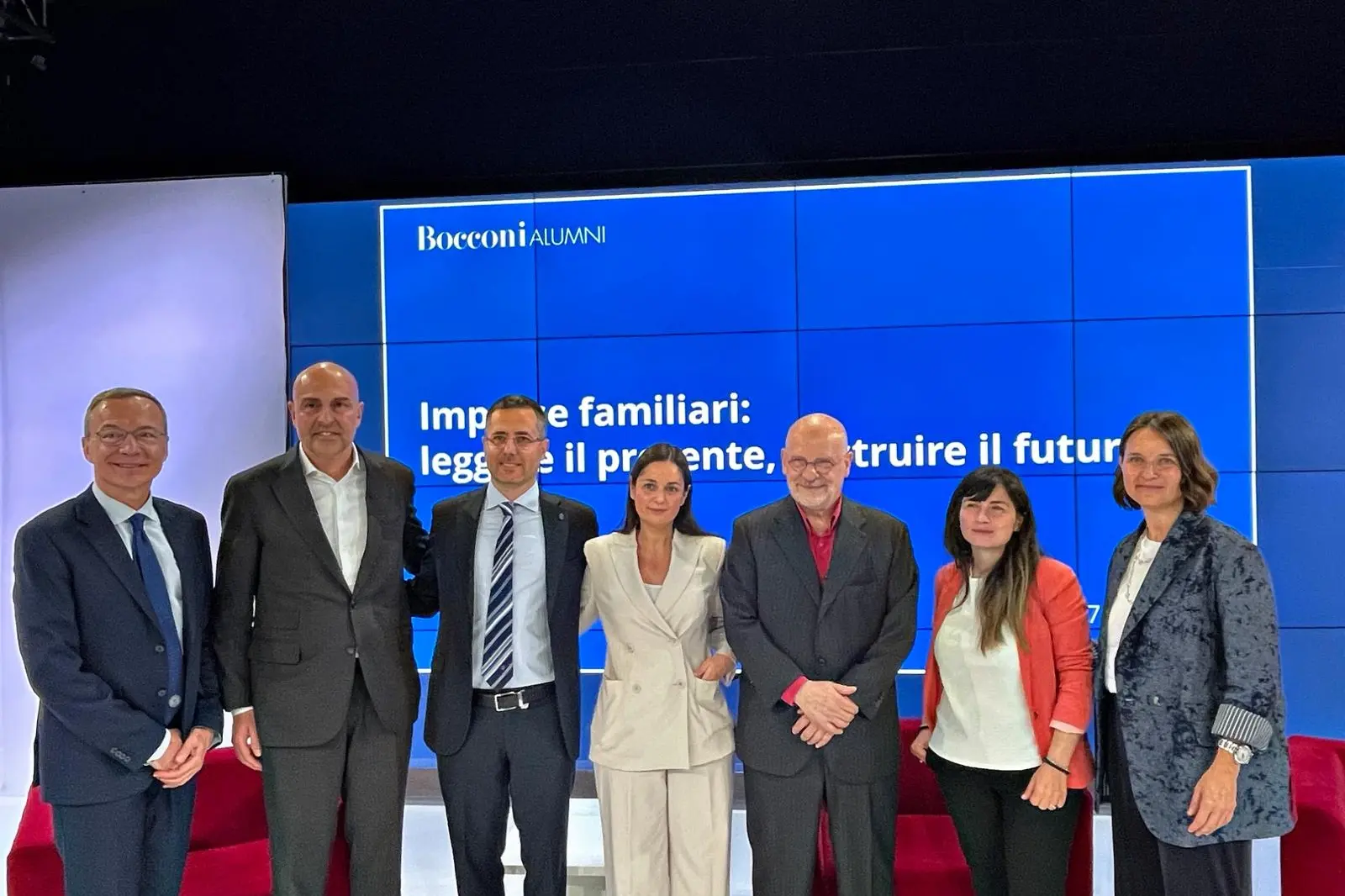
Per restare aggiornato entra nel nostro canale Whatsapp
Across generations and through storms. If there's one business that, more than others, has been able to withstand the impact of crises and survive, even pursuing unexpected growth, over the last twenty years, it's the family business. This is what emerges from data collected by the AUB Observatory (Aidaf, Unicredit, Bocconi), presented by Carlo Salvato, Deputy Pro-Rector of Bocconi University, in the "Giorgio Pisano" multimedia room of the Unione Sarda, during an event organized by the Bocconi Alumni community in Cagliari, led by Chapter Leader Alberto Piras . "We observed, using twenty years of data," explains Salvato, "the financial crises of 2008-2009 and the more recent Covid crisis. In both cases, family businesses managed to grow and return to levels of profitability higher than the pre-crisis period more quickly than non-family businesses."
Parents and children
It's the strength of roots, capable of withstanding landslides, the passing of decades, and the upheavals that history inevitably brings: "The theme for the future," continues the Bocconi professor, "is generational transition. We've observed it in all companies: it's a process that lasts over time and, according to our data, improves company performance. After any transition from the senior to the junior generation, there's always growth, especially when successors have pursued higher education or gained experience outside the family business and abroad. The key words are competence and collaboration." A handover that never happens overnight, as Professor Salvato points out: "More than a third of transitions involve a period of coexistence between the two generations, the outgoing and the incoming, which we can call 'mentorship.' Here, young people can gradually learn from their parents, also accessing skills that aren't learned in schools." The moment of reflection on generational transition, on passing the baton, comes for any business leader. Sergio Zuncheddu , entrepreneur and publisher of the L'Unione Sarda group, knows this well: "I'm starting to think about it," he admits. "It's not easy for first-generation entrepreneurs. Entrepreneurs identify with their companies, especially when they created them. And they're often a functioning system, with skills, experience, and values. For me, after my five daughters, comes the company. I'd like it to outlive me, and from the news we see that doesn't always happen: it's not a question of attachment to 'stuff'; I think rather of an attachment to something, created from nothing, that lives, that pulsates, that has people working for it. It's also a question of responsibility."
Life choices
More or less what Carlo Enrico Giulini, father of Tommaso , current president of Fluorsid and Cagliari Calcio, must have thought at a certain point in his entrepreneurial career. But in this case, the handover was less automatic, because the "young man" was planning a different life. "One day," Giulini recounts, "my father said to me: 'The commercial director of Fluorsid is retiring. Would you like to see what I've done with my life?'" Initially hesitant, he let himself be persuaded: "At that time, the business was doing very poorly. But I said to myself, 'Why not? Commercial director, I'll travel a lot.' I was young, I accepted the challenge, and I immediately felt very comfortable."
The role of the family
Among the testimonials is that of Francesca Fadda , vice president of the CFadda group. Hers is a family business where shared ideas reign—decisions are rarely made by majority vote, almost always unanimously—but generational transition, she explains, can't be taken for granted: "The key is to entrust the company to people who possess the skills, and not just because they're part of the family. Those who carry out a handover have a fundamental role in making room for those embarking on a new path, but also in accompanying and guiding them to develop their unique strengths and enable them to bring a new vision." For Alessandra Argiolas , head of organization for Argiolas Formaggi, beyond skills, confidence is crucial: "In one's own abilities, in one's own resources, especially the human ones." But then, to cross generations, dialogue is needed: "The older generations can give us experience, but also the disillusionment of those who have lived through so much. The younger ones, on the other hand, bring enthusiasm and new ideas. So the “big ones” learn to leave space, the “kids” to take it."
The economic moment
It's also the dialogue and exchange of ideas that allows family businesses to weather crises more successfully and to approach the uncertainties of the near future with greater awareness. The tourism sector is a clear example, threatened by the geopolitical upheaval. Diana Zuncheddu , CEO of the Hotel Abi d'Oru, expresses confidence: "Unknown factors always exist, and there's no point worrying about those you can't control. In our case, it's not so much a drop in demand as a longer delay in confirming reservations. But I believe," Diana Zuncheddu clarifies, "that precisely in a time of instability, what is stable will shine again. We have nothing to fear; we're at the center of the Mediterranean, we're a safe island, and this will ultimately prevail over destinations that until recently were direct competitors. We need patience and strong nerves."